

ctenoid; supramaxilla absent; palatine teeth present or
absent; LL complete . Fraser (1972) recognised 3 subgenera;
4 valid species; 1 in our area.
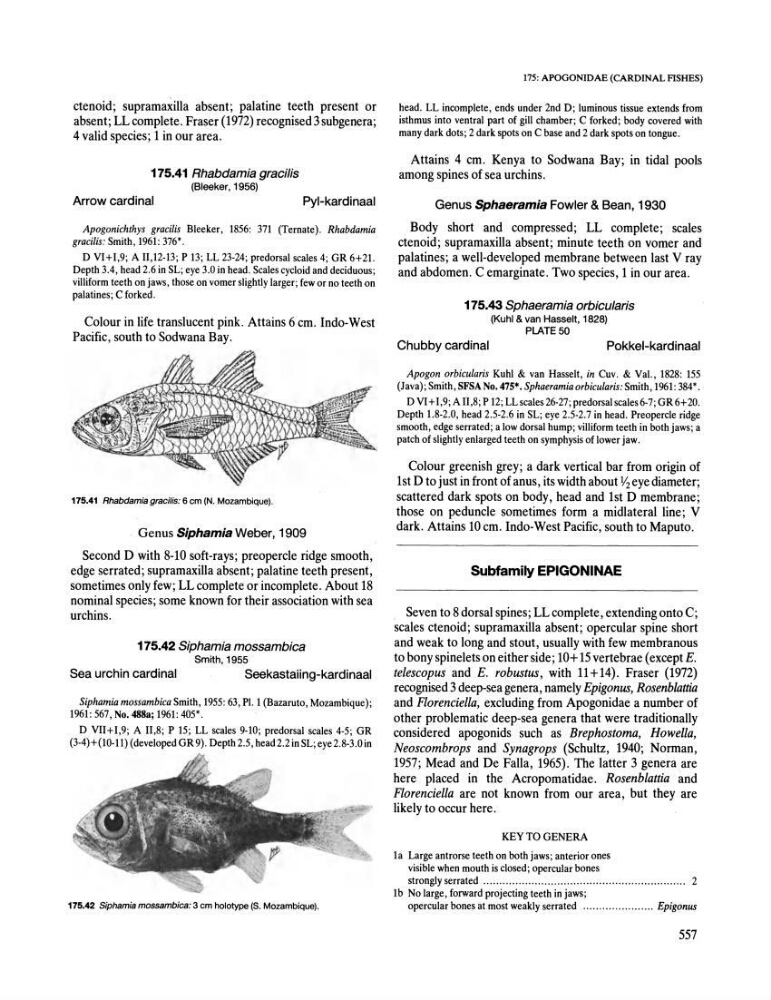
175.41 Rhabdamia gracilis
(Bleeker, 1956)
Arrow cardinal
Pyl-kardinaal
Apogonichthys gracilis Bleeker, 1856: 371 (Ternate). Rhabdamia
gracilis: Smith, 1961: 376*.
D VI+I,9; A 11,12-13; P 13; LL 23-24; predorsal scales 4; GR 6+21.
Depth 3.4, head 2.6 in SL; eye 3.0 in head. Scales cycloid and deciduous;
villi form teeth on jaws, those on vomer slightly larger ; few or no teeth on
palatines; C forked.
Colour in life translucent pink. Attains 6 cm. Indo-West
Pacific, south to Sodwana Bay.
175.41 Rhabdamia gracilis: 6 cm (N. Mozambique).
Genus SiphamiaWeber, 1909
Second D with 8-10 soft-rays; preopercle ridge smooth,
edge serrated; supramaxilla absent; palatine teeth present,
sometimes only few; LL complete or incomplete . About 18
nominal species; some known for their association with sea
urchins.
175.42 Siphamia mossambica
Smith,1955
Sea urchin cardinal
Seekastaiing-kardinaal
Siphamia mossambica Smith, 1955: 63, PI. 1 (Bazaruto, Mozambique);
1961: 567 , No. 4883; 1961: 405* .
D VII+I ,9; A 11 ,8; P 15; LL scales 9-10; predorsal scales 4-5 ; GR
(3-4)+(10-11) (developed GR 9). Depth 2.5, head 2.2 in SL; eye 2.8-3.0in
175.42 Siphamia mossambica: 3 em holotype (S. Mozambique).
175: APOGONIDAE (CARDINAL FISHES)
head. LL incomplete, ends under 2nd D; luminous tissue extends from
isthmus into ventral part of gill chamber; C forked; body covered with
many dark dots; 2 dark spots on C base and 2 dark spots on tongue.
Attains 4 cm. Kenya to Sodwana Bay; in tidal pools
among spines of sea urchins.
Genus Sphaeramia Fowler & Bean, 1930
Body short and compressed; LL complete; scales
ctenoid; supramaxilla absent; minute teeth on vomer and
palatines; a well-developed membrane between last V ray
and abdomen. C emarginate. Two species, 1 in our area.
175.43 Sphaeramia orbicularis
(Kuhl & van Hasselt, 1828)
PLATE 50
Chubby cardinal
Pokkel-kardinaal
Apogon orbicularis Kuhl & van Hasselt , in Cuv. & Val., 1828: 155
(J ava); Smith, SFSA No. 475* • Sphaeramia orbicularis: Smith, 1961: 384' .
D VI + 1,9; A 11,8; P 12; LL scales 26-27; predorsalscales6-7; GR6+20.
Depth 1.8-2.0, head 2.5-2.6 in SL; eye 2.5-2.7 in head. Preopercle ridge
smooth , edge serrated ; a low dorsal hump; villiform teeth in both jaws; a
patch of slightly enlarged teeth on symphysis of lower jaw.
Colour greenish grey; a dark vertical bar from origin of
1st D to just in front of anus, its width about V 2 eye diameter;
scattered dark spots on body, head and 1st D membrane;
those on peduncle sometimes form a midlateral line; V
dark. Attains 10 cm. Indo-West Pacific, south to Maputo.
Subfamily EPIGONINAE
Seven to 8 dorsal spines; LL complete, extending onto C;
scales ctenoid; supramaxilla absent; opercular spine short
and weak to long and stout, usually with few membranous
to bony spinelets on either side; 10+ 15 vertebrae (except E.
telescopus and E. robustus, with 11+14). Fraser (1972)
recognised 3 deep-sea genera, namely Epigonus, Rosenblattia
and Florenciella, excluding from Apogonidae a number of
other problematic deep-sea genera that were traditionally
considered apogonids such as Brephostoma, Howella,
Neoscombrops and Synagrops (Schultz, 1940; Norman,
1957; Mead and De Falla, 1965) . The latter 3 genera are
here placed in the Acropomatidae. Rosenblattia and
Florenciella are not known from our area, but they are
likely to occur here.
KEY TO GENERA
la Large antrorse teeth on both jaws; anterior ones
visible when mouth is closed; opercular bones
strongly serrated ..... .... ....... ... ....... .... ..... .. ... ....... ... ...... ...... . 2
Ib No large, forward projecting teeth in jaws;
opercular bones at most weakly serrated ... ..... ........ .. .... Epigonus
557
absent; LL complete . Fraser (1972) recognised 3 subgenera;
4 valid species; 1 in our area.
175.41 Rhabdamia gracilis
(Bleeker, 1956)
Arrow cardinal
Pyl-kardinaal
Apogonichthys gracilis Bleeker, 1856: 371 (Ternate). Rhabdamia
gracilis: Smith, 1961: 376*.
D VI+I,9; A 11,12-13; P 13; LL 23-24; predorsal scales 4; GR 6+21.
Depth 3.4, head 2.6 in SL; eye 3.0 in head. Scales cycloid and deciduous;
villi form teeth on jaws, those on vomer slightly larger ; few or no teeth on
palatines; C forked.
Colour in life translucent pink. Attains 6 cm. Indo-West
Pacific, south to Sodwana Bay.
175.41 Rhabdamia gracilis: 6 cm (N. Mozambique).
Genus SiphamiaWeber, 1909
Second D with 8-10 soft-rays; preopercle ridge smooth,
edge serrated; supramaxilla absent; palatine teeth present,
sometimes only few; LL complete or incomplete . About 18
nominal species; some known for their association with sea
urchins.
175.42 Siphamia mossambica
Smith,1955
Sea urchin cardinal
Seekastaiing-kardinaal
Siphamia mossambica Smith, 1955: 63, PI. 1 (Bazaruto, Mozambique);
1961: 567 , No. 4883; 1961: 405* .
D VII+I ,9; A 11 ,8; P 15; LL scales 9-10; predorsal scales 4-5 ; GR
(3-4)+(10-11) (developed GR 9). Depth 2.5, head 2.2 in SL; eye 2.8-3.0in
175.42 Siphamia mossambica: 3 em holotype (S. Mozambique).
175: APOGONIDAE (CARDINAL FISHES)
head. LL incomplete, ends under 2nd D; luminous tissue extends from
isthmus into ventral part of gill chamber; C forked; body covered with
many dark dots; 2 dark spots on C base and 2 dark spots on tongue.
Attains 4 cm. Kenya to Sodwana Bay; in tidal pools
among spines of sea urchins.
Genus Sphaeramia Fowler & Bean, 1930
Body short and compressed; LL complete; scales
ctenoid; supramaxilla absent; minute teeth on vomer and
palatines; a well-developed membrane between last V ray
and abdomen. C emarginate. Two species, 1 in our area.
175.43 Sphaeramia orbicularis
(Kuhl & van Hasselt, 1828)
PLATE 50
Chubby cardinal
Pokkel-kardinaal
Apogon orbicularis Kuhl & van Hasselt , in Cuv. & Val., 1828: 155
(J ava); Smith, SFSA No. 475* • Sphaeramia orbicularis: Smith, 1961: 384' .
D VI + 1,9; A 11,8; P 12; LL scales 26-27; predorsalscales6-7; GR6+20.
Depth 1.8-2.0, head 2.5-2.6 in SL; eye 2.5-2.7 in head. Preopercle ridge
smooth , edge serrated ; a low dorsal hump; villiform teeth in both jaws; a
patch of slightly enlarged teeth on symphysis of lower jaw.
Colour greenish grey; a dark vertical bar from origin of
1st D to just in front of anus, its width about V 2 eye diameter;
scattered dark spots on body, head and 1st D membrane;
those on peduncle sometimes form a midlateral line; V
dark. Attains 10 cm. Indo-West Pacific, south to Maputo.
Subfamily EPIGONINAE
Seven to 8 dorsal spines; LL complete, extending onto C;
scales ctenoid; supramaxilla absent; opercular spine short
and weak to long and stout, usually with few membranous
to bony spinelets on either side; 10+ 15 vertebrae (except E.
telescopus and E. robustus, with 11+14). Fraser (1972)
recognised 3 deep-sea genera, namely Epigonus, Rosenblattia
and Florenciella, excluding from Apogonidae a number of
other problematic deep-sea genera that were traditionally
considered apogonids such as Brephostoma, Howella,
Neoscombrops and Synagrops (Schultz, 1940; Norman,
1957; Mead and De Falla, 1965) . The latter 3 genera are
here placed in the Acropomatidae. Rosenblattia and
Florenciella are not known from our area, but they are
likely to occur here.
KEY TO GENERA
la Large antrorse teeth on both jaws; anterior ones
visible when mouth is closed; opercular bones
strongly serrated ..... .... ....... ... ....... .... ..... .. ... ....... ... ...... ...... . 2
Ib No large, forward projecting teeth in jaws;
opercular bones at most weakly serrated ... ..... ........ .. .... Epigonus
557