

175: APOGONIDAE (CARDINAL FISHES)
Large black ocellus on rear part of 1st D; edge of soft D,
A and C white; a wide dark stripe from ventral margin of
eye to angle of preopercle and another stripe from rear margin of eye to beginning of LL. Attains 6 cm SL. Widespread
in Indo-West Pacific; south to Coffee Bay, Transkei.
175.29 Apogonichthys perdix
Bleeker, 1854
Speckled cardinal
Gespikkelde kardinaal
Apogonichthys perdix Bleeker, 1854: 321 (Floris Id., E. Indies); Smith,
1961: 391 *.
D VII + 1,9; A II,8; P 14; LL 25; predorsal scales 3-4; GR (1-2)+(11-12)
(developed GR 5-7). Depth 2.4-2.6, head 2.1-2.4 in SL; eye 3.2-3.6 in
head. Preopercle edge poorly ossified; anterior nostril with short flap;
maxilla reaches to rear margin of orbit or slightly beyond; a band of
minute villiform teeth on each jaw and vomer.
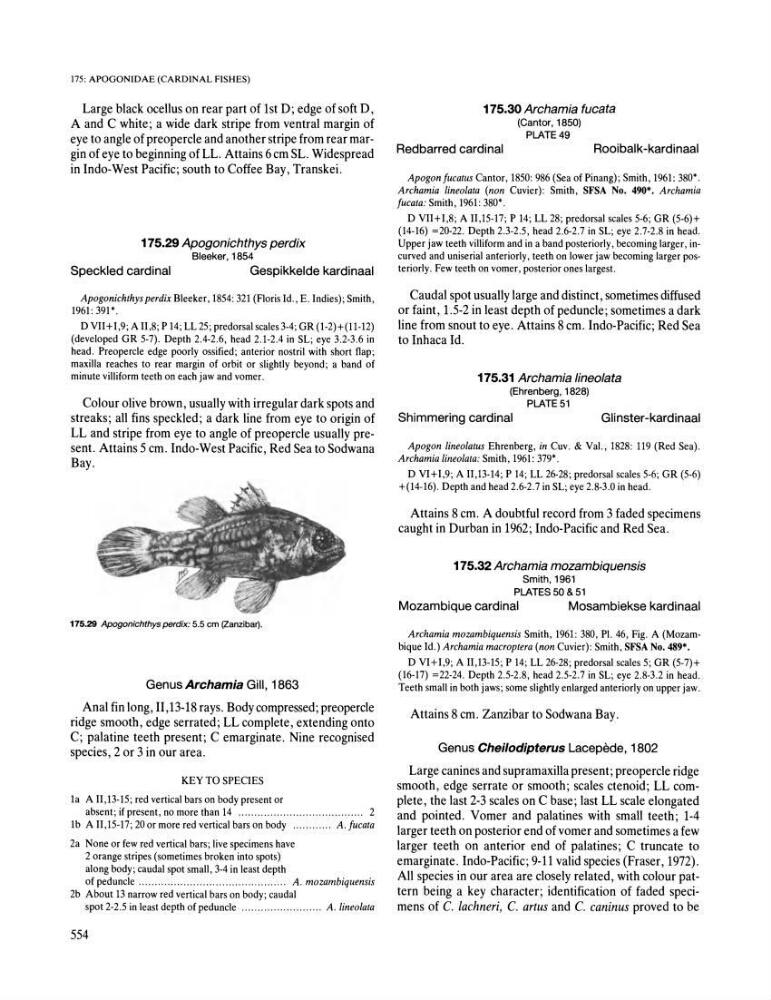
Colour olive brown, usually with irregular dark spots and
streaks; all fins speckled; a dark line from eye to origin of
LL and stripe from eye to angle of preopercle usually present. Attains 5 cm. Indo-West Pacific, Red Sea to Sodwana
Bay.
175.29 Apogonichthys perdix: 5.5 em (Zanzibar).
Genus Archamia Gill, 1863
Anal fin long, 11,13-18 rays. Body compressed; preopercle
ridge smooth, edge serrated; LL complete, extending onto
C; palatine teeth present; C emarginate. Nine recognised
species, 2 or 3 in our area.
KEY TO SPECIES
la A II,13-15; red vertical bars on body present or
absent; if present, no more than 14 ....................................... 2
1 b A II, 15-17; 20 or more red vertical bars on body .. .. .. .. .... A. Jucata
2a None or few red vertical bars; live specimens have
2 orange stripes (sometimes broken into spots)
along body; caudal spot small, 3-4 in least depth
of peduncle .............................................. A. mozambiquensis
2b About 13 narrow red vertical bars on body; caudal
spot 2-2.5 in least depth of peduncle ......................... A. lineolata
554
175.30 Archamia fucata
(Cantor, 1850)
PLATE 49
Redbarred cardinal
Rooibalk-kardinaal
Apogon Jucatus Cantor, 1850: 986 (Sea of Pinang); Smith, 1961: 380*.
Archamia lineolata (non Cuvier): Smith, SFSA No. 490*. Archamia
Jucata: Smith, 1961: 380*.
D VII+I,8; A II,15-17; P 14; LL 28; predorsal scales 5-6; GR (5-6)+
(14-16) =20-22. Depth 2.3-2.5, head 2.6-2.7 in SL; eye 2.7-2.8 in head.
Upper jaw teeth villiform and in a band posteriorly, becoming larger, incurved and uniserial anteriorly, teeth on lower jaw becoming larger posteriorly. Few teeth on vomer, posterior ones largest.
Caudal spot usually large and distinct, sometimes diffused
or faint, 1.5-2 in least depth of peduncle; sometimes a dark
line from snout to eye. Attains 8 cm. Indo-Pacific; Red Sea
to Inhaca Id.
175.31 Archamia lineolata
(Ehrenberg, 1828)
PLATE 51
Shimmering cardinal
Glinster-kardinaal
Apogon lineolatus Ehrenberg, in Cuv. & Val., 1828: 119 (Red Sea).
Archamia lineolata: Smith, 1961: 379*.
D VI+I,9; A II,13-14; P 14; LL 26-28; predorsal scales 5-6; GR (5-6)
+(14-16). Depth and head 2.6-2.7 in SL; eye 2.8-3.0 in head.
Attains 8 cm. A doubtful record from 3 faded specimens
caught in Durban in 1962; Indo-Pacific and Red Sea.
175.32 Archamia mozambiquensis
Smith,1961
PLATES 50 & 51
Mozambique cardinal
Mosambiekse kardinaal
Archamia mozambiquensis Smith, 1961: 380, PI. 46, Fig. A (Mozambique Id.) Archamia macroptera (non Cuvier): Smith, SFSA No. 489*.
D VI+I,9; A II,13-15; P 14; LL 26-28; pre dorsal scales 5; GR (5-7)+
(16-17) =22-24. Depth 2.5-2.8, head 2.5-2.7 in SL; eye 2.8-3.2 in head.
Teeth small in both jaws; some slightly enlarged anteriorly on upper jaw.
Attains 8 cm. Zanzibar to Sodwana Bay.
Genus Cheilodipterus Lacepede, 1802
Large canines and supramaxilla present; preopercle ridge
smooth, edge serrate or smooth; scales ctenoid; LL complete, the last 2-3 scales on C base; last LL scale elongated
and pointed. Vomer and palatines with small teeth; 1-4
larger teeth on posterior end of vomer and sometimes a few
larger teeth on anterior end of palatines; C truncate to
emarginate. Indo-Pacific; 9-11 valid species (Fraser, 1972).
All species in our area are closely related, with colour pattern being a key character; identification of faded specimens of C. lachneri, C. artus and C. caninus proved to be
Large black ocellus on rear part of 1st D; edge of soft D,
A and C white; a wide dark stripe from ventral margin of
eye to angle of preopercle and another stripe from rear margin of eye to beginning of LL. Attains 6 cm SL. Widespread
in Indo-West Pacific; south to Coffee Bay, Transkei.
175.29 Apogonichthys perdix
Bleeker, 1854
Speckled cardinal
Gespikkelde kardinaal
Apogonichthys perdix Bleeker, 1854: 321 (Floris Id., E. Indies); Smith,
1961: 391 *.
D VII + 1,9; A II,8; P 14; LL 25; predorsal scales 3-4; GR (1-2)+(11-12)
(developed GR 5-7). Depth 2.4-2.6, head 2.1-2.4 in SL; eye 3.2-3.6 in
head. Preopercle edge poorly ossified; anterior nostril with short flap;
maxilla reaches to rear margin of orbit or slightly beyond; a band of
minute villiform teeth on each jaw and vomer.
Colour olive brown, usually with irregular dark spots and
streaks; all fins speckled; a dark line from eye to origin of
LL and stripe from eye to angle of preopercle usually present. Attains 5 cm. Indo-West Pacific, Red Sea to Sodwana
Bay.
175.29 Apogonichthys perdix: 5.5 em (Zanzibar).
Genus Archamia Gill, 1863
Anal fin long, 11,13-18 rays. Body compressed; preopercle
ridge smooth, edge serrated; LL complete, extending onto
C; palatine teeth present; C emarginate. Nine recognised
species, 2 or 3 in our area.
KEY TO SPECIES
la A II,13-15; red vertical bars on body present or
absent; if present, no more than 14 ....................................... 2
1 b A II, 15-17; 20 or more red vertical bars on body .. .. .. .. .... A. Jucata
2a None or few red vertical bars; live specimens have
2 orange stripes (sometimes broken into spots)
along body; caudal spot small, 3-4 in least depth
of peduncle .............................................. A. mozambiquensis
2b About 13 narrow red vertical bars on body; caudal
spot 2-2.5 in least depth of peduncle ......................... A. lineolata
554
175.30 Archamia fucata
(Cantor, 1850)
PLATE 49
Redbarred cardinal
Rooibalk-kardinaal
Apogon Jucatus Cantor, 1850: 986 (Sea of Pinang); Smith, 1961: 380*.
Archamia lineolata (non Cuvier): Smith, SFSA No. 490*. Archamia
Jucata: Smith, 1961: 380*.
D VII+I,8; A II,15-17; P 14; LL 28; predorsal scales 5-6; GR (5-6)+
(14-16) =20-22. Depth 2.3-2.5, head 2.6-2.7 in SL; eye 2.7-2.8 in head.
Upper jaw teeth villiform and in a band posteriorly, becoming larger, incurved and uniserial anteriorly, teeth on lower jaw becoming larger posteriorly. Few teeth on vomer, posterior ones largest.
Caudal spot usually large and distinct, sometimes diffused
or faint, 1.5-2 in least depth of peduncle; sometimes a dark
line from snout to eye. Attains 8 cm. Indo-Pacific; Red Sea
to Inhaca Id.
175.31 Archamia lineolata
(Ehrenberg, 1828)
PLATE 51
Shimmering cardinal
Glinster-kardinaal
Apogon lineolatus Ehrenberg, in Cuv. & Val., 1828: 119 (Red Sea).
Archamia lineolata: Smith, 1961: 379*.
D VI+I,9; A II,13-14; P 14; LL 26-28; predorsal scales 5-6; GR (5-6)
+(14-16). Depth and head 2.6-2.7 in SL; eye 2.8-3.0 in head.
Attains 8 cm. A doubtful record from 3 faded specimens
caught in Durban in 1962; Indo-Pacific and Red Sea.
175.32 Archamia mozambiquensis
Smith,1961
PLATES 50 & 51
Mozambique cardinal
Mosambiekse kardinaal
Archamia mozambiquensis Smith, 1961: 380, PI. 46, Fig. A (Mozambique Id.) Archamia macroptera (non Cuvier): Smith, SFSA No. 489*.
D VI+I,9; A II,13-15; P 14; LL 26-28; pre dorsal scales 5; GR (5-7)+
(16-17) =22-24. Depth 2.5-2.8, head 2.5-2.7 in SL; eye 2.8-3.2 in head.
Teeth small in both jaws; some slightly enlarged anteriorly on upper jaw.
Attains 8 cm. Zanzibar to Sodwana Bay.
Genus Cheilodipterus Lacepede, 1802
Large canines and supramaxilla present; preopercle ridge
smooth, edge serrate or smooth; scales ctenoid; LL complete, the last 2-3 scales on C base; last LL scale elongated
and pointed. Vomer and palatines with small teeth; 1-4
larger teeth on posterior end of vomer and sometimes a few
larger teeth on anterior end of palatines; C truncate to
emarginate. Indo-Pacific; 9-11 valid species (Fraser, 1972).
All species in our area are closely related, with colour pattern being a key character; identification of faded specimens of C. lachneri, C. artus and C. caninus proved to be