

167: GRAMMISTIDAE (SOAPFISHES)
o VIII+I,lO; A II,8; P 13-15; GR (6-8)+(13-15); LL 69- 76; scales
ctenoid; body depth 3.5-3.7, head length 2.5-2.7 in SL; preopercle
coarsely serrate; subopercle and interopercle serrate; nasal organ a
rosette.
Body brown with a saddle-like bright yellow spot on C
peduncle and a large ocellated black spot in spinous D.
Largest specimen, 145 mm. Central Pacific to east Africa,
ranging south to Natal. A reef species generally seen in
caves; becomes active and moves out of shelter at dusk.
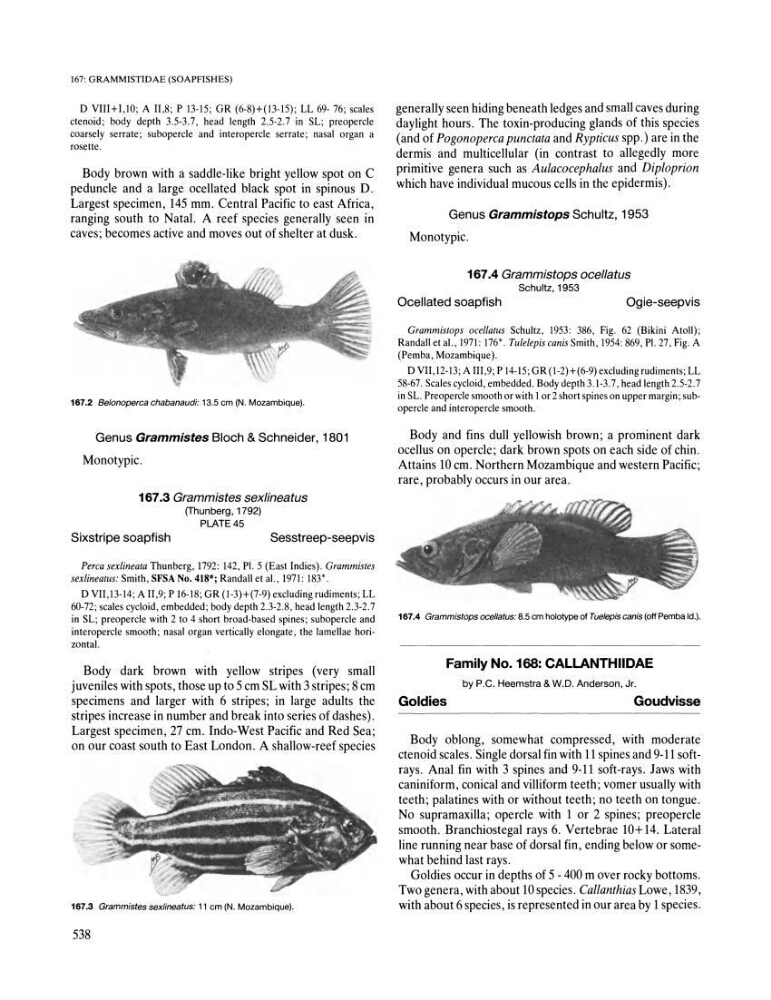
167.2 Be/onoperca chabanaudi: 13.5 em (N. Mozambique).
Genus Grammistes Bloch & Schneider, 1801
Monotypic.
167.3 Grammistes sexlineatus
(Thunberg, 1792)
PLATE 45
Sixstripe soapfish
Sesstreep-seepvis
Perea sexlineata Thunberg, 1792: 142, PI. 5 (East Indies). Grammistes
sexlineatus: Smith, SFSA No. 418*; Randall et aI., 1971: 183*.
o VII,13-14; A II,9; P 16-18; GR (1-3)+(7-9) excluding rudiments; LL
60-72; scales cycloid, embedded; body depth 2.3-2.8, head length 2.3-2.7
in SL; preopercle with 2 to 4 short broad-based spines; subopercle and
interopercle smooth; nasal organ vertically elongate, the lamellae horizontal.
Body dark brown with yellow stripes (very small
juveniles with spots, those up to 5 cm SL with 3 stripes; 8 cm
specimens and larger with 6 stripes; in large adults the
stripes increase in number and break into series of dashes).
Largest specimen, 27 cm. Indo-West Pacific and Red Sea;
on our coast south to East London. A shallow-reef species
167.3 Grammistes sexlineatus: 11 em (N. Mozambique).
538
generally seen hiding beneath ledges and small caves during
daylight hours. The toxin-producing glands of this species
(and of Pogonoperca punctata and Rypticus spp.) are in the
dermis and multicellular (in contrast to allegedly more
primitive genera such as Aulacocephalus and Diploprion
which have individual mucous cells in the epidermis).
Genus Grammistops Schultz, 1953
Monotypic.
167.4 Grammistops ocellatus
Schultz, 1953
Ocellated soapfish
Ogie-seepvis
Grammistops ocellatus Schultz, 1953: 386, Fig. 62 (Bikini Atoll);
Randall et aI., 1971: 176*. Tulelepis canis Smith, 1954: 869, PI. 27, Fig. A
(Pemba, Mozambique).
o VII, 12-13; A III,9; P 14-15; GR (1-2)+(6-9) excluding rudiments; LL
58-67. Scales cycloid, embedded. Body depth 3.1-3.7, head length 2.5-2.7
in SL. Preopercle smooth or with 1 or 2 short spines on upper margin; subopercle and interopercle smooth.
Body and fins dull yellowish brown; a prominent dark
ocellus on opercle; dark brown spots on each side of chin.
Attains 10 cm. Northern Mozambique and western Pacific;
rare, probably occurs in our area.
167.4 Grammistops ocellatus: 8.5 em holotype of Tue/epis canis (off Pemba Id.).
Family No. 168: CALLANTHIIDAE
by p.e. Heemstra & W.o. Anderson, Jr.
Goldies
Goudvisse
Body oblong, somewhat compressed, with moderate
ctenoid scales. Single dorsal fin with 11 spines and 9-11 softrays. Anal fin with 3 spines and 9-11 soft-rays. Jaws with
caniniform, conical and villiform teeth; vomer usually with
teeth; palatines with or without teeth; no teeth on tongue.
No supramaxilla; opercle with 1 or 2 spines; preopercle
smooth. Branchiostegal rays 6. Vertebrae 10+ 14. Lateral
line running near base of dorsal fin, ending below or somewhat behind last rays.
Goldies occur in depths of 5 - 400 m over rocky bottoms.
Two genera, with about 10 species. Callanthias Lowe, 1839,
with about 6 species, is represented in our area by 1 species.
o VIII+I,lO; A II,8; P 13-15; GR (6-8)+(13-15); LL 69- 76; scales
ctenoid; body depth 3.5-3.7, head length 2.5-2.7 in SL; preopercle
coarsely serrate; subopercle and interopercle serrate; nasal organ a
rosette.
Body brown with a saddle-like bright yellow spot on C
peduncle and a large ocellated black spot in spinous D.
Largest specimen, 145 mm. Central Pacific to east Africa,
ranging south to Natal. A reef species generally seen in
caves; becomes active and moves out of shelter at dusk.
167.2 Be/onoperca chabanaudi: 13.5 em (N. Mozambique).
Genus Grammistes Bloch & Schneider, 1801
Monotypic.
167.3 Grammistes sexlineatus
(Thunberg, 1792)
PLATE 45
Sixstripe soapfish
Sesstreep-seepvis
Perea sexlineata Thunberg, 1792: 142, PI. 5 (East Indies). Grammistes
sexlineatus: Smith, SFSA No. 418*; Randall et aI., 1971: 183*.
o VII,13-14; A II,9; P 16-18; GR (1-3)+(7-9) excluding rudiments; LL
60-72; scales cycloid, embedded; body depth 2.3-2.8, head length 2.3-2.7
in SL; preopercle with 2 to 4 short broad-based spines; subopercle and
interopercle smooth; nasal organ vertically elongate, the lamellae horizontal.
Body dark brown with yellow stripes (very small
juveniles with spots, those up to 5 cm SL with 3 stripes; 8 cm
specimens and larger with 6 stripes; in large adults the
stripes increase in number and break into series of dashes).
Largest specimen, 27 cm. Indo-West Pacific and Red Sea;
on our coast south to East London. A shallow-reef species
167.3 Grammistes sexlineatus: 11 em (N. Mozambique).
538
generally seen hiding beneath ledges and small caves during
daylight hours. The toxin-producing glands of this species
(and of Pogonoperca punctata and Rypticus spp.) are in the
dermis and multicellular (in contrast to allegedly more
primitive genera such as Aulacocephalus and Diploprion
which have individual mucous cells in the epidermis).
Genus Grammistops Schultz, 1953
Monotypic.
167.4 Grammistops ocellatus
Schultz, 1953
Ocellated soapfish
Ogie-seepvis
Grammistops ocellatus Schultz, 1953: 386, Fig. 62 (Bikini Atoll);
Randall et aI., 1971: 176*. Tulelepis canis Smith, 1954: 869, PI. 27, Fig. A
(Pemba, Mozambique).
o VII, 12-13; A III,9; P 14-15; GR (1-2)+(6-9) excluding rudiments; LL
58-67. Scales cycloid, embedded. Body depth 3.1-3.7, head length 2.5-2.7
in SL. Preopercle smooth or with 1 or 2 short spines on upper margin; subopercle and interopercle smooth.
Body and fins dull yellowish brown; a prominent dark
ocellus on opercle; dark brown spots on each side of chin.
Attains 10 cm. Northern Mozambique and western Pacific;
rare, probably occurs in our area.
167.4 Grammistops ocellatus: 8.5 em holotype of Tue/epis canis (off Pemba Id.).
Family No. 168: CALLANTHIIDAE
by p.e. Heemstra & W.o. Anderson, Jr.
Goldies
Goudvisse
Body oblong, somewhat compressed, with moderate
ctenoid scales. Single dorsal fin with 11 spines and 9-11 softrays. Anal fin with 3 spines and 9-11 soft-rays. Jaws with
caniniform, conical and villiform teeth; vomer usually with
teeth; palatines with or without teeth; no teeth on tongue.
No supramaxilla; opercle with 1 or 2 spines; preopercle
smooth. Branchiostegal rays 6. Vertebrae 10+ 14. Lateral
line running near base of dorsal fin, ending below or somewhat behind last rays.
Goldies occur in depths of 5 - 400 m over rocky bottoms.
Two genera, with about 10 species. Callanthias Lowe, 1839,
with about 6 species, is represented in our area by 1 species.