

D XI,14-15; A III,7; P 16-18; LL 67-74; 34-37 scales round C peduncle;
GR (9-11)+(21-23) of which 1 or 2 may be rudiments. Body depth 3.1-3.5,
head 2.5-2.9 in SL.
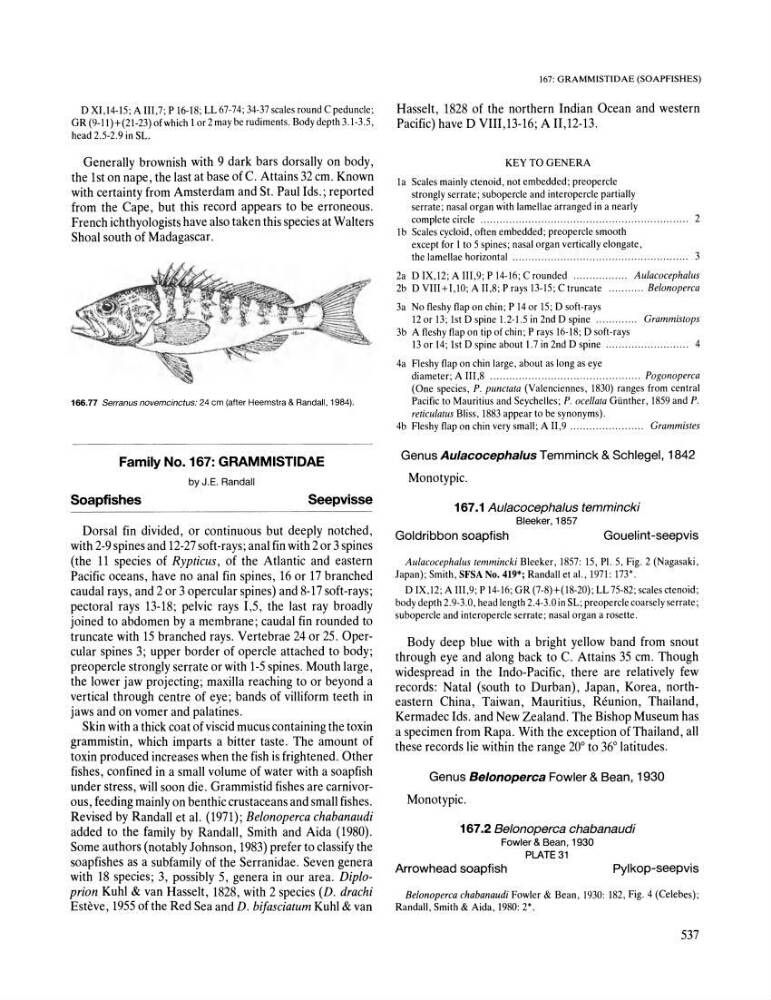
Generally brownish with 9 dark bars dorsally on body,
the 1st on nape, the last at base of C. Attains 32 cm. Known
with certainty from Amsterdam and St. Paul Ids.; reported
from the Cape, but this record appears to be erroneous.
French ichthyologists have also taken this species at Walters
Shoal south of Madagascar.
166.77 Serranus novemcinctus: 24 em (after Heemstra & Randall, 1984).
Family No. 167: GRAMMISTIDAE
by J.E. Randall
Soapfishes
Seepvisse
Dorsal fin divided, or continuous but deeply notched,
with 2-9 spines and 12-27 soft-rays; anal fin with 2 or 3 spines
(the 11 species of Rypticus, of the Atlantic and eastern
Pacific oceans, have no anal fin spines, 16 or 17 branched
caudal rays, and 2 or 3 opercular spines) and 8-17 soft-rays;
pectoral rays 13-18; pelvic rays 1,5, the last ray broadly
joined to abdomen by a membrane; caudal fin rounded to
truncate with 15 branched rays. Vertebrae 24 or 25. Opercular spines 3; upper border of opercle attached to body;
preopercle strongly serrate or with 1-5 spines. Mouth large,
the lower jaw projecting; maxilla reaching to or beyond a
vertical through centre of eye; bands of villiform teeth in
jaws and on vomer and palatines.
Skin with a thick coat of viscid mucus containing the toxin
grammistin, which imparts a bitter taste. The amount of
toxin produced increases when the fish is frightened. Other
fishes, confined in a small volume of water with a soapfish
under stress, will soon die. Grammistid fishes are carnivorous, feeding mainly on benthic crustaceans and small fishes.
Revised by Randall et al. (1971); Belonoperca chabanaudi
added to the family by Randall, Smith and Aida (1980).
Some authors (notably Johnson, 1983) prefer to classify the
soapfishes as a subfamily of the Serranidae. Seven genera
with 18 species; 3, possibly 5, genera in our area. Diploprion Kuhl & van Hasselt, 1828, with 2 species (D. drachi
Esteve, 1955 of the Red Sea and D. bifasciatum Kuhl & van
167: GRAMMISTIDAE (SOAPFISHES)
Hasselt, 1828 of the northern Indian Ocean and western
Pacific) have D VIII,13-16; A 11,12-13.
KEY TO GENERA
la Scales mainly ctenoid, not embedded; preopercle
strongly serrate; subopercle and interopercle partially
serrate; nasal organ with lamellae arranged in a nearly
complete circle ................................................................. 2
1 b Scales cycloid, often embedded; preopercle smooth
except for 1 to 5 spines; nasal organ vertically elongate,
the lamellae horizontal ....................................................... 3
2a D IX,12; A III,9; P 14-16; C rounded ................. Aulacocephalus
2b D VIII+I,lO; A 11,8; Prays 13-15; C truncate ........... Belonoperca
3a No fleshy flap on chin; P 14 or 15; D soft-rays
12 or 13; 1st D spine 1.2-1.5 in 2nd D spine ............. Grammistops
3b A fleshy flap on tip of chin; Prays 16-18; D soft-rays
13 or 14; 1st D spine about 1.7 in 2nd D spine .......................... 4
4a Fleshy flap on chin large, about as long as eye
diameter; A III,8 ............................................... Pogonoperca
(One species, P. punctata (Valenciennes, 1830) ranges from central
Pacific to Mauritius and Seychelles; P. ocellata Gunther, 1859 and P.
reticulatus Bliss, 1883 appear to be synonyms).
4b Fleshy flap on chin very small; A 11,9 ....................... Grammistes
Genus Aulacocephalu5 Temminck & Schlegel, 1842
Monotypic.
167.1 Au/acocepha/us temmincki
Bleeker, 1857
Goldribbon soapfish
Gouelint-seepvis
Aulacocephalus temmincki Bleeker, 1857: 15, PI. 5, Fig. 2 (Nagasaki,
Japan); Smith, SFSA No. 419*; Randall et a!., 1971: 173*.
D IX,12; A III,9; P 14-16; GR (7-8)+(18-20); LL 75-82; scales ctenoid;
body depth 2.9-3.0, head length 2.4-3.0 in SL; preopercle coarsely serrate;
subopercle and interopercle serrate; nasal organ a rosette.
Body deep blue with a bright yellow band from snout
through eye and along back to C. Attains 35 cm. Though
widespread in the Indo-Pacific, there are relatively few
records: Natal (south to Durban), Japan, Korea, northeastern China, Taiwan, Mauritius, Reunion, Thailand,
Kermadec Ids. and New Zealand. The Bishop Museum has
a specimen from Rapa. With the exception of Thailand, all
these records lie within the range 20° to 36° latitudes.
Genus Belonoperca Fowler & Bean, 1930
Monotypic.
167.2 Be/onoperca chabanaudi
Fowler & Bean, 1930
PLATE 31
Arrowhead soapfish
Pylkop-seepvis
Belonoperca chabanaudi Fowler & Bean, 1930: 182, Fig. 4 (Celebes);
Randall, Smith & Aida, 1980: 2*.
537
GR (9-11)+(21-23) of which 1 or 2 may be rudiments. Body depth 3.1-3.5,
head 2.5-2.9 in SL.
Generally brownish with 9 dark bars dorsally on body,
the 1st on nape, the last at base of C. Attains 32 cm. Known
with certainty from Amsterdam and St. Paul Ids.; reported
from the Cape, but this record appears to be erroneous.
French ichthyologists have also taken this species at Walters
Shoal south of Madagascar.
166.77 Serranus novemcinctus: 24 em (after Heemstra & Randall, 1984).
Family No. 167: GRAMMISTIDAE
by J.E. Randall
Soapfishes
Seepvisse
Dorsal fin divided, or continuous but deeply notched,
with 2-9 spines and 12-27 soft-rays; anal fin with 2 or 3 spines
(the 11 species of Rypticus, of the Atlantic and eastern
Pacific oceans, have no anal fin spines, 16 or 17 branched
caudal rays, and 2 or 3 opercular spines) and 8-17 soft-rays;
pectoral rays 13-18; pelvic rays 1,5, the last ray broadly
joined to abdomen by a membrane; caudal fin rounded to
truncate with 15 branched rays. Vertebrae 24 or 25. Opercular spines 3; upper border of opercle attached to body;
preopercle strongly serrate or with 1-5 spines. Mouth large,
the lower jaw projecting; maxilla reaching to or beyond a
vertical through centre of eye; bands of villiform teeth in
jaws and on vomer and palatines.
Skin with a thick coat of viscid mucus containing the toxin
grammistin, which imparts a bitter taste. The amount of
toxin produced increases when the fish is frightened. Other
fishes, confined in a small volume of water with a soapfish
under stress, will soon die. Grammistid fishes are carnivorous, feeding mainly on benthic crustaceans and small fishes.
Revised by Randall et al. (1971); Belonoperca chabanaudi
added to the family by Randall, Smith and Aida (1980).
Some authors (notably Johnson, 1983) prefer to classify the
soapfishes as a subfamily of the Serranidae. Seven genera
with 18 species; 3, possibly 5, genera in our area. Diploprion Kuhl & van Hasselt, 1828, with 2 species (D. drachi
Esteve, 1955 of the Red Sea and D. bifasciatum Kuhl & van
167: GRAMMISTIDAE (SOAPFISHES)
Hasselt, 1828 of the northern Indian Ocean and western
Pacific) have D VIII,13-16; A 11,12-13.
KEY TO GENERA
la Scales mainly ctenoid, not embedded; preopercle
strongly serrate; subopercle and interopercle partially
serrate; nasal organ with lamellae arranged in a nearly
complete circle ................................................................. 2
1 b Scales cycloid, often embedded; preopercle smooth
except for 1 to 5 spines; nasal organ vertically elongate,
the lamellae horizontal ....................................................... 3
2a D IX,12; A III,9; P 14-16; C rounded ................. Aulacocephalus
2b D VIII+I,lO; A 11,8; Prays 13-15; C truncate ........... Belonoperca
3a No fleshy flap on chin; P 14 or 15; D soft-rays
12 or 13; 1st D spine 1.2-1.5 in 2nd D spine ............. Grammistops
3b A fleshy flap on tip of chin; Prays 16-18; D soft-rays
13 or 14; 1st D spine about 1.7 in 2nd D spine .......................... 4
4a Fleshy flap on chin large, about as long as eye
diameter; A III,8 ............................................... Pogonoperca
(One species, P. punctata (Valenciennes, 1830) ranges from central
Pacific to Mauritius and Seychelles; P. ocellata Gunther, 1859 and P.
reticulatus Bliss, 1883 appear to be synonyms).
4b Fleshy flap on chin very small; A 11,9 ....................... Grammistes
Genus Aulacocephalu5 Temminck & Schlegel, 1842
Monotypic.
167.1 Au/acocepha/us temmincki
Bleeker, 1857
Goldribbon soapfish
Gouelint-seepvis
Aulacocephalus temmincki Bleeker, 1857: 15, PI. 5, Fig. 2 (Nagasaki,
Japan); Smith, SFSA No. 419*; Randall et a!., 1971: 173*.
D IX,12; A III,9; P 14-16; GR (7-8)+(18-20); LL 75-82; scales ctenoid;
body depth 2.9-3.0, head length 2.4-3.0 in SL; preopercle coarsely serrate;
subopercle and interopercle serrate; nasal organ a rosette.
Body deep blue with a bright yellow band from snout
through eye and along back to C. Attains 35 cm. Though
widespread in the Indo-Pacific, there are relatively few
records: Natal (south to Durban), Japan, Korea, northeastern China, Taiwan, Mauritius, Reunion, Thailand,
Kermadec Ids. and New Zealand. The Bishop Museum has
a specimen from Rapa. With the exception of Thailand, all
these records lie within the range 20° to 36° latitudes.
Genus Belonoperca Fowler & Bean, 1930
Monotypic.
167.2 Be/onoperca chabanaudi
Fowler & Bean, 1930
PLATE 31
Arrowhead soapfish
Pylkop-seepvis
Belonoperca chabanaudi Fowler & Bean, 1930: 182, Fig. 4 (Celebes);
Randall, Smith & Aida, 1980: 2*.
537