

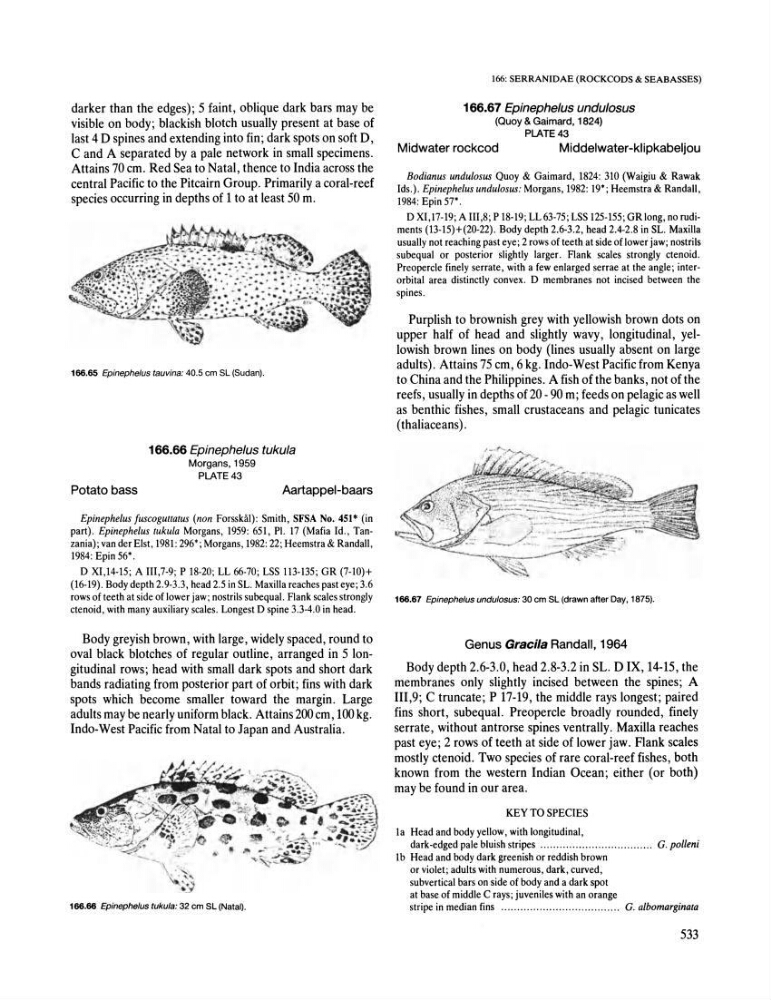
darker than the edges); 5 faint, oblique dark bars may be
visible on body; blackish blotch usually present at base of
last 4 D spines and extending into fin; dark spots on soft D,
C and A separated by a pale network in small specimens.
Attains 70 cm. Red Sea to Natal, thence to India across the
central Pacific to the Pitcairn Group. Primarily a coral-reef
species occurring in depths of 1 to at least 50 m.
166.65 Epinephelus tauvina: 40.5 em SL (Sudan).
Potato bass
166.66 Epinephelus tukula
Morgans, 1959
PLATE 43
Aartappel-baars
Epinephelus fuscoguttatus (non ForsskiH): Smith, SFSA No. 451* (in
part). Epinephelus tukula Morgans, 1959: 651, PI. 17 (Mafia Id., Tanzania); van der Elst, 1981: 296*; Morgans, 1982: 22; Heemstra & Randall,
1984: Epin 56*.
o XI,14-15; A III,7-9; P 18-20; LL 66-70; LSS 113-135; GR (7-10)+
(16-19). Body depth 2.9-3.3, head 2.5 in SL. Maxilla reaches past eye; 3.6
rows of teeth at side of lower jaw; nostrils subequal. Flank scales strongly
ctenoid, with many auxiliary scales. Longest 0 spine 3.3-4.0 in head.
Body greyish brown, with large, widely spaced, round to
oval black blotches of regular outline, arranged in 5 longitudinal rows; head with small dark spots and short dark
bands radiating from posterior part of orbit; fins with dark
spots which become smaller toward the margin. Large
adults may be nearly uniform black. Attains 200 cm, 100 kg.
Indo-West Pacific from Natal to Japan and Australia.
166.66 Epinephelus tukula: 32 em SL (Natal).
166: SERRANIDAE (ROCKCODS & SEABASSES)
166.67 Epinephelus undulosus
(Quoy & Gaimard, 1824)
PLATE 43
Midwater rockcod
Middelwater-klipkabeljou
Bodianus undulosus Quoy & Gaimard, 1824: 310 (Waigiu & Rawak
Ids.). Epinephelus undulosus: Morgans, 1982: 19*; Heemstra & Randall,
1984: Epin 57*.
o XI,17-19; A III,8; P 18-19; LL63-75; LSS 125-155; GR long, no rudiments (13-15)+(20-22). Body depth 2.6-3.2, head 2.4-2.8 in SL. Maxilla
usually not reaching past eye; 2 rows of teeth at side oflower jaw; nostrils
subequal or posterior slightly larger. Flank scales strongly ctenoid.
Preopercle finely serrate, with a few enlarged serrae at the angle; interorbital area distinctly convex. 0 membranes not incised between the
spines.
Purplish to brownish grey with yellowish brown dots on
upper half of head and slightly wavy, longitudinal, yellowish brown lines on body (lines usually absent on large
adults). Attains 75 cm, 6 kg. Indo-West Pacific from Kenya
to China and the Philippines. A fish of the banks, not of the
reefs, usually in depths of20 - 90 m; feeds on pelagic as well
as benthic fishes, small crustaceans and pelagic tunicates
(thaliaceans) .
166.67 Epinephelus undulosus: 30 em SL (drawn after Day, 1875).
Genus Gracila Randall, 1964
Body depth 2.6-3.0, head 2.8-3.2 in SL. D IX, 14-15, the
membranes only slightly incised between the spines; A
III,9; C truncate; P 17-19, the middle rays longest; paired
fins short, sub equal. Preopercle broadly rounded, finely
serrate, without antrorse spines ventrally. Maxilla reaches
past eye; 2 rows of teeth at side of lower jaw. Flank scales
mostly ctenoid. Two species of rare coral-reef fishes, both
known from the western Indian Ocean; either (or both)
may be found in our area.
KEY TO SPECIES
la Head and body yellOW, with longitudinal,
dark-edged pale bluish stripes ................................... G. polleni
1 b Head and body dark greenish or reddish brown
or violet; adults with numerous, dark, curved,
subvertical bars on side of body and a dark spot
at base of middle C rays; juveniles with an orange
stripe in median fins ..................................... G. albomarginata
533
visible on body; blackish blotch usually present at base of
last 4 D spines and extending into fin; dark spots on soft D,
C and A separated by a pale network in small specimens.
Attains 70 cm. Red Sea to Natal, thence to India across the
central Pacific to the Pitcairn Group. Primarily a coral-reef
species occurring in depths of 1 to at least 50 m.
166.65 Epinephelus tauvina: 40.5 em SL (Sudan).
Potato bass
166.66 Epinephelus tukula
Morgans, 1959
PLATE 43
Aartappel-baars
Epinephelus fuscoguttatus (non ForsskiH): Smith, SFSA No. 451* (in
part). Epinephelus tukula Morgans, 1959: 651, PI. 17 (Mafia Id., Tanzania); van der Elst, 1981: 296*; Morgans, 1982: 22; Heemstra & Randall,
1984: Epin 56*.
o XI,14-15; A III,7-9; P 18-20; LL 66-70; LSS 113-135; GR (7-10)+
(16-19). Body depth 2.9-3.3, head 2.5 in SL. Maxilla reaches past eye; 3.6
rows of teeth at side of lower jaw; nostrils subequal. Flank scales strongly
ctenoid, with many auxiliary scales. Longest 0 spine 3.3-4.0 in head.
Body greyish brown, with large, widely spaced, round to
oval black blotches of regular outline, arranged in 5 longitudinal rows; head with small dark spots and short dark
bands radiating from posterior part of orbit; fins with dark
spots which become smaller toward the margin. Large
adults may be nearly uniform black. Attains 200 cm, 100 kg.
Indo-West Pacific from Natal to Japan and Australia.
166.66 Epinephelus tukula: 32 em SL (Natal).
166: SERRANIDAE (ROCKCODS & SEABASSES)
166.67 Epinephelus undulosus
(Quoy & Gaimard, 1824)
PLATE 43
Midwater rockcod
Middelwater-klipkabeljou
Bodianus undulosus Quoy & Gaimard, 1824: 310 (Waigiu & Rawak
Ids.). Epinephelus undulosus: Morgans, 1982: 19*; Heemstra & Randall,
1984: Epin 57*.
o XI,17-19; A III,8; P 18-19; LL63-75; LSS 125-155; GR long, no rudiments (13-15)+(20-22). Body depth 2.6-3.2, head 2.4-2.8 in SL. Maxilla
usually not reaching past eye; 2 rows of teeth at side oflower jaw; nostrils
subequal or posterior slightly larger. Flank scales strongly ctenoid.
Preopercle finely serrate, with a few enlarged serrae at the angle; interorbital area distinctly convex. 0 membranes not incised between the
spines.
Purplish to brownish grey with yellowish brown dots on
upper half of head and slightly wavy, longitudinal, yellowish brown lines on body (lines usually absent on large
adults). Attains 75 cm, 6 kg. Indo-West Pacific from Kenya
to China and the Philippines. A fish of the banks, not of the
reefs, usually in depths of20 - 90 m; feeds on pelagic as well
as benthic fishes, small crustaceans and pelagic tunicates
(thaliaceans) .
166.67 Epinephelus undulosus: 30 em SL (drawn after Day, 1875).
Genus Gracila Randall, 1964
Body depth 2.6-3.0, head 2.8-3.2 in SL. D IX, 14-15, the
membranes only slightly incised between the spines; A
III,9; C truncate; P 17-19, the middle rays longest; paired
fins short, sub equal. Preopercle broadly rounded, finely
serrate, without antrorse spines ventrally. Maxilla reaches
past eye; 2 rows of teeth at side of lower jaw. Flank scales
mostly ctenoid. Two species of rare coral-reef fishes, both
known from the western Indian Ocean; either (or both)
may be found in our area.
KEY TO SPECIES
la Head and body yellOW, with longitudinal,
dark-edged pale bluish stripes ................................... G. polleni
1 b Head and body dark greenish or reddish brown
or violet; adults with numerous, dark, curved,
subvertical bars on side of body and a dark spot
at base of middle C rays; juveniles with an orange
stripe in median fins ..................................... G. albomarginata
533