

166: SERRANIDAE (ROCKCODS & SEA BASSES)
peduncle; fins dark brown. Attains 100 cm. Known in western Indian Ocean only from Mauritius, Reunion and
Chagos Ids.; also occurs in Japan.
166.62 Epinephelus sp.
PLATE 42
Brown rockcod
Bruin klipkabeljou
D XI,14; A I1I,8; P 17; LL 58; LSS'115; GR 8+ 15. Body depth 3.05,
head length 2.5 in SL; orbit 6.0, interorbital 5.6, P 1.9, longest D spine 3.5
in head. Maxilla not reaching past eye; 2 rows of teeth on lower jaw;
diameter of rear nostrils about twice that of front ones; preopercie finely
serrate, the angle produced, with enlarged serrae; distinct notch above
preopercie angle. Flank scales ctenoid, with a few auxiliary scales.
Head and body brownish grey; dorsolateral part of body
with black dots (very faint or absent on some specimens);
median fins darker than body; margin of soft D, A and corners of C pale; dark streak on cheek along upper edge of
maxillary groove; faint dark stripe from lower edge of eye to
just above preopercle notch. Attains at least 60 cm, 5 kg.
Diagnosis above taken from a 50 cm SL specimen caught off
Umdloti, Natal by Mr Dave Williams. Mr A. R. Thorpe has
supplied excellent photographs of 5 other specimens from
Natal. This "brown rockcod" may represent a new species;
it is very similar to E. epistictus (Temminck & Schlegel) of
Japan, which differs slightly in scale counts and colour pattern; another similar species, E. poecilonotus, differs from
the brown rockcod only in colour pattern.
166.63 Epinephelus spilotoceps
Schultz, 1953
PLATE 42
Foursaddle rockcod
Viersaal-klipkabeljou
Epinephelus spi/otoceps Schultz, 1953: 357, Figs. 56 & 57 (Bikini Atoll,
Marshall Ids.); Morgans, 1982: 26*; Heemstra & Randall, 1984: Epin54*.
Epinephelus salonotus Smith & Smith, 1963: 15, PI. 14, Fig. 1 (Cape
Delgado, Mozambique).
D XI,15; A I1I,8; P 17-19; LL 60-69; LSS 91-94; GR (7-8)+(15-18).
Body depth 3.1-3.5, head length 2.2-2.4 in SL. Maxilla reaches past eye; 3
or 4 rows of teeth at side of lower jaw; nostrils subequal. Flank scales
ctenoid, with auxiliary scales.
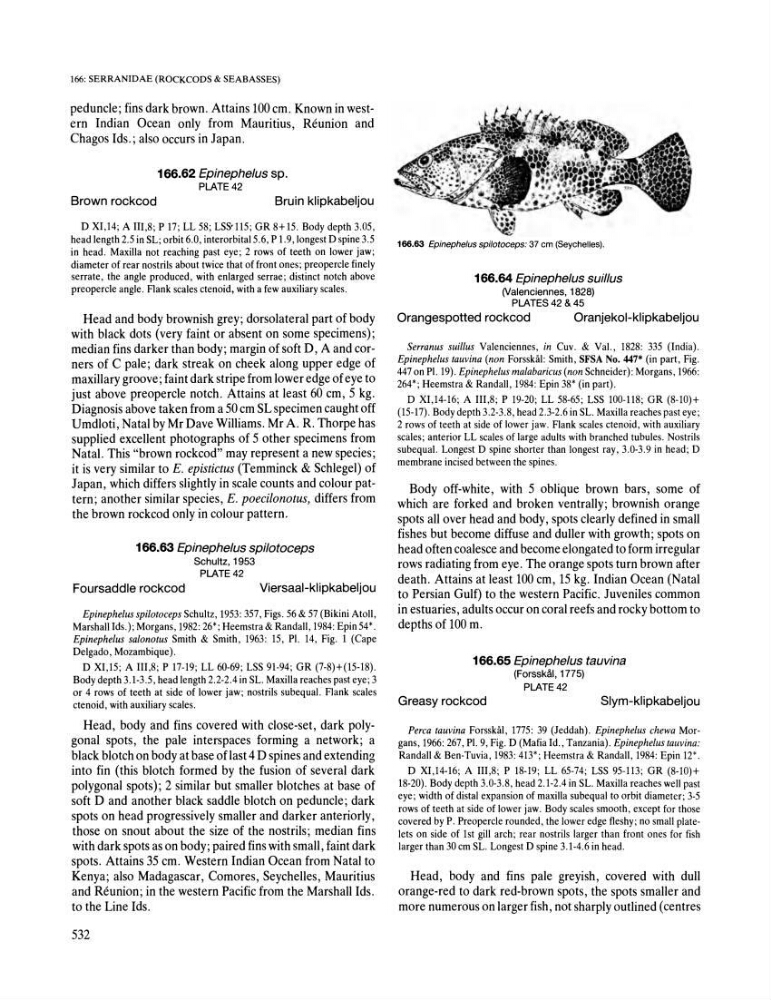
Head, body and fins covered with close-set, dark polygonal spots, the pale interspaces forming a network; a
black blotch on body at base of last 4 D spines and extending
into fin (this blotch formed by the fusion of several dark
polygonal spots); 2 similar but smaller blotches at base of
soft D and another black saddle blotch on peduncle; dark
spots on head progressively smaller and darker anteriorly,
those on snout about the size of the nostrils; median fins
with dark spots as on body; paired fins with small, faint dark
spots. Attains 35 cm. Western Indian Ocean from Natal to
Kenya; also Madagascar, Comores, Seychelles, Mauritius
and Reunion; in the western Pacific from the Marshall Ids.
to the Line Ids.
532
166.63 Epinephelus spilotoceps: 37 cm (Seychelles).
166.64 Epinephelus suillus
(Valenciennes, 1828)
PLATES 42 & 45
Orangespotted rockcod
Oranjekol-klipkabeljou
Serranus suillus Valenciennes, in Cuv. & Val., 1828: 335 (India).
Epinephelus tauvina (non Forsskal: Smith, SFSA No. 447* (in part, Fig.
447 on PI. 19). Epinephelus malabaricus (non Schneider): Morgans, 1966:
264*; Heemstra & Randall, 1984: Epin 38* (in part).
D XI,14-16; A III,8; P 19-20; LL 58-65; LSS 100-118; GR (8-10)+
(15-17). Body depth 3.2-3.8, head 2.3-2.6 in SL. Maxilla reaches past eye;
2 rows of teeth at side of lower jaw. Flank scales ctenoid, with auxiliary
scales; anterior LL scales of large adults with branched tubules. Nostrils
subequal. Longest D spine shorter than longest ray, 3.0-3.9 in head; D
membrane incised between the spines.
Body off-white, with 5 oblique brown bars, some of
which are forked and broken ventrally; brownish orange
spots all over head and body, spots clearly defined in small
fishes but become diffuse and duller with growth; spots on
head often coalesce and become elongated to form irregular
rows radiating from eye. The orange spots turn brown after
death. Attains at least 100 cm, 15 kg. Indian Ocean (Natal
to Persian Gulf) to the western Pacific. Juveniles common
in estuaries, adults occur on coral reefs and rocky bottom to
depths of 100 m.
166.65 Epinephelus tauvina
(Forsskal, 1775)
PLATE 42
Greasy rockcod
Slym-klipkabeljou
Perea tauvina Forsskal, 1775: 39 (Jeddah). Epinephelus chewa Morgans, 1966: 267, PI. 9, Fig. D (Mafia Id., Tanzania). Epinephelus tauvina:
Randall & Ben-Tuvia, 1983: 413*; Heemstra & Randall, 1984: Epin 12*.
D XI,14-16; A III,8; P 18-19; LL 65-74; LSS 95-113; GR (8-10)+
18-20). Body depth 3.0-3.8, head 2.1-2.4 in SL. Maxilla reaches well past
eye; width of distal expansion of maxilla subequal to orbit diameter; 3-5
rows of teeth at side of lower jaw. Body scales smooth, except for those
covered by P. Preopercie rounded, the lower edge fleshy; no small platelets on side of 1st gill arch; rear nostrils larger than front ones for fish
larger than 30 em SL. Longest D spine 3.1-4.6 in head.
Head, body and fins pale greyish, covered with dull
orange-red to dark red-brown spots, the spots smaller and
more numerous on larger fish, not sharply outlined (centres
peduncle; fins dark brown. Attains 100 cm. Known in western Indian Ocean only from Mauritius, Reunion and
Chagos Ids.; also occurs in Japan.
166.62 Epinephelus sp.
PLATE 42
Brown rockcod
Bruin klipkabeljou
D XI,14; A I1I,8; P 17; LL 58; LSS'115; GR 8+ 15. Body depth 3.05,
head length 2.5 in SL; orbit 6.0, interorbital 5.6, P 1.9, longest D spine 3.5
in head. Maxilla not reaching past eye; 2 rows of teeth on lower jaw;
diameter of rear nostrils about twice that of front ones; preopercie finely
serrate, the angle produced, with enlarged serrae; distinct notch above
preopercie angle. Flank scales ctenoid, with a few auxiliary scales.
Head and body brownish grey; dorsolateral part of body
with black dots (very faint or absent on some specimens);
median fins darker than body; margin of soft D, A and corners of C pale; dark streak on cheek along upper edge of
maxillary groove; faint dark stripe from lower edge of eye to
just above preopercle notch. Attains at least 60 cm, 5 kg.
Diagnosis above taken from a 50 cm SL specimen caught off
Umdloti, Natal by Mr Dave Williams. Mr A. R. Thorpe has
supplied excellent photographs of 5 other specimens from
Natal. This "brown rockcod" may represent a new species;
it is very similar to E. epistictus (Temminck & Schlegel) of
Japan, which differs slightly in scale counts and colour pattern; another similar species, E. poecilonotus, differs from
the brown rockcod only in colour pattern.
166.63 Epinephelus spilotoceps
Schultz, 1953
PLATE 42
Foursaddle rockcod
Viersaal-klipkabeljou
Epinephelus spi/otoceps Schultz, 1953: 357, Figs. 56 & 57 (Bikini Atoll,
Marshall Ids.); Morgans, 1982: 26*; Heemstra & Randall, 1984: Epin54*.
Epinephelus salonotus Smith & Smith, 1963: 15, PI. 14, Fig. 1 (Cape
Delgado, Mozambique).
D XI,15; A I1I,8; P 17-19; LL 60-69; LSS 91-94; GR (7-8)+(15-18).
Body depth 3.1-3.5, head length 2.2-2.4 in SL. Maxilla reaches past eye; 3
or 4 rows of teeth at side of lower jaw; nostrils subequal. Flank scales
ctenoid, with auxiliary scales.
Head, body and fins covered with close-set, dark polygonal spots, the pale interspaces forming a network; a
black blotch on body at base of last 4 D spines and extending
into fin (this blotch formed by the fusion of several dark
polygonal spots); 2 similar but smaller blotches at base of
soft D and another black saddle blotch on peduncle; dark
spots on head progressively smaller and darker anteriorly,
those on snout about the size of the nostrils; median fins
with dark spots as on body; paired fins with small, faint dark
spots. Attains 35 cm. Western Indian Ocean from Natal to
Kenya; also Madagascar, Comores, Seychelles, Mauritius
and Reunion; in the western Pacific from the Marshall Ids.
to the Line Ids.
532
166.63 Epinephelus spilotoceps: 37 cm (Seychelles).
166.64 Epinephelus suillus
(Valenciennes, 1828)
PLATES 42 & 45
Orangespotted rockcod
Oranjekol-klipkabeljou
Serranus suillus Valenciennes, in Cuv. & Val., 1828: 335 (India).
Epinephelus tauvina (non Forsskal: Smith, SFSA No. 447* (in part, Fig.
447 on PI. 19). Epinephelus malabaricus (non Schneider): Morgans, 1966:
264*; Heemstra & Randall, 1984: Epin 38* (in part).
D XI,14-16; A III,8; P 19-20; LL 58-65; LSS 100-118; GR (8-10)+
(15-17). Body depth 3.2-3.8, head 2.3-2.6 in SL. Maxilla reaches past eye;
2 rows of teeth at side of lower jaw. Flank scales ctenoid, with auxiliary
scales; anterior LL scales of large adults with branched tubules. Nostrils
subequal. Longest D spine shorter than longest ray, 3.0-3.9 in head; D
membrane incised between the spines.
Body off-white, with 5 oblique brown bars, some of
which are forked and broken ventrally; brownish orange
spots all over head and body, spots clearly defined in small
fishes but become diffuse and duller with growth; spots on
head often coalesce and become elongated to form irregular
rows radiating from eye. The orange spots turn brown after
death. Attains at least 100 cm, 15 kg. Indian Ocean (Natal
to Persian Gulf) to the western Pacific. Juveniles common
in estuaries, adults occur on coral reefs and rocky bottom to
depths of 100 m.
166.65 Epinephelus tauvina
(Forsskal, 1775)
PLATE 42
Greasy rockcod
Slym-klipkabeljou
Perea tauvina Forsskal, 1775: 39 (Jeddah). Epinephelus chewa Morgans, 1966: 267, PI. 9, Fig. D (Mafia Id., Tanzania). Epinephelus tauvina:
Randall & Ben-Tuvia, 1983: 413*; Heemstra & Randall, 1984: Epin 12*.
D XI,14-16; A III,8; P 18-19; LL 65-74; LSS 95-113; GR (8-10)+
18-20). Body depth 3.0-3.8, head 2.1-2.4 in SL. Maxilla reaches well past
eye; width of distal expansion of maxilla subequal to orbit diameter; 3-5
rows of teeth at side of lower jaw. Body scales smooth, except for those
covered by P. Preopercie rounded, the lower edge fleshy; no small platelets on side of 1st gill arch; rear nostrils larger than front ones for fish
larger than 30 em SL. Longest D spine 3.1-4.6 in head.
Head, body and fins pale greyish, covered with dull
orange-red to dark red-brown spots, the spots smaller and
more numerous on larger fish, not sharply outlined (centres