

Head and body pale brown with dark reddish brown spots
that are round and well separated on head and front part of
body, but become crowded and elongated to form short
oblique streaks on rear part of body and peduncle. Attains
55 cm. Indian Ocean from the Transkei to Indonesia in
depths of 10 - 70 m. Sometimes misidentified as E. gaimardi.
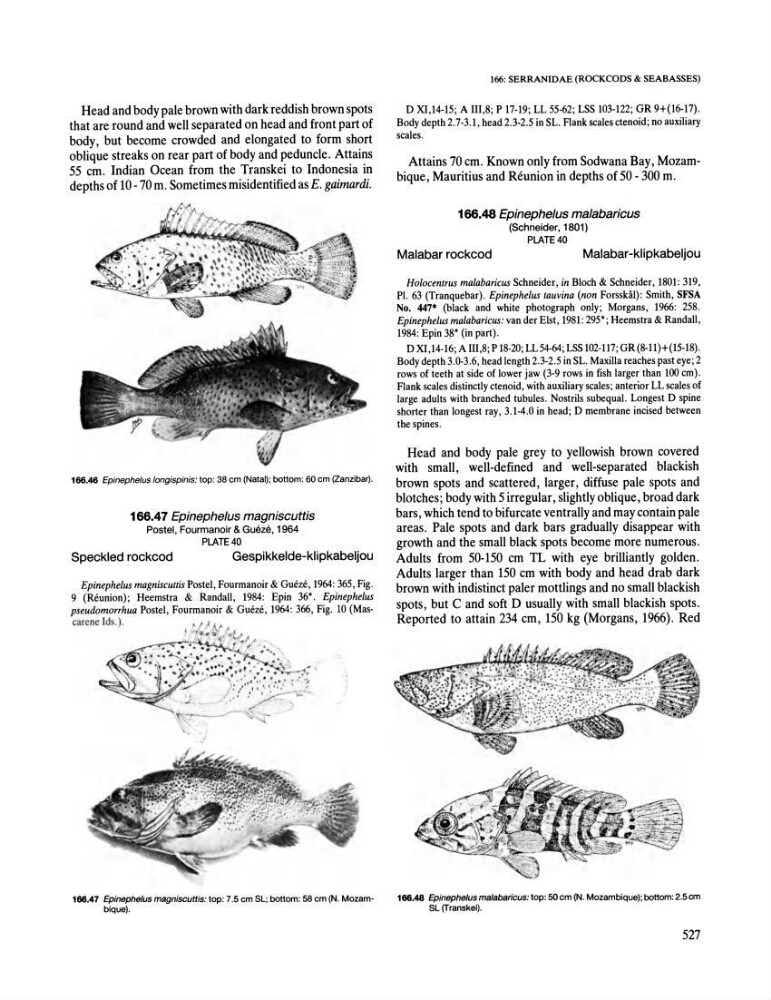
166.46 Epinephelus longispinis: top: 38 em (Natal); bottom: 60 em (Zanzibar).
166.47 Epinephelus magniscuttis
Postel, Fourmanoir & Gueze, 1964
PLATE 40
Speckled rockcod
Gespikkelde-klipkabeljou
Epinephelus magniscuttis Postel , Fourmanoir & Gueze, 1964: 365, Fig.
9 (Reunion) ; Heemstra & Randall , 1984: Epin 36*. Epinephelus
pseudomorrhua Postel , Fourmanoir & Gueze, 1964: 366, Fig. 10 (Mascarene Id .).
-,
166.47 Epinephelus magniscuttis: top: 7.5 em SL; bottom: 58 em (N . Mozambique).
166: SERRANIDAE (ROCKCODS & SEABASSES)
D XI,14-15; A 1II,8; P 17-19; LL 55-62; LSS 103-122; GR 9+(16-17).
Body depth 2.7-3.1, head 2.3-2.5 in SL. Flank scales ctenoid; no auxiliary
scales.
Attains 70 cm. Known only from Sodwana Bay, Mozambique, Mauritius and Reunion in depths of 50 - 300 m.
166.48 Epinephelus malabaricus
(Schneider, 1801)
PLATE 40
Malabar rockcod
Malabar-klipkabeljou
Holocentrus malabaricus Schneider, in Bloch & Schneider, 1801: 319,
PI. 63 (Tranquebar) . Epinephelus tauvina (non Forsskid) : Smith, SFSA
No. 447* (black and white photograph only; Morgans, 1966: 258.
Epinephelus malabaricus: van der Elst, 1981: 295*; Heemstra & Randall,
1984: Epin 3~* (in part).
D XI,14-16; A III,8; P 18-20; LL54-64; LSS 102-117; GR (8-11)+(15-18).
Body depth 3.0-3.6, head length 2.3-2.5 in SL. Maxilla reaches past eye ; 2
rows of teeth at side of lower jaw (3-9 rows in fish larger than 100 em).
Flank scales distinctly ctenoid, with auxiliary scales; anterior LL scales of
large adults with branched tubules. Nostrils subequal. Longest D spine
shorter than longest ray, 3.1-4.0 in head; D membrane incised between
the spines.
Head and body pale grey to yellowish brown covered
with small, well-defined and well-separated blackish
brown spots and scattered, larger, diffuse pale spots and
blotches; body with 5 irregular, slightly oblique, broad dark
bars, which tend to bifurcate ventrally and may contain pale
areas. Pale spots and dark bars gradually disappear with
growth and the small black spots become more numerous.
Adults from 50-150 cm TL with eye brilliantly golden.
Adults larger than 150 cm with body and head drab dark
brown with indistinct paler mottlings and no small blackish
spots, but C and soft D usually with small blackish spots.
Reported to attain 234 cm, 150 kg (Morgans, 1966). Red
166.48 Epinephelus malabaricus: top: 50 em (N. Mozambique); bottom: 2.5cm
SL (Transkei).
527
that are round and well separated on head and front part of
body, but become crowded and elongated to form short
oblique streaks on rear part of body and peduncle. Attains
55 cm. Indian Ocean from the Transkei to Indonesia in
depths of 10 - 70 m. Sometimes misidentified as E. gaimardi.
166.46 Epinephelus longispinis: top: 38 em (Natal); bottom: 60 em (Zanzibar).
166.47 Epinephelus magniscuttis
Postel, Fourmanoir & Gueze, 1964
PLATE 40
Speckled rockcod
Gespikkelde-klipkabeljou
Epinephelus magniscuttis Postel , Fourmanoir & Gueze, 1964: 365, Fig.
9 (Reunion) ; Heemstra & Randall , 1984: Epin 36*. Epinephelus
pseudomorrhua Postel , Fourmanoir & Gueze, 1964: 366, Fig. 10 (Mascarene Id .).
-,
166.47 Epinephelus magniscuttis: top: 7.5 em SL; bottom: 58 em (N . Mozambique).
166: SERRANIDAE (ROCKCODS & SEABASSES)
D XI,14-15; A 1II,8; P 17-19; LL 55-62; LSS 103-122; GR 9+(16-17).
Body depth 2.7-3.1, head 2.3-2.5 in SL. Flank scales ctenoid; no auxiliary
scales.
Attains 70 cm. Known only from Sodwana Bay, Mozambique, Mauritius and Reunion in depths of 50 - 300 m.
166.48 Epinephelus malabaricus
(Schneider, 1801)
PLATE 40
Malabar rockcod
Malabar-klipkabeljou
Holocentrus malabaricus Schneider, in Bloch & Schneider, 1801: 319,
PI. 63 (Tranquebar) . Epinephelus tauvina (non Forsskid) : Smith, SFSA
No. 447* (black and white photograph only; Morgans, 1966: 258.
Epinephelus malabaricus: van der Elst, 1981: 295*; Heemstra & Randall,
1984: Epin 3~* (in part).
D XI,14-16; A III,8; P 18-20; LL54-64; LSS 102-117; GR (8-11)+(15-18).
Body depth 3.0-3.6, head length 2.3-2.5 in SL. Maxilla reaches past eye ; 2
rows of teeth at side of lower jaw (3-9 rows in fish larger than 100 em).
Flank scales distinctly ctenoid, with auxiliary scales; anterior LL scales of
large adults with branched tubules. Nostrils subequal. Longest D spine
shorter than longest ray, 3.1-4.0 in head; D membrane incised between
the spines.
Head and body pale grey to yellowish brown covered
with small, well-defined and well-separated blackish
brown spots and scattered, larger, diffuse pale spots and
blotches; body with 5 irregular, slightly oblique, broad dark
bars, which tend to bifurcate ventrally and may contain pale
areas. Pale spots and dark bars gradually disappear with
growth and the small black spots become more numerous.
Adults from 50-150 cm TL with eye brilliantly golden.
Adults larger than 150 cm with body and head drab dark
brown with indistinct paler mottlings and no small blackish
spots, but C and soft D usually with small blackish spots.
Reported to attain 234 cm, 150 kg (Morgans, 1966). Red
166.48 Epinephelus malabaricus: top: 50 em (N. Mozambique); bottom: 2.5cm
SL (Transkei).
527