

166: SERRANIDAE (ROCKCODS & SEABASSES)
Head and body greyish or brown dorsally, yellow or
whitish ventrally; irregular white blotches usually visible on
body and head, sometimes in vertical rows; spinous D margin and basal part of A and paired fins often golden yellow;
median fins usually dark brown; rear edge of C with a white
line. Attains 150 cm and at least 30 kg. Mediterranean and
eastern Atlantic south to the Cape and into the Indian
Ocean at least to Quissico, Mozambique (25°S). The most
common species of rock cod from Knysna to Natal. Also
reported from Brazil (c. L. Smith, 1971).
166.44 Epinephelus hexagonatus
(Schneider, 1801)
PLATE 39
White specked rockcod
Witspikkel-klipkabeljou
Holocentrus hexagonatus Schneider, in Bloch & Schneider, 1801: 323
(Tahiti). Epinephelus hexagonatus: Morgans, 1982: 25'; Heemstra &
Randall, 1984: Epin 34'.
D XI,15-16; A III,8; P 18-20; LL 61-66; LSS 93-104; GR (7-9)+(16-19).
Body depth 3.1-3.5, head 2.4-2.6 in SL; 2nd A spine distinctly longer than
3rd and more than C peduncle depth. Flank scales ctenoid; 3-5 rows of
teeth at side of lower jaw.
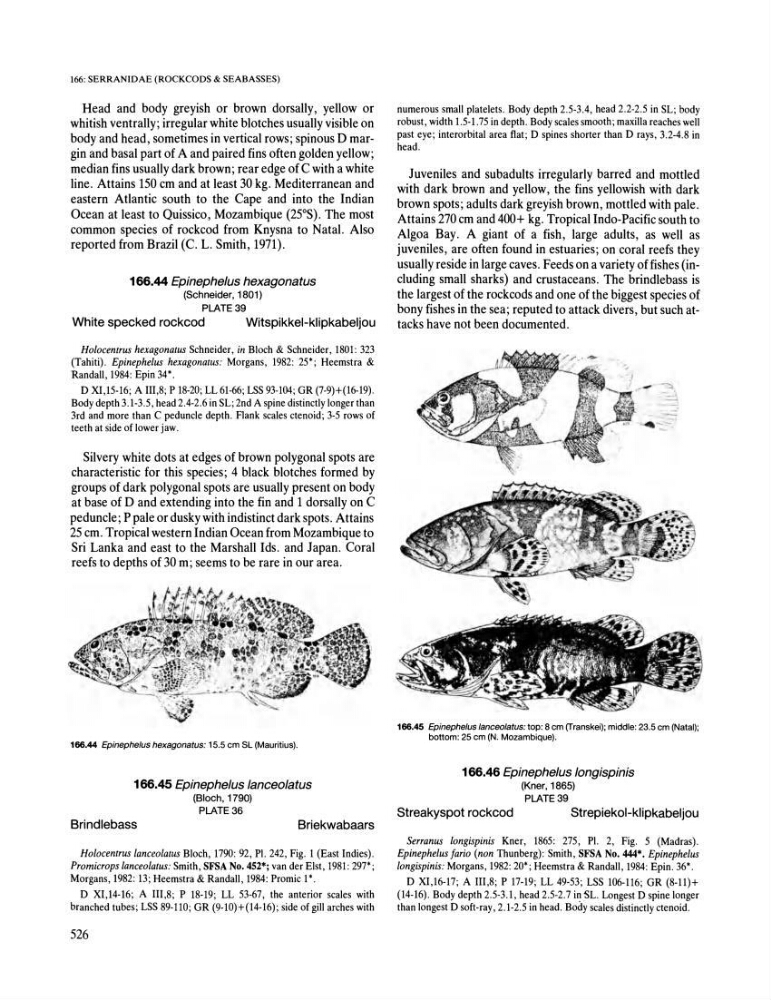
Silvery white dots at edges of brown polygonal spots are
characteristic for this species; 4 black blotches formed by
groups of dark polygonal spots are usually present on body
at base of D and extending into the fin and 1 dorsally on C
peduncle; P pale or dusky with indistinct dark spots. Attains
25 cm. Tropical western Indian Ocean from Mozambique to
Sri Lanka and east to the Marshall Ids. and Japan. Coral
reefs to depths of 30 m; seems to be rare in our area.
166.44 Epinephelus hexagonatus: 15.5 em SL (Mauritius).
166.45 Epinephelus lanceolatus
(Bloch, 1790)
PLATE 36
Brindlebass
Briekwabaars
Holocentrus lanceolatus Bloch, 1790: 92, PI. 242, Fig. 1 (East Indies).
Promicrops lanceolatus: Smith, SFSA No. 452*; van der Elst, 1981: 297';
Morgans, 1982: 13; Heemstra & Randall, 1984: Promic 1'.
D XI,14-16; A III,8; P 18-19; LL 53-67, the anterior scales with
branched tubes; LSS 89-110; GR (9-10)+(14-16); side of gill arches with
526
numerous small platelets. Body depth 2.5-3.4, head 2.2-2.5 in SL; body
robust, width 1.5-1.75 in depth. Body scales smooth; maxilla reaches well
past eye; interorbital area flat; D spines shorter than Drays, 3.2-4.8 in
head.
Juveniles and sub adults irregularly barred and mottled
with dark brown and yellow, the fins yellowish with dark
brown spots; adults dark greyish brown, mottled with pale.
Attains 270 cm and 400+ kg. Tropical Indo-Pacific south to
Algoa Bay. A giant of a fish, large adults, as well as
juveniles, are often found in estuaries; on coral reefs they
usually reside in large caves. Feeds on a variety of fishes (including small sharks) and crustaceans. The brindlebass is
the largest of the rockcods and one of the biggest species of
bony fishes in the sea; reputed to attack divers, but such attacks have not been documented.
166.45 Epinephelus lanceolatus: top: 8 em (Transkei); middle: 23.5 em (Natal);
bottom: 25 em (N. Mozambique).
166.46 Epinephelus longispinis
(Kner, 1865)
PLATE 39
Streakyspot rockcod
Strepiekol-klipkabeljou
Serranus longispinis Kner, 1865: 275, PI. 2, Fig. 5 (Madras).
Epinephelus fario (non Thunberg): Smith, SFSA No. 444*. Epinephelus
longispinis: Morgans, 1982: 20'; Heemstra & Randall, 1984: Epin. 36*.
D XI,16-17; A III,8; P 17-19; LL 49-53; LSS 106-116; GR (8-11)+
(14-16). Body depth 2.5-3.1, head 2.5-2.7 in SL. Longest D spine longer
than longest D soft-ray, 2.1-2.5 in head. Body scales distinctly ctenoid.
Head and body greyish or brown dorsally, yellow or
whitish ventrally; irregular white blotches usually visible on
body and head, sometimes in vertical rows; spinous D margin and basal part of A and paired fins often golden yellow;
median fins usually dark brown; rear edge of C with a white
line. Attains 150 cm and at least 30 kg. Mediterranean and
eastern Atlantic south to the Cape and into the Indian
Ocean at least to Quissico, Mozambique (25°S). The most
common species of rock cod from Knysna to Natal. Also
reported from Brazil (c. L. Smith, 1971).
166.44 Epinephelus hexagonatus
(Schneider, 1801)
PLATE 39
White specked rockcod
Witspikkel-klipkabeljou
Holocentrus hexagonatus Schneider, in Bloch & Schneider, 1801: 323
(Tahiti). Epinephelus hexagonatus: Morgans, 1982: 25'; Heemstra &
Randall, 1984: Epin 34'.
D XI,15-16; A III,8; P 18-20; LL 61-66; LSS 93-104; GR (7-9)+(16-19).
Body depth 3.1-3.5, head 2.4-2.6 in SL; 2nd A spine distinctly longer than
3rd and more than C peduncle depth. Flank scales ctenoid; 3-5 rows of
teeth at side of lower jaw.
Silvery white dots at edges of brown polygonal spots are
characteristic for this species; 4 black blotches formed by
groups of dark polygonal spots are usually present on body
at base of D and extending into the fin and 1 dorsally on C
peduncle; P pale or dusky with indistinct dark spots. Attains
25 cm. Tropical western Indian Ocean from Mozambique to
Sri Lanka and east to the Marshall Ids. and Japan. Coral
reefs to depths of 30 m; seems to be rare in our area.
166.44 Epinephelus hexagonatus: 15.5 em SL (Mauritius).
166.45 Epinephelus lanceolatus
(Bloch, 1790)
PLATE 36
Brindlebass
Briekwabaars
Holocentrus lanceolatus Bloch, 1790: 92, PI. 242, Fig. 1 (East Indies).
Promicrops lanceolatus: Smith, SFSA No. 452*; van der Elst, 1981: 297';
Morgans, 1982: 13; Heemstra & Randall, 1984: Promic 1'.
D XI,14-16; A III,8; P 18-19; LL 53-67, the anterior scales with
branched tubes; LSS 89-110; GR (9-10)+(14-16); side of gill arches with
526
numerous small platelets. Body depth 2.5-3.4, head 2.2-2.5 in SL; body
robust, width 1.5-1.75 in depth. Body scales smooth; maxilla reaches well
past eye; interorbital area flat; D spines shorter than Drays, 3.2-4.8 in
head.
Juveniles and sub adults irregularly barred and mottled
with dark brown and yellow, the fins yellowish with dark
brown spots; adults dark greyish brown, mottled with pale.
Attains 270 cm and 400+ kg. Tropical Indo-Pacific south to
Algoa Bay. A giant of a fish, large adults, as well as
juveniles, are often found in estuaries; on coral reefs they
usually reside in large caves. Feeds on a variety of fishes (including small sharks) and crustaceans. The brindlebass is
the largest of the rockcods and one of the biggest species of
bony fishes in the sea; reputed to attack divers, but such attacks have not been documented.
166.45 Epinephelus lanceolatus: top: 8 em (Transkei); middle: 23.5 em (Natal);
bottom: 25 em (N. Mozambique).
166.46 Epinephelus longispinis
(Kner, 1865)
PLATE 39
Streakyspot rockcod
Strepiekol-klipkabeljou
Serranus longispinis Kner, 1865: 275, PI. 2, Fig. 5 (Madras).
Epinephelus fario (non Thunberg): Smith, SFSA No. 444*. Epinephelus
longispinis: Morgans, 1982: 20'; Heemstra & Randall, 1984: Epin. 36*.
D XI,16-17; A III,8; P 17-19; LL 49-53; LSS 106-116; GR (8-11)+
(14-16). Body depth 2.5-3.1, head 2.5-2.7 in SL. Longest D spine longer
than longest D soft-ray, 2.1-2.5 in head. Body scales distinctly ctenoid.