

166: SERRANIDAE (ROCKCODS & SEABASSES)
Genus Aethaloperca Fowler, 1904
Body depth greater than head length, 2.1-2.5 in SL; body
width 2.25-2.8 in depth. Dorsal profile of head straight, becoming convex on nape. One species.
166.19 Aetha/operca rogaa
(Forsskal, 1775)
PLATE 34
Redmouth rockcod
Rooibek-kabeljou
Perea rogaa ForsskiH, 1775: 38 (Djedda, Red Sea). Cephalopholis
rogaa: Smith, SFSA No. 420*. Aethloperea rogaa: Smith, 1955: 310;
Morgans, 1982: 6; Heemstra & Randall, 1984: Aethall*.
D IX,17-18; A III,8-9; P 17-18; LL 48-55; LSS 90-104; 2-4 rows ofteeth
at side of lower jaw; lower GR 9 plus some rudiments.
Dark brown, inside of mouth and gill cavity scarlet;
juveniles with a white margin on soft D and C; some fish
with a white bar on belly at tip of P. Attains 60 cm. Coral
reefs in depths of 10 - 40 m; widespread but not common.
Red Sea and western Indian Ocean from Delagoa Bay to
Persian Gulf, Philippines and Japan.
166.19 Aethaloperca rogaa: ea. 45 em (N. Mozambique).
Genus Anyperodon Gunther, 1859
Body elongate and compressed, the depth 3.3-3.7 in SL;
head distinctly longer than body depth. No teeth on
palatines; 2 rows of teeth at side of lower jaw. See account
of the single species of the genus below.
166.20 Anyperodon /eucogrammicus
(Valenciennes, 1828)
PLATES 34 & 36
Slender rockcod
Siank klipkabeljou
Serranus leueogrammieus Valenciennes, in Cuv. & Val., 1828: 347
(Seychelles). Anyperodon leueogrammieus: Morgans, 1982: 12; Randall
& Ben-Tuvia, 1983: 380*; Heemstra & Randall, 1984: Anyper 1'.
D XI,14-16; A III,8-9; P 15-17; LL 63-71; LSS 110-125; GR (7-9)+
(14-17). Head 2.4-2.5 in SL. Scales ctenoid.
516
Attains 52 cm. Juveniles with alternating blue and red
stripes and 1 or 2 black spots at C base. Tropical Indo-West
Pacific and Red Sea south to Mozambique. Probably occurs
in our area.
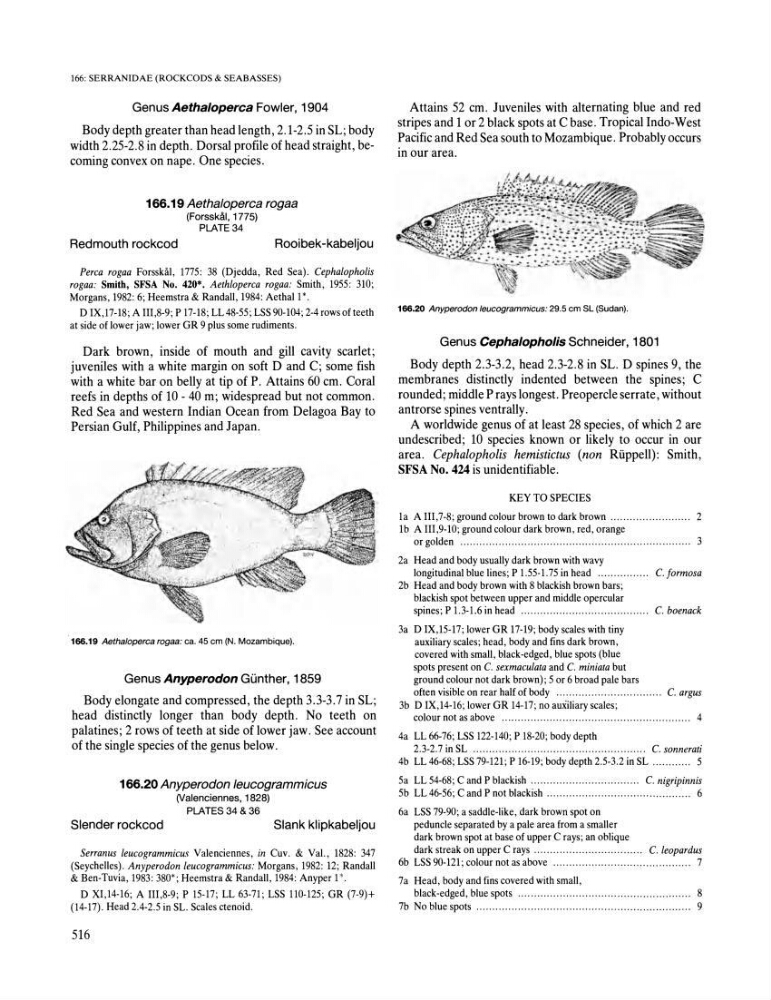
166.20 Anyperodon leucogrammicus: 29.5 em SL (Sudan).
Genus Cephalopholis Schneider, 1801
Body depth 2.3-3.2, head 2.3-2.8 in SL. D spines 9, the
membranes distinctly indented between the spines; C
rounded; middle P rays longest. Preopercie serrate, without
antrorse spines ventrally.
A worldwide genus of at least 28 species, of which 2 are
undescribed; 10 species known or likely to occur in our
area. Cephalopholis hemistictus (non Riippell): Smith,
SFSA No. 424 is unidentifiable.
KEY TO SPECIES
1a A III,7-8; ground colour brown to dark brown ................ ......... 2
Ib A III,9-1O; ground colour dark brown, red, orange
or golden ........................................................... ........ ..... 3
2a Head and body usually dark brown with wavy
longitudinal blue lines; P 1.55-1.75 in head ................ C. formosa
2b Head and body brown with 8 blackish brown bars;
blackish spot between upper and middle opercular
spines; P 1.3-1.6 in head ........................................ C. boenaek
3a D IX,15-17; lower GR 17-19; body scales with tiny
auxiliary scales; head, body and fins dark brown,
covered with small, black-edged, blue spots (blue
spots present on C. sexmaeulata and C. miniata but
ground colour not dark brown); 5 or 6 broad pale bars
often visible on rear half of body ................................. C. argus
3b D IX,14-16; lower GR 14-17; no auxiliary scales;
colour not as above ........................................................... 4
4a LL 66-76; LSS 122-140; P 18-20; body depth
2.3-2.7 in SL ...................................................... C. sonnerati
4b LL 46-68; LSS 79-121; P 16-19; body depth 2.5-3.2 in SL ............ 5
5a LL 54-68; C and P blackish... ............................... C. nigripinnis
5b LL 46-56; C and P not blackish ............................................. 6
6a LSS 79-90; a saddle-like, dark brown spot on
peduncle separated by a pale area from a smaller
dark brown spot at base of upper C rays; an oblique
dark streak on upper Crays .................................. C. leopardus
6b LSS 90-121; colour not as above ........................................... 7
7a Head, body and fins covered with small,
black-edged, blue spots ......................... .......... .. ........ .... .. ... 8
7b No blue spots ................................................................... 9
Genus Aethaloperca Fowler, 1904
Body depth greater than head length, 2.1-2.5 in SL; body
width 2.25-2.8 in depth. Dorsal profile of head straight, becoming convex on nape. One species.
166.19 Aetha/operca rogaa
(Forsskal, 1775)
PLATE 34
Redmouth rockcod
Rooibek-kabeljou
Perea rogaa ForsskiH, 1775: 38 (Djedda, Red Sea). Cephalopholis
rogaa: Smith, SFSA No. 420*. Aethloperea rogaa: Smith, 1955: 310;
Morgans, 1982: 6; Heemstra & Randall, 1984: Aethall*.
D IX,17-18; A III,8-9; P 17-18; LL 48-55; LSS 90-104; 2-4 rows ofteeth
at side of lower jaw; lower GR 9 plus some rudiments.
Dark brown, inside of mouth and gill cavity scarlet;
juveniles with a white margin on soft D and C; some fish
with a white bar on belly at tip of P. Attains 60 cm. Coral
reefs in depths of 10 - 40 m; widespread but not common.
Red Sea and western Indian Ocean from Delagoa Bay to
Persian Gulf, Philippines and Japan.
166.19 Aethaloperca rogaa: ea. 45 em (N. Mozambique).
Genus Anyperodon Gunther, 1859
Body elongate and compressed, the depth 3.3-3.7 in SL;
head distinctly longer than body depth. No teeth on
palatines; 2 rows of teeth at side of lower jaw. See account
of the single species of the genus below.
166.20 Anyperodon /eucogrammicus
(Valenciennes, 1828)
PLATES 34 & 36
Slender rockcod
Siank klipkabeljou
Serranus leueogrammieus Valenciennes, in Cuv. & Val., 1828: 347
(Seychelles). Anyperodon leueogrammieus: Morgans, 1982: 12; Randall
& Ben-Tuvia, 1983: 380*; Heemstra & Randall, 1984: Anyper 1'.
D XI,14-16; A III,8-9; P 15-17; LL 63-71; LSS 110-125; GR (7-9)+
(14-17). Head 2.4-2.5 in SL. Scales ctenoid.
516
Attains 52 cm. Juveniles with alternating blue and red
stripes and 1 or 2 black spots at C base. Tropical Indo-West
Pacific and Red Sea south to Mozambique. Probably occurs
in our area.
166.20 Anyperodon leucogrammicus: 29.5 em SL (Sudan).
Genus Cephalopholis Schneider, 1801
Body depth 2.3-3.2, head 2.3-2.8 in SL. D spines 9, the
membranes distinctly indented between the spines; C
rounded; middle P rays longest. Preopercie serrate, without
antrorse spines ventrally.
A worldwide genus of at least 28 species, of which 2 are
undescribed; 10 species known or likely to occur in our
area. Cephalopholis hemistictus (non Riippell): Smith,
SFSA No. 424 is unidentifiable.
KEY TO SPECIES
1a A III,7-8; ground colour brown to dark brown ................ ......... 2
Ib A III,9-1O; ground colour dark brown, red, orange
or golden ........................................................... ........ ..... 3
2a Head and body usually dark brown with wavy
longitudinal blue lines; P 1.55-1.75 in head ................ C. formosa
2b Head and body brown with 8 blackish brown bars;
blackish spot between upper and middle opercular
spines; P 1.3-1.6 in head ........................................ C. boenaek
3a D IX,15-17; lower GR 17-19; body scales with tiny
auxiliary scales; head, body and fins dark brown,
covered with small, black-edged, blue spots (blue
spots present on C. sexmaeulata and C. miniata but
ground colour not dark brown); 5 or 6 broad pale bars
often visible on rear half of body ................................. C. argus
3b D IX,14-16; lower GR 14-17; no auxiliary scales;
colour not as above ........................................................... 4
4a LL 66-76; LSS 122-140; P 18-20; body depth
2.3-2.7 in SL ...................................................... C. sonnerati
4b LL 46-68; LSS 79-121; P 16-19; body depth 2.5-3.2 in SL ............ 5
5a LL 54-68; C and P blackish... ............................... C. nigripinnis
5b LL 46-56; C and P not blackish ............................................. 6
6a LSS 79-90; a saddle-like, dark brown spot on
peduncle separated by a pale area from a smaller
dark brown spot at base of upper C rays; an oblique
dark streak on upper Crays .................................. C. leopardus
6b LSS 90-121; colour not as above ........................................... 7
7a Head, body and fins covered with small,
black-edged, blue spots ......................... .......... .. ........ .... .. ... 8
7b No blue spots ................................................................... 9