

D X,13-15; A III,7; P 13-14, a few of the middle rays branched in a
specimen of 48 mm SL, all P rays simple in smaller specimens; LL 28-31;
GR (5-6)+(11-12) including 4 or 5 rudiments on each limb. Maxilla and
lower jaw naked; no supramaxilla. C slightly rounded, with 14 or 15
branched rays; 3rd D spine elongate, with a pennant-like filament at the
tip.
Attains 5 cm SL. Five specimens from off Kenya and 3
from off South Africa; depth range 80 - 138 m.
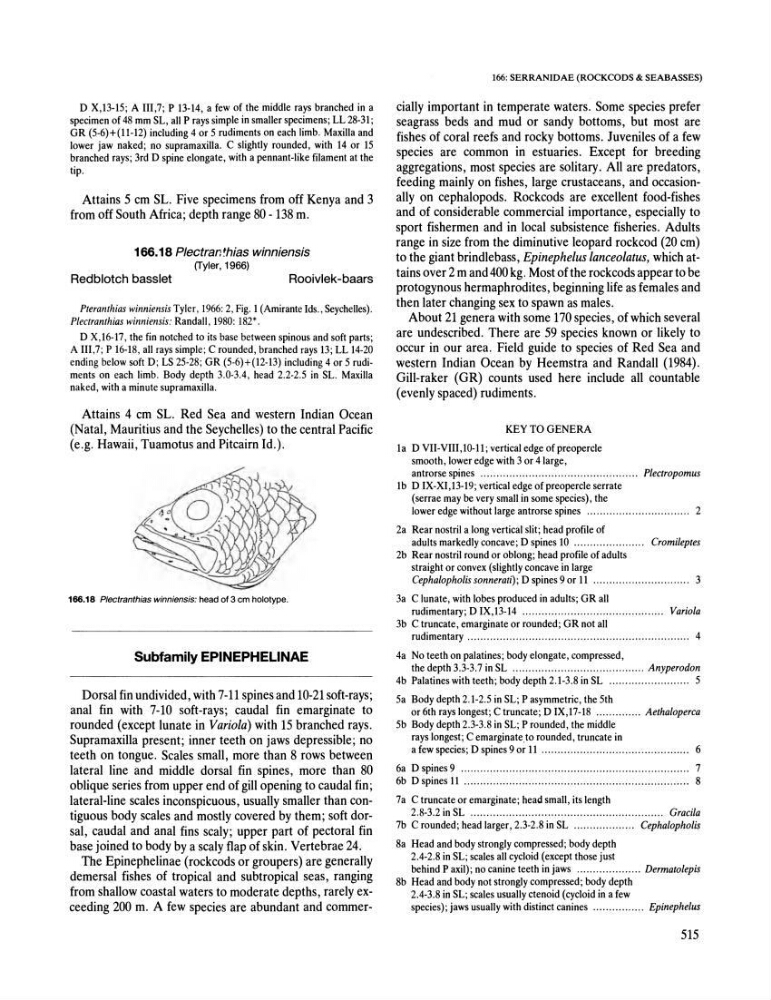
166.18 Plectran ~hias winniensis
(Tyler, 1966)
Redblotch bass let
Rooivlek -baars
Pteranthias winniensis Tyler, 1966: 2, Fig. 1 (Amirante Ids., Seychelles).
Plectranthias winniensis: Randall, 1980: 182*.
D X,16-17, the fin notched to its base between spinous and soft parts;
A III,?; P 16-18, all rays simple; C rounded, branched rays 13; LL 14-20
ending below soft D; LS 25-28; GR (5-6)+(12-13) including 4 or 5 rudiments on each limb. Body depth 3.0-3.4, head 2.2-2.5 in SL. Maxilla
naked, with a minute supramaxilla.
Attains 4 cm SL. Red Sea and western Indian Ocean
(Natal, Mauritius and the Seychelles) to the central Pacific
(e.g. Hawaii, Tuamotus and Pitcairn Id.).
166.18 PJectranthias winniensis: head of 3 em holotype.
Subfamily EPINEPHELINAE
Dorsal fin undivided, with 7-11 spines and 10-21 soft-rays;
anal fin with 7-10 soft-rays; caudal fin emarginate to
rounded (except lunate in Variola) with 15 branched rays.
Supramaxilla present; inner teeth on jaws depressible; no
teeth on tongue. Scales small, more than 8 rows between
lateral line and middle dorsal fin spines, more than 80
oblique series from upper end of gill opening to caudal fin;
lateral-line scales inconspicuous, usually smaller than contiguous body scales and mostly covered by them; soft dorsal, caudal and anal fins scaly; upper part of pectoral fin
base joined to body by a scaly flap of skin. Vertebrae 24.
The Epinephelinae (rockcods or groupers) are generally
demersal fishes of tropical and subtropical seas, ranging
from shallow coastal waters to moderate depths, rarely exceeding 200 m. A few species are abundant and commer166: SERRANIDAE (ROCKCODS & SEABASSES)
cially important in temperate waters. Some species prefer
seagrass beds and mud or sandy bottoms, but most are
fishes of coral reefs and rocky bottoms. Juveniles of a few
species are common in estuaries. Except for breeding
aggregations, most species are solitary. All are predators,
feeding mainly on fishes, large crustaceans, and occasionally on cephalopods. Rockcods are excellent food-fishes
and of considerable commercial importance, especially to
sport fishermen and in local subsistence fisheries. Adults
range in size from the diminutive leopard rockcod (20 cm)
to the giant brindlebass, Epinephelus lanceolatus, which attains over 2 m and 400 kg. Most of the rockcods appear to be
protogynous hermaphrodites, beginning life as females and
then later changing sex to spawn as males.
About 21 genera with some 170 species, of which several
are undescribed. There are 59 species known or likely to
occur in our area. Field guide to species of Red Sea and
western Indian Ocean by Heemstra and Randall (1984).
Gill-raker (GR) counts used here include all countable
(evenly spaced) rudiments.
KEY TO GENERA
la D VII-VIII, 10-11 ; vertical edge of preopercle
smooth, lower edge with 3 or 4 large,
antrorse spines ................................................. Plectropomus
1 b D IX-XI, 13-19; vertical edge of preopercle serrate
(serrae may be very small in some species), the
lower edge without large antrorse spines ................................ 2
2a Rear nostril a long vertical slit; head profile of
adults markedly concave; D spines 10 ...................... Cromileptes
2b Rear nostril round or oblong; head profile of adults
straight or convex (slightly concave in large
Cephalopholis sonnerati); D spines 9 or 11 .............................. 3
3a C lunate, with lobes produced in adults; GR all
rudimentary; D IX,13-14 ............................................ Variola
3b C truncate, emarginate or rounded; GR not all
rudimentary ..................................................................... 4
4a No teeth on palatines; body elongate, compressed,
the depth 3.3-3.7 in SL ......................................... Anyperodon
4b Palatines with teeth; body depth 2.1-3.8 in SL ......................... 5
5a Body depth 2.1-2.5 in SL; P asymmetric, the 5th
or 6th rays longest; C truncate; D IX,17-18 .............. Aethaloperca
5b Body depth 2.3-3.8 in SL; P rounded, the middle
rays longest; C emarginateto rounded, truncate in
a few species; D spines 9 or 11 .............................................. 6
6a D spines 9 ....................................................................... 7
6b D spines 11 ...................................................................... 8
7a C truncate or emarginate; head small, its length
2.8-3.2 in SL ............................................................ Gracila
7b C rounded; head larger, 2.3-2.8 in SL ................... Cephalopholis
8a Head and body strongly compressed; body depth
2.4-2.8 in SL; scales all cycloid (except those just
behind P axil); no canine teeth in jaws .................... Dermatolepis
8b Head and body not strongly compressed; body depth
2.4-3.8 in SL; scales usually ctenoid (cycloid in a few
species); jaws usually with distinct canines ................ Epinephelus
515
specimen of 48 mm SL, all P rays simple in smaller specimens; LL 28-31;
GR (5-6)+(11-12) including 4 or 5 rudiments on each limb. Maxilla and
lower jaw naked; no supramaxilla. C slightly rounded, with 14 or 15
branched rays; 3rd D spine elongate, with a pennant-like filament at the
tip.
Attains 5 cm SL. Five specimens from off Kenya and 3
from off South Africa; depth range 80 - 138 m.
166.18 Plectran ~hias winniensis
(Tyler, 1966)
Redblotch bass let
Rooivlek -baars
Pteranthias winniensis Tyler, 1966: 2, Fig. 1 (Amirante Ids., Seychelles).
Plectranthias winniensis: Randall, 1980: 182*.
D X,16-17, the fin notched to its base between spinous and soft parts;
A III,?; P 16-18, all rays simple; C rounded, branched rays 13; LL 14-20
ending below soft D; LS 25-28; GR (5-6)+(12-13) including 4 or 5 rudiments on each limb. Body depth 3.0-3.4, head 2.2-2.5 in SL. Maxilla
naked, with a minute supramaxilla.
Attains 4 cm SL. Red Sea and western Indian Ocean
(Natal, Mauritius and the Seychelles) to the central Pacific
(e.g. Hawaii, Tuamotus and Pitcairn Id.).
166.18 PJectranthias winniensis: head of 3 em holotype.
Subfamily EPINEPHELINAE
Dorsal fin undivided, with 7-11 spines and 10-21 soft-rays;
anal fin with 7-10 soft-rays; caudal fin emarginate to
rounded (except lunate in Variola) with 15 branched rays.
Supramaxilla present; inner teeth on jaws depressible; no
teeth on tongue. Scales small, more than 8 rows between
lateral line and middle dorsal fin spines, more than 80
oblique series from upper end of gill opening to caudal fin;
lateral-line scales inconspicuous, usually smaller than contiguous body scales and mostly covered by them; soft dorsal, caudal and anal fins scaly; upper part of pectoral fin
base joined to body by a scaly flap of skin. Vertebrae 24.
The Epinephelinae (rockcods or groupers) are generally
demersal fishes of tropical and subtropical seas, ranging
from shallow coastal waters to moderate depths, rarely exceeding 200 m. A few species are abundant and commer166: SERRANIDAE (ROCKCODS & SEABASSES)
cially important in temperate waters. Some species prefer
seagrass beds and mud or sandy bottoms, but most are
fishes of coral reefs and rocky bottoms. Juveniles of a few
species are common in estuaries. Except for breeding
aggregations, most species are solitary. All are predators,
feeding mainly on fishes, large crustaceans, and occasionally on cephalopods. Rockcods are excellent food-fishes
and of considerable commercial importance, especially to
sport fishermen and in local subsistence fisheries. Adults
range in size from the diminutive leopard rockcod (20 cm)
to the giant brindlebass, Epinephelus lanceolatus, which attains over 2 m and 400 kg. Most of the rockcods appear to be
protogynous hermaphrodites, beginning life as females and
then later changing sex to spawn as males.
About 21 genera with some 170 species, of which several
are undescribed. There are 59 species known or likely to
occur in our area. Field guide to species of Red Sea and
western Indian Ocean by Heemstra and Randall (1984).
Gill-raker (GR) counts used here include all countable
(evenly spaced) rudiments.
KEY TO GENERA
la D VII-VIII, 10-11 ; vertical edge of preopercle
smooth, lower edge with 3 or 4 large,
antrorse spines ................................................. Plectropomus
1 b D IX-XI, 13-19; vertical edge of preopercle serrate
(serrae may be very small in some species), the
lower edge without large antrorse spines ................................ 2
2a Rear nostril a long vertical slit; head profile of
adults markedly concave; D spines 10 ...................... Cromileptes
2b Rear nostril round or oblong; head profile of adults
straight or convex (slightly concave in large
Cephalopholis sonnerati); D spines 9 or 11 .............................. 3
3a C lunate, with lobes produced in adults; GR all
rudimentary; D IX,13-14 ............................................ Variola
3b C truncate, emarginate or rounded; GR not all
rudimentary ..................................................................... 4
4a No teeth on palatines; body elongate, compressed,
the depth 3.3-3.7 in SL ......................................... Anyperodon
4b Palatines with teeth; body depth 2.1-3.8 in SL ......................... 5
5a Body depth 2.1-2.5 in SL; P asymmetric, the 5th
or 6th rays longest; C truncate; D IX,17-18 .............. Aethaloperca
5b Body depth 2.3-3.8 in SL; P rounded, the middle
rays longest; C emarginateto rounded, truncate in
a few species; D spines 9 or 11 .............................................. 6
6a D spines 9 ....................................................................... 7
6b D spines 11 ...................................................................... 8
7a C truncate or emarginate; head small, its length
2.8-3.2 in SL ............................................................ Gracila
7b C rounded; head larger, 2.3-2.8 in SL ................... Cephalopholis
8a Head and body strongly compressed; body depth
2.4-2.8 in SL; scales all cycloid (except those just
behind P axil); no canine teeth in jaws .................... Dermatolepis
8b Head and body not strongly compressed; body depth
2.4-3.8 in SL; scales usually ctenoid (cycloid in a few
species); jaws usually with distinct canines ................ Epinephelus
515