

PERCIFORMES
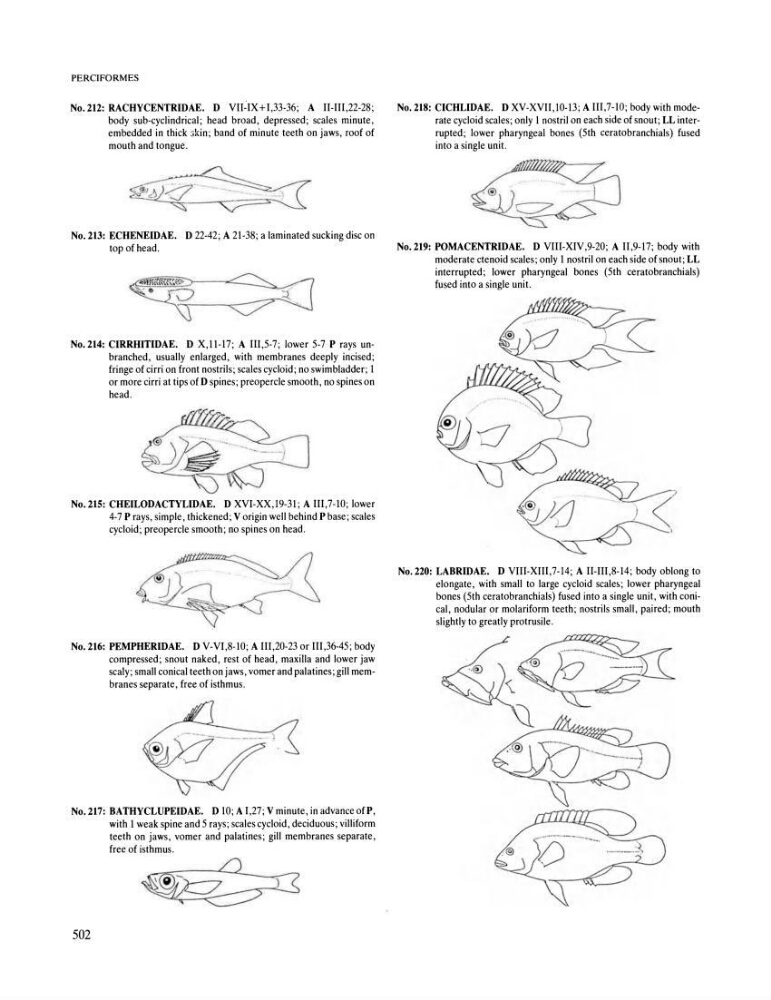
No. 212: RACHYCENTRIDAE. D VII-IX+I,33-36; A II-III,22-2S;
body sub-cyclindrical; head broad, depressed; scales minute,
embedded in thick 3kin; band of minute teeth on jaws, roof of
mouth and tongue.
No. 213: ECHENEIDAE. D 22-42; A 21-3S; a laminated sucking disc on
top of head.
No. 214: CIRRHITIDAE. D X,1l-17; A III,5-7; lower 5-7 P rays unbranched, usually enlarged, with membranes deeply incised;
fringe of cirri on front nostrils; scales cycloid; no swimbladder; 1
or more cirri at tips of D spines; preopercle smooth, no spines on
head.
No.2IS: CHEILODACTYLIDAE. D XVI-XX,19-31; A III,7-1O; lower
4-7 P rays, simple, thickened; V origin well behind Pbase; scales
cycloid; preopercle smooth; no spines on head.
No. 216: PEMPHERIDAE. D V-VI,S-lO; A III,20-23 or III,36-45; body
compressed; snout naked, rest of head, maxilla and lower jaw
scaly; small conical teeth onjaws, vomer and palatines; gill membranes separate, free of isthmus.
No. 217: BATHYCLUPEIDAE. D 10; A I,27; V minute, in advanceofP,
with 1 weak spine and 5 rays; scales cycloid, deciduous; villiform
teeth on jaws, vomer and palatines; gill membranes separate,
free of isthmus.
502
No. 218: CICHLIDAE. D XV-XVII,lO-13; A III,7-1O; body with moderate cycloid scales; only 1 nostril on each side of snout; LL interrupted; lower pharyngeal bones (5th ceratobranchials) fused
into a single unit.
No. 219: POMACENTRIDAE. D VIII-XIV,9-20; A 11,9-17; body with
moderate ctenoid scales; only 1 nostril on each side of snout; LL
interrupted; lower pharyngeal bones (5th ceratobranchials)
fused into a single unit.
No. 220: LABRIDAE. D VIII-XIII,7-14; A II-III,S-14; body oblong to
elongate, with small to large cycloid scale!;; lower pharyngeal
bones (5th ceratobranchials) fused into a single unit, with conical, nodular or molariform teeth; nostrils small, paired; mouth
slightly to greatly protrusile.
No. 212: RACHYCENTRIDAE. D VII-IX+I,33-36; A II-III,22-2S;
body sub-cyclindrical; head broad, depressed; scales minute,
embedded in thick 3kin; band of minute teeth on jaws, roof of
mouth and tongue.
No. 213: ECHENEIDAE. D 22-42; A 21-3S; a laminated sucking disc on
top of head.
No. 214: CIRRHITIDAE. D X,1l-17; A III,5-7; lower 5-7 P rays unbranched, usually enlarged, with membranes deeply incised;
fringe of cirri on front nostrils; scales cycloid; no swimbladder; 1
or more cirri at tips of D spines; preopercle smooth, no spines on
head.
No.2IS: CHEILODACTYLIDAE. D XVI-XX,19-31; A III,7-1O; lower
4-7 P rays, simple, thickened; V origin well behind Pbase; scales
cycloid; preopercle smooth; no spines on head.
No. 216: PEMPHERIDAE. D V-VI,S-lO; A III,20-23 or III,36-45; body
compressed; snout naked, rest of head, maxilla and lower jaw
scaly; small conical teeth onjaws, vomer and palatines; gill membranes separate, free of isthmus.
No. 217: BATHYCLUPEIDAE. D 10; A I,27; V minute, in advanceofP,
with 1 weak spine and 5 rays; scales cycloid, deciduous; villiform
teeth on jaws, vomer and palatines; gill membranes separate,
free of isthmus.
502
No. 218: CICHLIDAE. D XV-XVII,lO-13; A III,7-1O; body with moderate cycloid scales; only 1 nostril on each side of snout; LL interrupted; lower pharyngeal bones (5th ceratobranchials) fused
into a single unit.
No. 219: POMACENTRIDAE. D VIII-XIV,9-20; A 11,9-17; body with
moderate ctenoid scales; only 1 nostril on each side of snout; LL
interrupted; lower pharyngeal bones (5th ceratobranchials)
fused into a single unit.
No. 220: LABRIDAE. D VIII-XIII,7-14; A II-III,S-14; body oblong to
elongate, with small to large cycloid scale!;; lower pharyngeal
bones (5th ceratobranchials) fused into a single unit, with conical, nodular or molariform teeth; nostrils small, paired; mouth
slightly to greatly protrusile.