

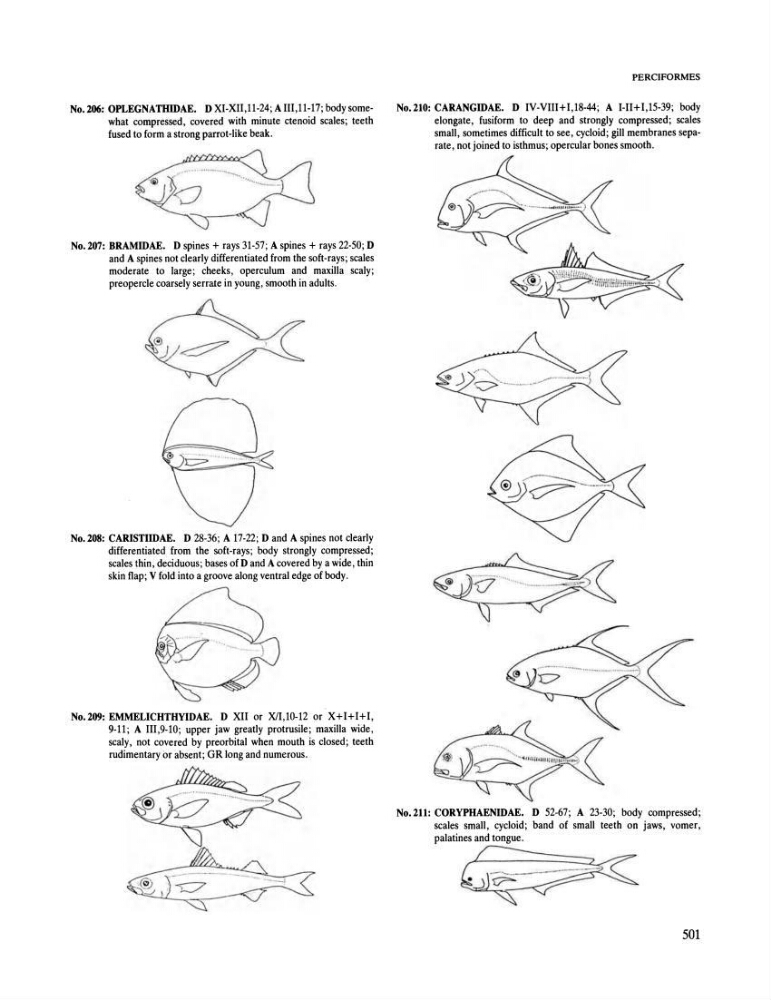
No. 206: OPLEGNATHIDAE. 0 XI-XII ,11-24; A I1I,11-17; body somewhat compressed, covered with minute ctenoid scales; teeth
fused to form a strong parrot-like beak.
No. 207: BRAMIDAE. 0 spines + rays 31-57; A spines + rays 22-50; 0
and A spines not clearly differentiated from the soft-rays; scales
moderate to large; cheeks, operculum and maxilla scaly;
preopercle coarsely serrate in young, smooth in adults.
No.208: CARISTIIDAE. 0 28-36; A 17-22; 0 and A spines not clearly
differentiated from the soft-rays; body strongly compressed;
scales thin, deciduous; bases of 0 and A covered by a wide, thin
skin flap; V fold into a groove along ventral edge of body.
No. 209: EMMELICHTHYIDAE. 0 XII or XlI,10-12 or X+I+I+I,
9-11; A I1I,9-10; upper jaw greatly protrusile; maxilla wide,
scaly, not covered by preorbital when mouth is closed; teeth
rudimentary or absent; GR long and numerous.
PERCIFORMES
No. 210: CARANGIDAE. 0 IV-VIII + 1,18-44; A 1-11+1,15-39; body
elongate, fusiform to deep and strongly compressed; scales
small, sometimes difficult to see, cycloid; gill membranes separate, not joined to isthmus; opercular bones smooth.
No. 211: CORYPHAENIDAE. 0 52-67; A 23-30; body compressed;
scales small, cycloid; band of small teeth on jaws, vomer,
palatines and tongue.
~
501
fused to form a strong parrot-like beak.
No. 207: BRAMIDAE. 0 spines + rays 31-57; A spines + rays 22-50; 0
and A spines not clearly differentiated from the soft-rays; scales
moderate to large; cheeks, operculum and maxilla scaly;
preopercle coarsely serrate in young, smooth in adults.
No.208: CARISTIIDAE. 0 28-36; A 17-22; 0 and A spines not clearly
differentiated from the soft-rays; body strongly compressed;
scales thin, deciduous; bases of 0 and A covered by a wide, thin
skin flap; V fold into a groove along ventral edge of body.
No. 209: EMMELICHTHYIDAE. 0 XII or XlI,10-12 or X+I+I+I,
9-11; A I1I,9-10; upper jaw greatly protrusile; maxilla wide,
scaly, not covered by preorbital when mouth is closed; teeth
rudimentary or absent; GR long and numerous.
PERCIFORMES
No. 210: CARANGIDAE. 0 IV-VIII + 1,18-44; A 1-11+1,15-39; body
elongate, fusiform to deep and strongly compressed; scales
small, sometimes difficult to see, cycloid; gill membranes separate, not joined to isthmus; opercular bones smooth.
No. 211: CORYPHAENIDAE. 0 52-67; A 23-30; body compressed;
scales small, cycloid; band of small teeth on jaws, vomer,
palatines and tongue.
~
501