

Order SCORPAENIFORMES
Body shape varies. All species have a bony ridge (suborbital stay) across the cheek that is usually firmly attached to
the preopercle. Head usually spiny, sometimes armored
with bony plates. Many are almost fully scaled, some unscaled; others have scales modified into bony plates. Most
have a rounded pectoral fin and a square-cut or rounded
caudal fin (rarely forked) .
Usually under 30 cm, some reach 90 cm or more. They
occur nearly worldwide in a variety of habitats. Most live on
the bottom inshore or in moderate depths offshore, a few in
the deep sea; many are well adapted for concealment. Some
have venomous fin spines capable of inflicting painful
wounds. The flesh is edible and often delicious. A few are of
commercial importance, but many are rare. About 20
families, but classifications differ with regard to family
limits. About 1 000 species.
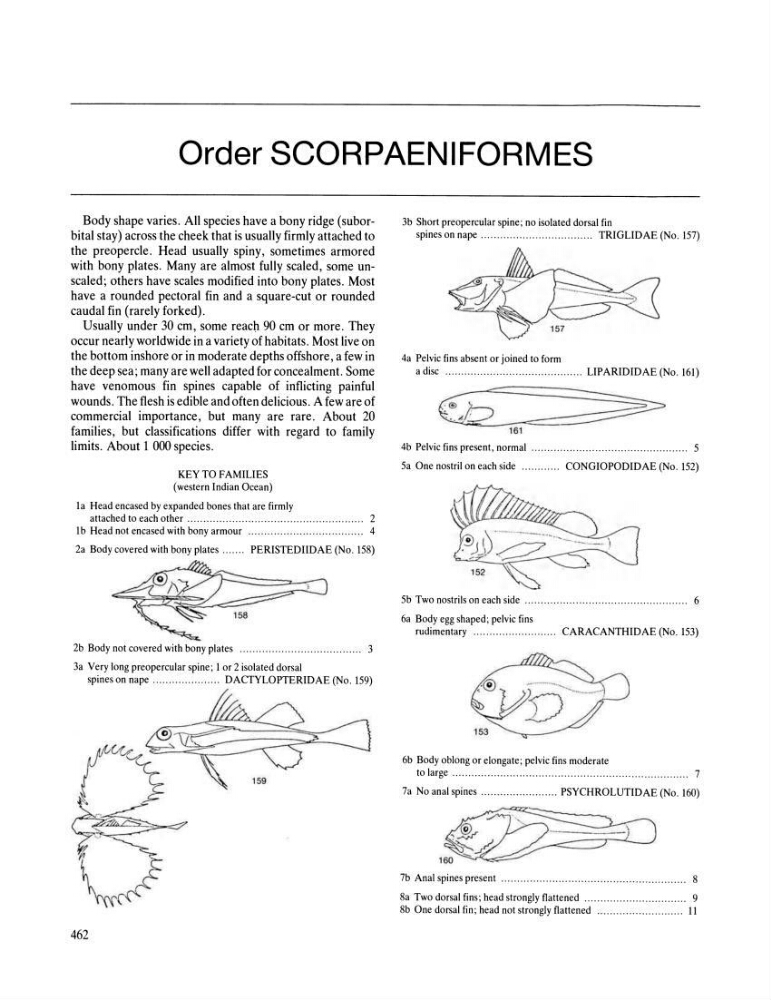
KEY TO FAMILIES
(western Indian Ocean)
la Head encased by expanded bones that are firmly
attached to each other ................... ... ... .... ... ... .. .. ... ... .......... 2
Ib Head not encased with bony armour ................. .. ... ......... .. ... 4
2a Body covered with bony plates ....... PERISTEDIIDAE (No. IS8)
2b Body not covered with bony plates ...................................... 3
3a Very long preopercular spine; 1 or 2 isolated dorsal
spines on nape ..................... DACfYLOPTERIDAE (No. IS9)
()
462
3b Short preopercular spine; no isolated dorsal fin
spines on nape ........ ...................... ..... TRIGLIDAE (No. IS7)
4a Pelvic fins absent or joined to form
a disc .................. ..... .... .... ...... .. ... . LIPARIDIDAE (No. 161)
~ 161
4b Pelvic fins present, normal.... ............... .............................. S
Sa One nostril on each side .... ... ..... CONGIOPODIDAE (No. IS2)
Sb Two nostrils on each side .......... ........... ... .... .. .... .. ... ..... ....... 6
6a Body egg shaped; pelvic fins
rudimentary .... ...................... CARACANTHIDAE (No. IS3)
6b Body oblong or elongate ; pelvic fins moderate
M~ ................ . ....... . .. ..... .. .. ..... .. .... .... ...... .. .... . .... .... .. 7
7a No anal spines ..... ...... ... .......... PSYCHROLUTIDAE (No . 160)
7b Anal spines present ...... ..... ............. ....... .. .. ...... .... ... ... ... .. .. 8
8a Two dorsal fins; head strongly flattened ........ ..... ..... ... .. ........ . 9
8b One dorsal fin ; head not strongly flattened ... .. .. ... ... ........ .. ... . 11
Body shape varies. All species have a bony ridge (suborbital stay) across the cheek that is usually firmly attached to
the preopercle. Head usually spiny, sometimes armored
with bony plates. Many are almost fully scaled, some unscaled; others have scales modified into bony plates. Most
have a rounded pectoral fin and a square-cut or rounded
caudal fin (rarely forked) .
Usually under 30 cm, some reach 90 cm or more. They
occur nearly worldwide in a variety of habitats. Most live on
the bottom inshore or in moderate depths offshore, a few in
the deep sea; many are well adapted for concealment. Some
have venomous fin spines capable of inflicting painful
wounds. The flesh is edible and often delicious. A few are of
commercial importance, but many are rare. About 20
families, but classifications differ with regard to family
limits. About 1 000 species.
KEY TO FAMILIES
(western Indian Ocean)
la Head encased by expanded bones that are firmly
attached to each other ................... ... ... .... ... ... .. .. ... ... .......... 2
Ib Head not encased with bony armour ................. .. ... ......... .. ... 4
2a Body covered with bony plates ....... PERISTEDIIDAE (No. IS8)
2b Body not covered with bony plates ...................................... 3
3a Very long preopercular spine; 1 or 2 isolated dorsal
spines on nape ..................... DACfYLOPTERIDAE (No. IS9)
()
462
3b Short preopercular spine; no isolated dorsal fin
spines on nape ........ ...................... ..... TRIGLIDAE (No. IS7)
4a Pelvic fins absent or joined to form
a disc .................. ..... .... .... ...... .. ... . LIPARIDIDAE (No. 161)
~ 161
4b Pelvic fins present, normal.... ............... .............................. S
Sa One nostril on each side .... ... ..... CONGIOPODIDAE (No. IS2)
Sb Two nostrils on each side .......... ........... ... .... .. .... .. ... ..... ....... 6
6a Body egg shaped; pelvic fins
rudimentary .... ...................... CARACANTHIDAE (No. IS3)
6b Body oblong or elongate ; pelvic fins moderate
M~ ................ . ....... . .. ..... .. .. ..... .. .... .... ...... .. .... . .... .... .. 7
7a No anal spines ..... ...... ... .......... PSYCHROLUTIDAE (No . 160)
7b Anal spines present ...... ..... ............. ....... .. .. ...... .... ... ... ... .. .. 8
8a Two dorsal fins; head strongly flattened ........ ..... ..... ... .. ........ . 9
8b One dorsal fin ; head not strongly flattened ... .. .. ... ... ........ .. ... . 11