

Attains 33 cm. Northwest of Cape Town to Saldanha Bay
in 200 - 500 m.
147.4 Notopogon macrosolen: 19.5 em SL? type (off Table Bay).
147.5 Notopogon xenosoma
Regan, 1914
Longspine bellowsfish
Langstekel-blaasbalkvis
Notopogon xenosoma Regan, 1914: 18 (Cape North, New Zealand);
1914: 15*. Notopogon natalensis Gilchrist, 1922: 57, PI. 12, Fig. 2 (off
Durban; types: RUSI 8349 & 8350). Notopogon fernandezianus (non
Delfin): Mohr, 1937: 47* (in part; not Fig. 22); Smith, SFSA No. 367.
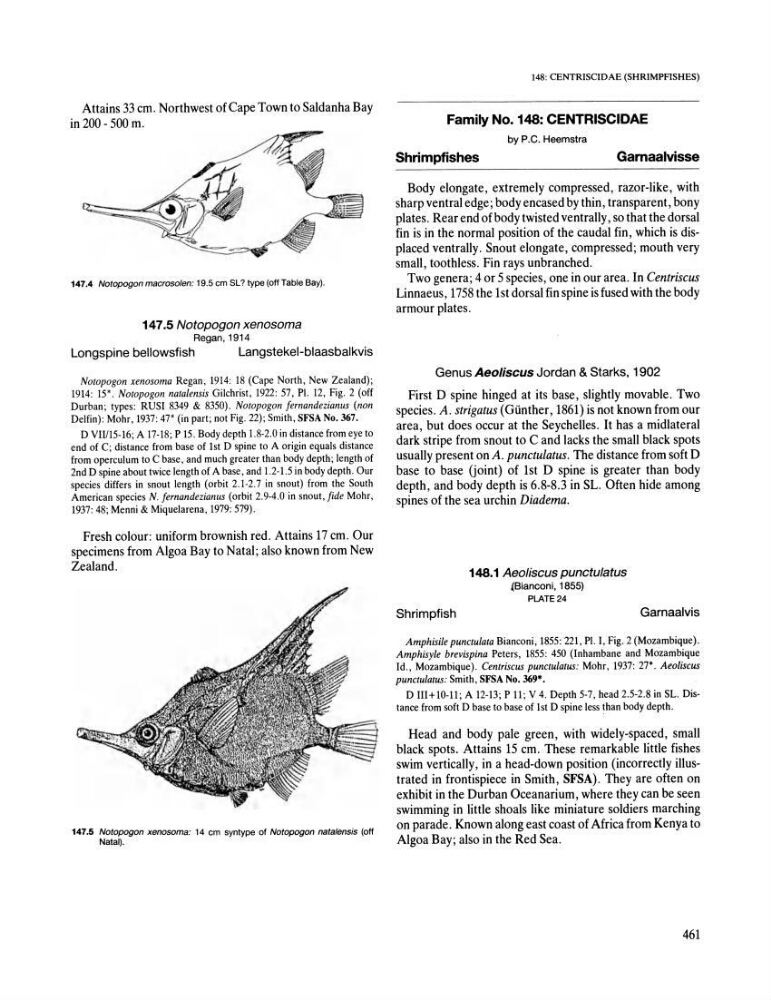
D VII/I5-16; A 17-18; P 15. Body depth 1.8-2.0 in distance from eye to
end of C; distance from base of 1st D spine to A origin equals distance
from operculum to C base, and much greater than body depth; length of
2nd D spine about twice length of A base, and 1.2-1.5 in body depth. Our
species differs in snout length (orbit 2.1-2.7 in snout) from the South
American species N. fernandezianus (orbit 2.9-4.0 in snout,fide Mohr,
1937: 48; Menni & Miquelarena, 1979: 579).
Fresh colour: uniform brownish red. Attains 17 cm. Our
specimens from Algoa Bay to Natal; also known from New
Zealand.
147.5 Notopogon xenosoma: 14 em syntype of Notopogon natalensis (off
Natal).
148: CENTRISCIDAE (SHRIMPFISHES)
Family No. 148: CENTRISCIDAE
by P.C. Heemstra
Shrimpfishes
Gamaalvisse
Body elongate, extremely compressed, razor-like, with
sharp ventral edge; body encased by thin, transparent, bony
plates. Rear end of body twisted ventrally, so that the dorsal
fin is in the normal position of the caudal fin, which is displaced ventrally. Snout elongate, compressed; mouth very
small, toothless. Fin rays unbranched.
Two genera; 4 or 5 species, one in our area. In Centriscus
Linnaeus, 1758 the 1st dorsal fin spine is fused with the body
armour plates.
Genus Aeoliscus Jordan & Starks, 1902
First D spine hinged at its base, slightly movable. Two
species. A. strigatus (Gunther, 1861) is not known from our
area, but does occur at the Seychelles. It has a midlateral
dark stripe from snout to C and lacks the small black spots
usually present on A. punctulatus. The distance from soft D
base to base (joint) of 1st D spine is greater than body
depth, and body depth is 6.8-8.3 in SL. Often hide among
spines of the sea urchin Diadema.
Shrimpfish
148.1 Aeoliscus punctulatus
{Bianconi, 1855)
PLATE 24
Garnaalvis
Amphisile punctulata Bianconi, 1855: 221, PI. I, Fig. 2 (Mozambique).
Amphisyle brevispina Peters, 1855: 450 (Inhambane and Mozambique
Id., Mozambique). Centriscus punctulatus: Mohr, 1937: 27*. Aeoliscus
punctulatus: Smith, SFSA No. 369*.
D III + 10-11; A 12-13; P 11; V 4. Depth 5-7, head 2.5-2.8 in SL. Distance from soft D base to base of 1st D spine less than body depth.
Head and body pale green, with widely-spaced, small
black spots. Attains 15 cm. These remarkable little fishes
swim vertically, in a head-down position (incorrectly illustrated in frontispiece in Smith, SFSA). They are often on
exhibit in the Durban Oceanarium, where they can be seen
swimming in little shoals like miniature soldiers marching
on parade. Known along east coast of Africa from Kenya to
Algoa Bay; also in the Red Sea.
461
in 200 - 500 m.
147.4 Notopogon macrosolen: 19.5 em SL? type (off Table Bay).
147.5 Notopogon xenosoma
Regan, 1914
Longspine bellowsfish
Langstekel-blaasbalkvis
Notopogon xenosoma Regan, 1914: 18 (Cape North, New Zealand);
1914: 15*. Notopogon natalensis Gilchrist, 1922: 57, PI. 12, Fig. 2 (off
Durban; types: RUSI 8349 & 8350). Notopogon fernandezianus (non
Delfin): Mohr, 1937: 47* (in part; not Fig. 22); Smith, SFSA No. 367.
D VII/I5-16; A 17-18; P 15. Body depth 1.8-2.0 in distance from eye to
end of C; distance from base of 1st D spine to A origin equals distance
from operculum to C base, and much greater than body depth; length of
2nd D spine about twice length of A base, and 1.2-1.5 in body depth. Our
species differs in snout length (orbit 2.1-2.7 in snout) from the South
American species N. fernandezianus (orbit 2.9-4.0 in snout,fide Mohr,
1937: 48; Menni & Miquelarena, 1979: 579).
Fresh colour: uniform brownish red. Attains 17 cm. Our
specimens from Algoa Bay to Natal; also known from New
Zealand.
147.5 Notopogon xenosoma: 14 em syntype of Notopogon natalensis (off
Natal).
148: CENTRISCIDAE (SHRIMPFISHES)
Family No. 148: CENTRISCIDAE
by P.C. Heemstra
Shrimpfishes
Gamaalvisse
Body elongate, extremely compressed, razor-like, with
sharp ventral edge; body encased by thin, transparent, bony
plates. Rear end of body twisted ventrally, so that the dorsal
fin is in the normal position of the caudal fin, which is displaced ventrally. Snout elongate, compressed; mouth very
small, toothless. Fin rays unbranched.
Two genera; 4 or 5 species, one in our area. In Centriscus
Linnaeus, 1758 the 1st dorsal fin spine is fused with the body
armour plates.
Genus Aeoliscus Jordan & Starks, 1902
First D spine hinged at its base, slightly movable. Two
species. A. strigatus (Gunther, 1861) is not known from our
area, but does occur at the Seychelles. It has a midlateral
dark stripe from snout to C and lacks the small black spots
usually present on A. punctulatus. The distance from soft D
base to base (joint) of 1st D spine is greater than body
depth, and body depth is 6.8-8.3 in SL. Often hide among
spines of the sea urchin Diadema.
Shrimpfish
148.1 Aeoliscus punctulatus
{Bianconi, 1855)
PLATE 24
Garnaalvis
Amphisile punctulata Bianconi, 1855: 221, PI. I, Fig. 2 (Mozambique).
Amphisyle brevispina Peters, 1855: 450 (Inhambane and Mozambique
Id., Mozambique). Centriscus punctulatus: Mohr, 1937: 27*. Aeoliscus
punctulatus: Smith, SFSA No. 369*.
D III + 10-11; A 12-13; P 11; V 4. Depth 5-7, head 2.5-2.8 in SL. Distance from soft D base to base of 1st D spine less than body depth.
Head and body pale green, with widely-spaced, small
black spots. Attains 15 cm. These remarkable little fishes
swim vertically, in a head-down position (incorrectly illustrated in frontispiece in Smith, SFSA). They are often on
exhibit in the Durban Oceanarium, where they can be seen
swimming in little shoals like miniature soldiers marching
on parade. Known along east coast of Africa from Kenya to
Algoa Bay; also in the Red Sea.
461