

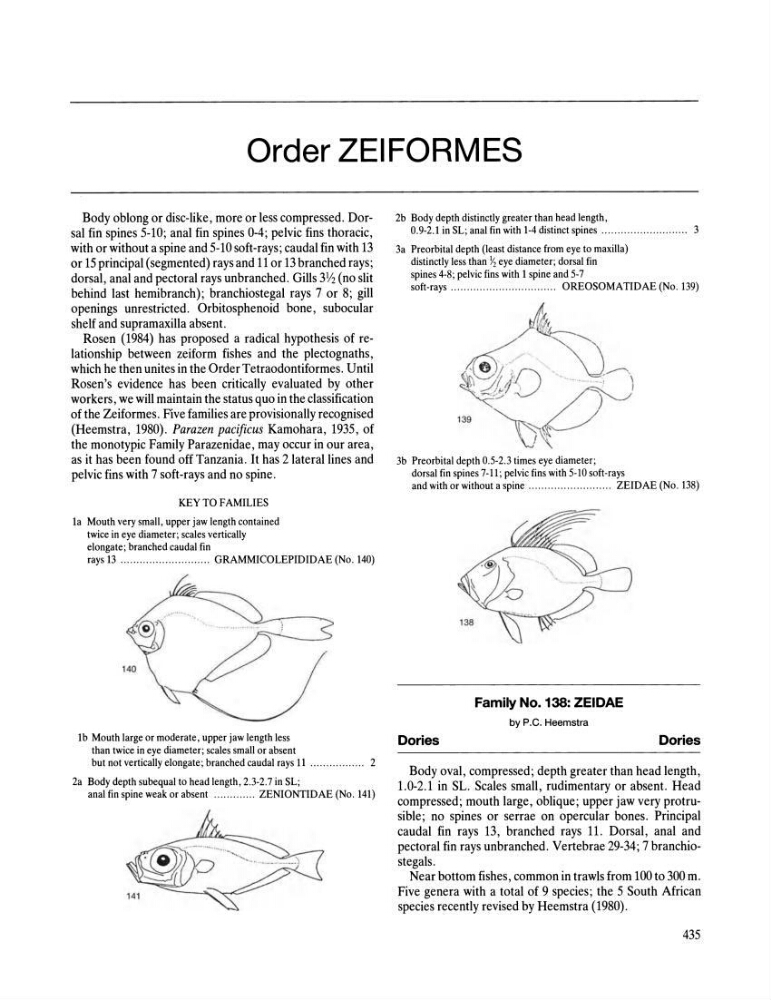
Order ZEIFORMES
Body oblong or disc-like, more or less compressed. Dorsal fin spines 5-10; anal fin spines 0-4; pelvic fins thoracic,
with or without a spine and 5-10 soft-rays; caudal fin with 13
or 15 principal (segmented) rays and 11 or 13 branched rays;
dorsal, anal and pectoral rays unbranched. Gills 3V2 (no slit
behind last hemibranch); branchiostegal rays 7 or 8; gill
openings unrestricted. Orbitosphenoid bone, subocular
shelf and supramaxilla absent.
Rosen (1984) has proposed a radical hypothesis of relationship between zeiform fishes and the plectognaths,
which he then unites in the Order Tetraodontiformes. Until
Rosen's evidence has been critically evaluated by other
workers, we will maintain the status quo in the classification
of the Zeiformes. Five families are provisionally recognised
(Heemstra, 1980). Parazen pacificus Kamohara, 1935, of
the monotypic Family Parazenidae, may occur in our area,
as it has been found off Tanzania. It has 2 lateral lines and
pelvic fins with 7 soft-rays and no spine.
KEY TO FAMILIES
la Mouth very small, upper jaw length contained
twice in eye diameter; scales vertically
elongate ; branched caudal fin
rays 13 .................. .. ........ GRAMMICOLEPIDIDAE (No. 140)
Ib Mouth large or moderate, upper jaw length less
than twice in eye diameter; scales small or absent
but not vertically elongate; branched caudal rays 11 ................. 2
2a Body depth subequal to head length, 2.3-2.7 in SL;
anal fin spine weak or absent ............. ZENIONTIDAE (No. 141)
2b Body depth distinctly greater than head length,
0.9-2.1 in SL; anal fin with 1-4 distinct spines .. .................... ..... 3
3a Preorbital depth (least distance from eye to maxilla)
distinctly less than Yz eye diameter; dorsal fin
spines 4-8; pelvic fins with 1 spine and 5-7
soft-rays .. .................... .... ...... . OREOSOMATIDAE (No. 139)
3b Preorbital depth 0.5-2.3 times eye diameter;
dorsal fin spines 7-11; pelvic fins with 5-10 soft-rays
and with or without a spine .......................... ZEIDAE (No. 138)
Family No. 138: ZEIDAE
by P.C. Heemstra
Dories
Dories
Body oval, compressed; depth greater than head length,
1.0-2.1 in SL. Scales small, rudimentary or absent. Head
compressed; mouth large, oblique; upper jaw very protrusible; no spines or serrae on opercular bones. Principal
caudal fin rays 13, branched rays 11. Dorsal, anal and
pectoral fin rays unbranched. Vertebrae 29-34; 7 branchiostegals.
Near bottom fishes, common in trawls from 100 to 300 m.
Five genera with a total of 9 species; the 5 South African
species recently revised by Heemstra (1980).
435
Body oblong or disc-like, more or less compressed. Dorsal fin spines 5-10; anal fin spines 0-4; pelvic fins thoracic,
with or without a spine and 5-10 soft-rays; caudal fin with 13
or 15 principal (segmented) rays and 11 or 13 branched rays;
dorsal, anal and pectoral rays unbranched. Gills 3V2 (no slit
behind last hemibranch); branchiostegal rays 7 or 8; gill
openings unrestricted. Orbitosphenoid bone, subocular
shelf and supramaxilla absent.
Rosen (1984) has proposed a radical hypothesis of relationship between zeiform fishes and the plectognaths,
which he then unites in the Order Tetraodontiformes. Until
Rosen's evidence has been critically evaluated by other
workers, we will maintain the status quo in the classification
of the Zeiformes. Five families are provisionally recognised
(Heemstra, 1980). Parazen pacificus Kamohara, 1935, of
the monotypic Family Parazenidae, may occur in our area,
as it has been found off Tanzania. It has 2 lateral lines and
pelvic fins with 7 soft-rays and no spine.
KEY TO FAMILIES
la Mouth very small, upper jaw length contained
twice in eye diameter; scales vertically
elongate ; branched caudal fin
rays 13 .................. .. ........ GRAMMICOLEPIDIDAE (No. 140)
Ib Mouth large or moderate, upper jaw length less
than twice in eye diameter; scales small or absent
but not vertically elongate; branched caudal rays 11 ................. 2
2a Body depth subequal to head length, 2.3-2.7 in SL;
anal fin spine weak or absent ............. ZENIONTIDAE (No. 141)
2b Body depth distinctly greater than head length,
0.9-2.1 in SL; anal fin with 1-4 distinct spines .. .................... ..... 3
3a Preorbital depth (least distance from eye to maxilla)
distinctly less than Yz eye diameter; dorsal fin
spines 4-8; pelvic fins with 1 spine and 5-7
soft-rays .. .................... .... ...... . OREOSOMATIDAE (No. 139)
3b Preorbital depth 0.5-2.3 times eye diameter;
dorsal fin spines 7-11; pelvic fins with 5-10 soft-rays
and with or without a spine .......................... ZEIDAE (No. 138)
Family No. 138: ZEIDAE
by P.C. Heemstra
Dories
Dories
Body oval, compressed; depth greater than head length,
1.0-2.1 in SL. Scales small, rudimentary or absent. Head
compressed; mouth large, oblique; upper jaw very protrusible; no spines or serrae on opercular bones. Principal
caudal fin rays 13, branched rays 11. Dorsal, anal and
pectoral fin rays unbranched. Vertebrae 29-34; 7 branchiostegals.
Near bottom fishes, common in trawls from 100 to 300 m.
Five genera with a total of 9 species; the 5 South African
species recently revised by Heemstra (1980).
435