

123: STYLEPHORIDAE (TUBE-EYE)
Family No. 123: STYLEPHORIDAE
by PA Hulley
Tube-eye
Pypoog
Body elongate, moderately compressed. Head with large
telescopic eyes, directed forward or upward; interorbital
extremely narrow; nasal rosettes small, immediately
anterior to eyes. Jaws strongly protrusible, with lower jaw
extending in front of upper jaw; mouth small with minute
teeth. Opercle small and thin; preopercular ridge oblique,
terminating in a posteriorly-directed ventral spine. Dorsal
fin extending from nape almost to caudal, the 1st 2 rays
longer than the rest; anal fin short; pectoral fins lateral;
ventral fins with only 1 ray, below base of pectoral; caudal
fin in 2 parts: upper with 5 rays; lower with 2 extremely
elongate rays. Lateral line simple, segmented tube, arching
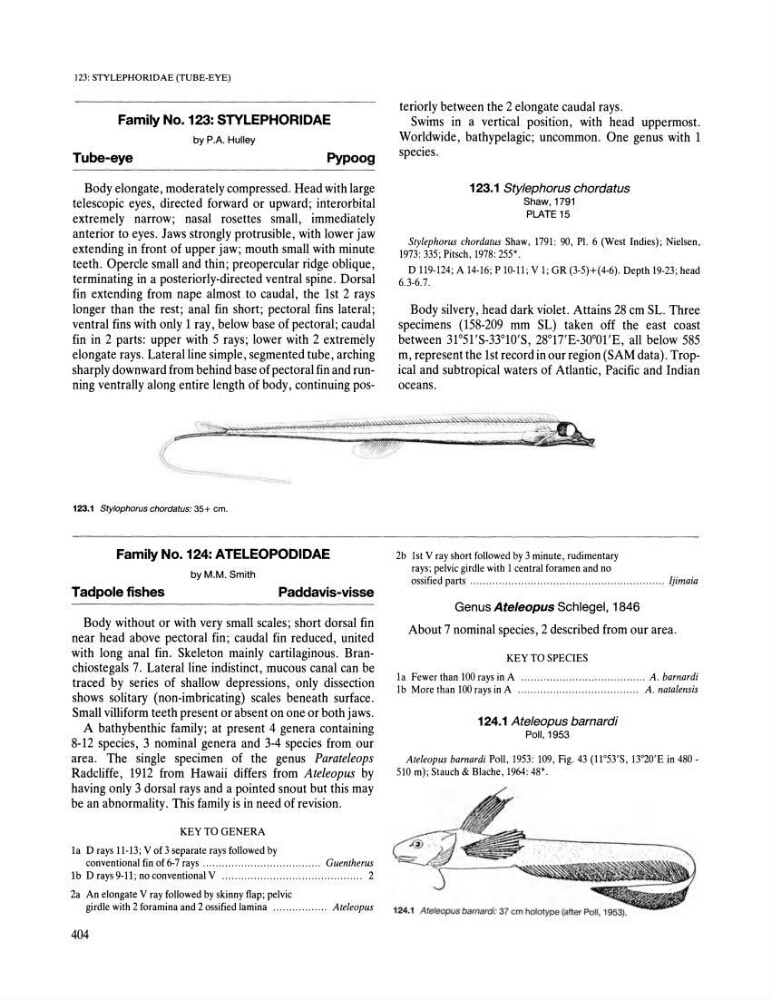
sharply downward from behind base of pectoral fin and running ventrally along entire length of body, continuing pos123.1 Stylophorus chordatus: 35 + cm.
Family No. 124: ATELEOPODIDAE
by M.M. Smith
Tadpole fishes
Paddavis-visse
Body without or with very small scales; short dorsal fin
near head above pectoral fin; caudal fin reduced, united
with long anal fin. Skeleton mainly cartilaginous. Branchiostegals 7. Lateral line indistinct, mucous canal can be
traced by series of shallow depressions, only dissection
shows solitary (non-imbricating) scales beneath surface.
Small villiform teeth present or absent on one or both jaws.
A bathybenthic family; at present 4 genera containing
8-12 species, 3 nominal genera and 3-4 species from our
area. The single specimen of the genus Parateleops
Radcliffe, 1912 from Hawaii differs from Ateleopus by
having only 3 dorsal rays and a pointed snout but this may
be an abnormality. This family is in need of revision.
KEY TO GENERA
1a Drays 11-13; Vof3 separate rays followed by
conventional fin of 6-7 rays.............................. ....... Guentherus
1b Drays 9-11; no conventional V ............................................ 2
2a An elongate V ray followed by skinny flap; pelvic
teriorly between the 2 elongate caudal rays.
Swims in a vertical position, with head uppermost.
Worldwide, bathypelagic; uncommon. One genus with 1
species.
123.1 Stylephorus chordatus
Shaw, 1791
PLATE 15
Stylephorus chordatus Shaw, 1791: 90, PI. 6 (West Indies); Nielsen,
1973: 335; Pitsch, 1978: 255*.
D 119-124; A 14-16; P 10-11; V 1; GR (3-5)+(4-6). Depth 19-23; head
6.3-6.7.
Body silvery, head dark violet. Attains 28 cm SL. Three
specimens (158-209 mm SL) taken off the east coast
between 31°51'S-33°lO'S, 28°17'E-30oOl'E, all below 585
m, represent the 1st record in our region (SAM data). Tropical and subtropical waters of Atlantic, Pacific and Indian
oceans.
2b 1st V ray short followed by 3 minute, rudimentary
rays; pelvic girdle with 1 central foramen and no
ossified parts ............................................................. Ijimaia
Genus Ate/eopus Schlegel, 1846
About 7 nominal species, 2 described from our area.
KEY TO SPECIES
1a Fewer than 100 rays in A ....................................... A. barnardi
Ib More than 100 rays in A .............................. ........ A. natalensis
124.1 Ateleopus barnardi
PolI,1953
Ateleopus barnardi Poll, 1953: 109, Fig. 43 (11°53'S, 13°20'E in 480 -
510 m); Stauch & Blache, 1964: 48*.
girdle with 2 foramina and 2 ossified lamina ................. Ateleopus
124.1 Ateleopus bamardi: 37 em holotype (after Poll, 1953).
404
Family No. 123: STYLEPHORIDAE
by PA Hulley
Tube-eye
Pypoog
Body elongate, moderately compressed. Head with large
telescopic eyes, directed forward or upward; interorbital
extremely narrow; nasal rosettes small, immediately
anterior to eyes. Jaws strongly protrusible, with lower jaw
extending in front of upper jaw; mouth small with minute
teeth. Opercle small and thin; preopercular ridge oblique,
terminating in a posteriorly-directed ventral spine. Dorsal
fin extending from nape almost to caudal, the 1st 2 rays
longer than the rest; anal fin short; pectoral fins lateral;
ventral fins with only 1 ray, below base of pectoral; caudal
fin in 2 parts: upper with 5 rays; lower with 2 extremely
elongate rays. Lateral line simple, segmented tube, arching
sharply downward from behind base of pectoral fin and running ventrally along entire length of body, continuing pos123.1 Stylophorus chordatus: 35 + cm.
Family No. 124: ATELEOPODIDAE
by M.M. Smith
Tadpole fishes
Paddavis-visse
Body without or with very small scales; short dorsal fin
near head above pectoral fin; caudal fin reduced, united
with long anal fin. Skeleton mainly cartilaginous. Branchiostegals 7. Lateral line indistinct, mucous canal can be
traced by series of shallow depressions, only dissection
shows solitary (non-imbricating) scales beneath surface.
Small villiform teeth present or absent on one or both jaws.
A bathybenthic family; at present 4 genera containing
8-12 species, 3 nominal genera and 3-4 species from our
area. The single specimen of the genus Parateleops
Radcliffe, 1912 from Hawaii differs from Ateleopus by
having only 3 dorsal rays and a pointed snout but this may
be an abnormality. This family is in need of revision.
KEY TO GENERA
1a Drays 11-13; Vof3 separate rays followed by
conventional fin of 6-7 rays.............................. ....... Guentherus
1b Drays 9-11; no conventional V ............................................ 2
2a An elongate V ray followed by skinny flap; pelvic
teriorly between the 2 elongate caudal rays.
Swims in a vertical position, with head uppermost.
Worldwide, bathypelagic; uncommon. One genus with 1
species.
123.1 Stylephorus chordatus
Shaw, 1791
PLATE 15
Stylephorus chordatus Shaw, 1791: 90, PI. 6 (West Indies); Nielsen,
1973: 335; Pitsch, 1978: 255*.
D 119-124; A 14-16; P 10-11; V 1; GR (3-5)+(4-6). Depth 19-23; head
6.3-6.7.
Body silvery, head dark violet. Attains 28 cm SL. Three
specimens (158-209 mm SL) taken off the east coast
between 31°51'S-33°lO'S, 28°17'E-30oOl'E, all below 585
m, represent the 1st record in our region (SAM data). Tropical and subtropical waters of Atlantic, Pacific and Indian
oceans.
2b 1st V ray short followed by 3 minute, rudimentary
rays; pelvic girdle with 1 central foramen and no
ossified parts ............................................................. Ijimaia
Genus Ate/eopus Schlegel, 1846
About 7 nominal species, 2 described from our area.
KEY TO SPECIES
1a Fewer than 100 rays in A ....................................... A. barnardi
Ib More than 100 rays in A .............................. ........ A. natalensis
124.1 Ateleopus barnardi
PolI,1953
Ateleopus barnardi Poll, 1953: 109, Fig. 43 (11°53'S, 13°20'E in 480 -
510 m); Stauch & Blache, 1964: 48*.
girdle with 2 foramina and 2 ossified lamina ................. Ateleopus
124.1 Ateleopus bamardi: 37 em holotype (after Poll, 1953).
404