

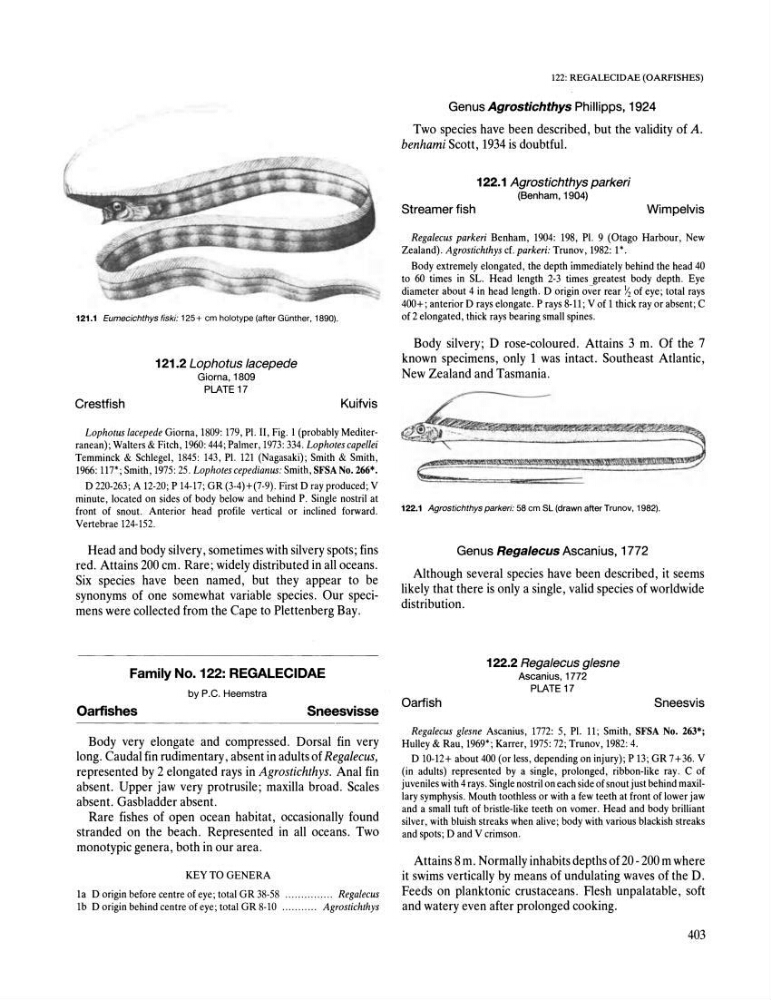
121.1 Eumecichthys fiski: 125+ em holotype (after Gunther, 1890).
Crestfish
121.2 Lophotus lacepede
Giorna, 1809
PLATE 17
Kuifvis
Lophotus lacepede Giorna, 1809: 179, PI. II, Fig. 1 (probably Mediterranean); Walters & Fitch, 1960: 444; Palmer, 1973: 334. Lophotescapeliei
Temminck & Schlegel, 1845: 143, PI. 121 (Nagasaki); Smith & Smith,
1966: 117*; Smith, 1975: 25. Lophotes cepedianus: Smith, SFSA No. 266*.
D 220-263; A 12-20; P 14-17; GR (3-4)+(7-9). First D ray produced; V
minute, located on sides of body below and behind P. Single nostril at
front of snout. Anterior head profile vertical or inclined forward.
Vertebrae 124-152.
Head and body silvery, sometimes with silvery spots; fins
red. Attains 200 cm. Rare; widely distributed in all oceans.
Six species have been named, but they appear to be
synonyms of one somewhat variable species. Our specimens were collected from the Cape to Plettenberg Bay.
Family No. 122: REGALECIDAE
by P.C. Heemstra
Oarfishes
Sneesvisse
Body very elongate and compressed. Dorsal fin very
long. Caudal fin rudimentary, absent in adults of Regalecus,
represented by 2 elongated rays in Agrostichthys. Anal fin
absent. Upper jaw very protrusile; maxilla broad. Scales
absent. Gasbladder absent.
Rare fishes of open ocean habitat, occasionally found
stranded on the beach. Represented in all oceans. Two
monotypic genera, both in our area.
KEY TO GENERA
la D origin before centre of eye; total GR 38-58 ............... Regalecus
1b D origin behind centre of eye; total GR 8-10 ........... Agrostichthys
122: REGALECIDAE (OARFISHES)
Genus Agrostichthys Phillipps, 1924
Two species have been described, but the validity of A.
benhami Scott, 1934 is doubtful.
Streamer fish
122.1 Agrostichthys parkeri
(Benham, 1904)
Wimpelvis
Regalecus parkeri Benham, 1904: 198, PI. 9 (Otago Harbour, New
Zealand). Agrostichthys cf. parkeri: Trunov, 1982: 1 *.
Body extremely elongated, the depth immediately behind the head 40
to 60 times in SL. Head length 2-3 times greatest body depth. Eye
diameter about 4 in head length. D origin over rear Yz of eye; total rays
400+; anterior D rays elongate. Prays 8-11; V of 1 thick ray or absent; C
of 2 elongated, thick rays bearing small spines.
Body silvery; D rose-coloured. Attains 3 m. Of the 7
known specimens, only 1 was intact. Southeast Atlantic,
New Zealand and Tasmania.
122.1 Agrostichthysparkeri: 58 em SL (drawn after Trunov, 1982).
Genus Rega/ecus Ascanius, 1772
Although several species have been described, it seems
likely that there is only a single, valid species of worldwide
distribution.
Oarfish
122.2 Rega/ecus glesne
Ascanius, 1772
PLATE 17
Sneesvis
Regalecus glesne Ascanius, 1772: 5, PI. 11; Smith, SFSA No. 263*;
Hulley & Rau, 1969*; Karrer, 1975: 72; Trunov, 1982: 4.
D 10-12+ about 400 (or less, depending on injury); P 13; GR 7+36. V
(in adults) represented by a single, prolonged, ribbon-like ray. C of
juveniles with 4 rays. Single nostril on each side of snout just behind maxillary symphysis. Mouth toothless or with a few teeth at front of lower jaw
and a small tuft of bristle-like teeth on vomer. Head and body brilliant
silver, with bluish streaks when alive; body with various blackish streaks
and spots; D and V crimson.
Attains 8 m. Normally inhabits depths of 20 - 200 m where
it swims vertically by means of undulating waves of the D.
Feeds on planktonic crustaceans. Flesh unpalatable, soft
and watery even after prolonged cooking.
403
Crestfish
121.2 Lophotus lacepede
Giorna, 1809
PLATE 17
Kuifvis
Lophotus lacepede Giorna, 1809: 179, PI. II, Fig. 1 (probably Mediterranean); Walters & Fitch, 1960: 444; Palmer, 1973: 334. Lophotescapeliei
Temminck & Schlegel, 1845: 143, PI. 121 (Nagasaki); Smith & Smith,
1966: 117*; Smith, 1975: 25. Lophotes cepedianus: Smith, SFSA No. 266*.
D 220-263; A 12-20; P 14-17; GR (3-4)+(7-9). First D ray produced; V
minute, located on sides of body below and behind P. Single nostril at
front of snout. Anterior head profile vertical or inclined forward.
Vertebrae 124-152.
Head and body silvery, sometimes with silvery spots; fins
red. Attains 200 cm. Rare; widely distributed in all oceans.
Six species have been named, but they appear to be
synonyms of one somewhat variable species. Our specimens were collected from the Cape to Plettenberg Bay.
Family No. 122: REGALECIDAE
by P.C. Heemstra
Oarfishes
Sneesvisse
Body very elongate and compressed. Dorsal fin very
long. Caudal fin rudimentary, absent in adults of Regalecus,
represented by 2 elongated rays in Agrostichthys. Anal fin
absent. Upper jaw very protrusile; maxilla broad. Scales
absent. Gasbladder absent.
Rare fishes of open ocean habitat, occasionally found
stranded on the beach. Represented in all oceans. Two
monotypic genera, both in our area.
KEY TO GENERA
la D origin before centre of eye; total GR 38-58 ............... Regalecus
1b D origin behind centre of eye; total GR 8-10 ........... Agrostichthys
122: REGALECIDAE (OARFISHES)
Genus Agrostichthys Phillipps, 1924
Two species have been described, but the validity of A.
benhami Scott, 1934 is doubtful.
Streamer fish
122.1 Agrostichthys parkeri
(Benham, 1904)
Wimpelvis
Regalecus parkeri Benham, 1904: 198, PI. 9 (Otago Harbour, New
Zealand). Agrostichthys cf. parkeri: Trunov, 1982: 1 *.
Body extremely elongated, the depth immediately behind the head 40
to 60 times in SL. Head length 2-3 times greatest body depth. Eye
diameter about 4 in head length. D origin over rear Yz of eye; total rays
400+; anterior D rays elongate. Prays 8-11; V of 1 thick ray or absent; C
of 2 elongated, thick rays bearing small spines.
Body silvery; D rose-coloured. Attains 3 m. Of the 7
known specimens, only 1 was intact. Southeast Atlantic,
New Zealand and Tasmania.
122.1 Agrostichthysparkeri: 58 em SL (drawn after Trunov, 1982).
Genus Rega/ecus Ascanius, 1772
Although several species have been described, it seems
likely that there is only a single, valid species of worldwide
distribution.
Oarfish
122.2 Rega/ecus glesne
Ascanius, 1772
PLATE 17
Sneesvis
Regalecus glesne Ascanius, 1772: 5, PI. 11; Smith, SFSA No. 263*;
Hulley & Rau, 1969*; Karrer, 1975: 72; Trunov, 1982: 4.
D 10-12+ about 400 (or less, depending on injury); P 13; GR 7+36. V
(in adults) represented by a single, prolonged, ribbon-like ray. C of
juveniles with 4 rays. Single nostril on each side of snout just behind maxillary symphysis. Mouth toothless or with a few teeth at front of lower jaw
and a small tuft of bristle-like teeth on vomer. Head and body brilliant
silver, with bluish streaks when alive; body with various blackish streaks
and spots; D and V crimson.
Attains 8 m. Normally inhabits depths of 20 - 200 m where
it swims vertically by means of undulating waves of the D.
Feeds on planktonic crustaceans. Flesh unpalatable, soft
and watery even after prolonged cooking.
403