

7-9 (no spine). Caudal fin forked; 19 principal, 17 branched
rays. Upper jaw very protrusile; maxillae bound to ascending
processes of premaxillae and move with them; no supramaxilla. Teeth absent. Gills 4, a slit behind the last; gill-rakers
very short; branchiostegals 6, the membranes narrowly
joined to isthmus. Scales cycloid, deciduous, covering body
and most of head; lateral line distinct. Vertebrae 16+(17-18).
Gasbladder well developed, bifurcate posteriorly, the 2
horns extending well past anal fin origin.
Rare fishes of the Indo-Pacific region; taken in depths of
40 - 110 m. Two widely distributed species in separate
genera: Velifer Bleeker, 1879 and Metavelifer, Walters,
1960.
KEY TO SPECIES
1a D XXI-XXII,20-23; A XVII-XVIII,
16-18; .... .. ......... .......... .... ............ ...... Metavelifer multiradiatus
1b D 1-11,33-34; A 1,24-25; .. ... ........... ... .. ... .. ... Velifer hypselopterus
118.1 Metavelifer multiradiatus
(Reg a I, 1907)
Spinyfin velifer
Stekelvin-velifer
Velifer multiradiatus Regan, 1907: 633 (northwest coast of Australia).
Velifer multispinosus Smith, 1951: 504, Pis. 11 & 12 (not far from Maputo,
in about 50 fms); 1953: 515, No. 262b*. Metavelifer multiradiatus: Walters,
1960: 246; Stephenson, 1977: 143.
D XXI-XXII ,20-23; A XVII-XVIII,16-18; P 15-16; V 9 (all rays
branched except the 1st); LL 40-42; GR 3+9. Depth 1.6- 1.8, head 3.4 in
SL; eye 2.9-3.1 in head. Preorbital bone with notch posteriorly. Anterior
D & A rays of juveniles «13 cm SL) are segmented, but at 17 cm SL, only
the distal parts of the 6th, 7th & 8th D rays are segmented.
Attains 28 cm. One specimen from off Maputo; also
known from Australia, New Zealand and Hawaii.
118.1 Metavelifer multiradiatus: 20.5 em holotype of V. multispinosus
(Mozambique Channel).
Sailfin velifer
118.2 Velifer hypse/opterus
Bleeker, 1879
Seilvin-velifer
Velifer hypselopterus Bleeker, 1879: 16 (Japan; on "Velifer" Temminck
& Schlegel , 1850); Smith, 1951: 500'; Walters, 1960: 246. Veliferafricanus
118: VELIFERIDAE (VELIFERS)
Smith, 1953: 7, PI. 1, Fig. 2 (off south end of Madagascar, about 26°S,
44°E; in about 60 fms); 1953: 515, No. 2628*.
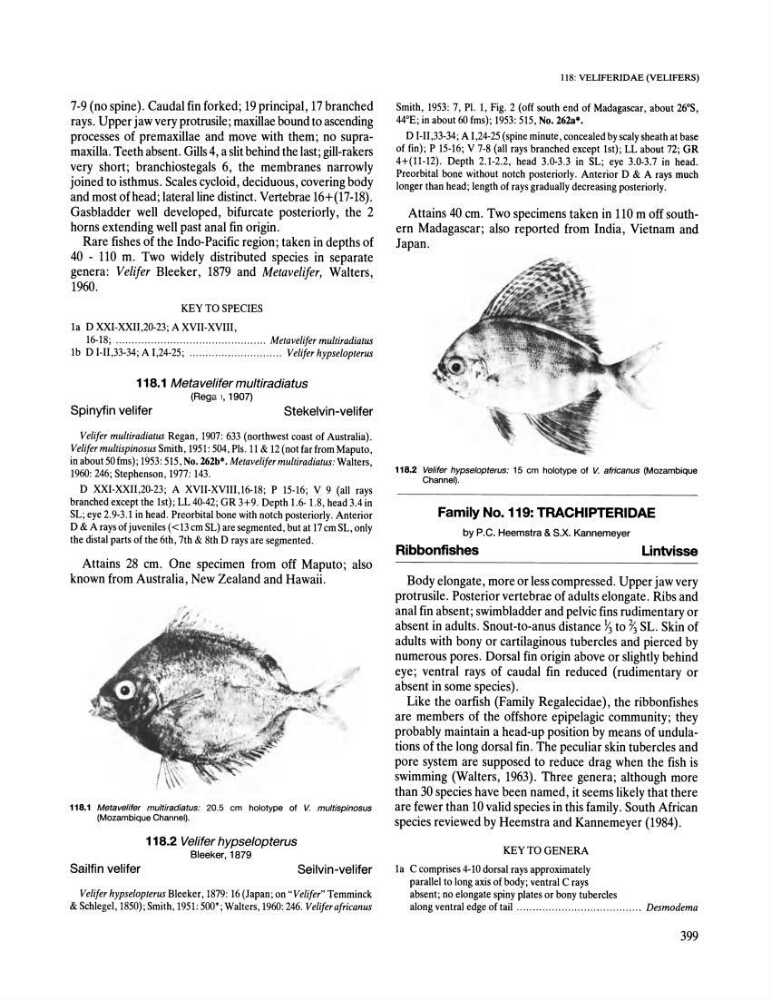
D 1-11,33-34; A 1,24-25 (spine minute, concealed by scaly sheath at base
of fin); P 15-16; V 7-8 (all rays branched except 1st); LL about 72; GR
4+(11-12). Depth 2.1-2.2, head 3.0-3.3 in SL; eye 3.0-3.7 in head.
Preorbital bone without notch posteriorly. Anterior D & A rays much
longer than head; length of rays gradually decreasing posteriorly.
Attains 40 cm. Two specimens taken in 110 m off southern Madagascar; also reported from India, Vietnam and
Japan.
118.2 Velifer hypselopterus: 15 em holotype of If. africanus (Mozambique
Channel).
Family No. 119: TRACHIPTERIDAE
by P.C. Heemstra & S.X. Kannemeyer
Ribbonfishes
Lintvisse
Body elongate, more or less compressed. Upper jaw very
protrusile. Posterior vertebrae of adults elongate. Ribs and
anal fin absent; swimbladder and pelvic fins rudimentary or
absent in adults. Snout-to-anus distance ~ to ~ SL. Skin of
adults with bony or cartilaginous tubercles and pierced by
numerous pores. Dorsal fin origin above or slightly behind
eye; ventral rays of caudal fin reduced (rudimentary or
absent in some species) .
Like the oarfish (Family Regalecidae), the ribbonfishes
are members of the offshore epipelagic community; they
probably maintain a head-up position by means of undulations of the long dorsal fin. The peculiar skin tubercles and
pore system are supposed to reduce drag when the fish is
swimming (Walters, 1963). Three genera; although more
than 30 species have been named, it seems likely that there
are fewer than 10 valid species in this family. South African
species reviewed by Heemstra and Kannemeyer (1984).
KEY TO GENERA
1a C comprises 4-10 dorsal rays approximately
parallel to long axis of body; ventral Crays
absent; no elongate spiny plates or bony tubercles
along ventral edge of tail ..... .. ........... .. ............ ... .... Desmodema
399
rays. Upper jaw very protrusile; maxillae bound to ascending
processes of premaxillae and move with them; no supramaxilla. Teeth absent. Gills 4, a slit behind the last; gill-rakers
very short; branchiostegals 6, the membranes narrowly
joined to isthmus. Scales cycloid, deciduous, covering body
and most of head; lateral line distinct. Vertebrae 16+(17-18).
Gasbladder well developed, bifurcate posteriorly, the 2
horns extending well past anal fin origin.
Rare fishes of the Indo-Pacific region; taken in depths of
40 - 110 m. Two widely distributed species in separate
genera: Velifer Bleeker, 1879 and Metavelifer, Walters,
1960.
KEY TO SPECIES
1a D XXI-XXII,20-23; A XVII-XVIII,
16-18; .... .. ......... .......... .... ............ ...... Metavelifer multiradiatus
1b D 1-11,33-34; A 1,24-25; .. ... ........... ... .. ... .. ... Velifer hypselopterus
118.1 Metavelifer multiradiatus
(Reg a I, 1907)
Spinyfin velifer
Stekelvin-velifer
Velifer multiradiatus Regan, 1907: 633 (northwest coast of Australia).
Velifer multispinosus Smith, 1951: 504, Pis. 11 & 12 (not far from Maputo,
in about 50 fms); 1953: 515, No. 262b*. Metavelifer multiradiatus: Walters,
1960: 246; Stephenson, 1977: 143.
D XXI-XXII ,20-23; A XVII-XVIII,16-18; P 15-16; V 9 (all rays
branched except the 1st); LL 40-42; GR 3+9. Depth 1.6- 1.8, head 3.4 in
SL; eye 2.9-3.1 in head. Preorbital bone with notch posteriorly. Anterior
D & A rays of juveniles «13 cm SL) are segmented, but at 17 cm SL, only
the distal parts of the 6th, 7th & 8th D rays are segmented.
Attains 28 cm. One specimen from off Maputo; also
known from Australia, New Zealand and Hawaii.
118.1 Metavelifer multiradiatus: 20.5 em holotype of V. multispinosus
(Mozambique Channel).
Sailfin velifer
118.2 Velifer hypse/opterus
Bleeker, 1879
Seilvin-velifer
Velifer hypselopterus Bleeker, 1879: 16 (Japan; on "Velifer" Temminck
& Schlegel , 1850); Smith, 1951: 500'; Walters, 1960: 246. Veliferafricanus
118: VELIFERIDAE (VELIFERS)
Smith, 1953: 7, PI. 1, Fig. 2 (off south end of Madagascar, about 26°S,
44°E; in about 60 fms); 1953: 515, No. 2628*.
D 1-11,33-34; A 1,24-25 (spine minute, concealed by scaly sheath at base
of fin); P 15-16; V 7-8 (all rays branched except 1st); LL about 72; GR
4+(11-12). Depth 2.1-2.2, head 3.0-3.3 in SL; eye 3.0-3.7 in head.
Preorbital bone without notch posteriorly. Anterior D & A rays much
longer than head; length of rays gradually decreasing posteriorly.
Attains 40 cm. Two specimens taken in 110 m off southern Madagascar; also reported from India, Vietnam and
Japan.
118.2 Velifer hypselopterus: 15 em holotype of If. africanus (Mozambique
Channel).
Family No. 119: TRACHIPTERIDAE
by P.C. Heemstra & S.X. Kannemeyer
Ribbonfishes
Lintvisse
Body elongate, more or less compressed. Upper jaw very
protrusile. Posterior vertebrae of adults elongate. Ribs and
anal fin absent; swimbladder and pelvic fins rudimentary or
absent in adults. Snout-to-anus distance ~ to ~ SL. Skin of
adults with bony or cartilaginous tubercles and pierced by
numerous pores. Dorsal fin origin above or slightly behind
eye; ventral rays of caudal fin reduced (rudimentary or
absent in some species) .
Like the oarfish (Family Regalecidae), the ribbonfishes
are members of the offshore epipelagic community; they
probably maintain a head-up position by means of undulations of the long dorsal fin. The peculiar skin tubercles and
pore system are supposed to reduce drag when the fish is
swimming (Walters, 1963). Three genera; although more
than 30 species have been named, it seems likely that there
are fewer than 10 valid species in this family. South African
species reviewed by Heemstra and Kannemeyer (1984).
KEY TO GENERA
1a C comprises 4-10 dorsal rays approximately
parallel to long axis of body; ventral Crays
absent; no elongate spiny plates or bony tubercles
along ventral edge of tail ..... .. ........... .. ............ ... .... Desmodema
399