

117: LAMPRIDAE (OPAHS)
8a Body greatly elongated, depth 15 to 60 times
in SL; dorsal fin with about 400 rays, the rays
smooth (without minute spines or prickles along
their lateral edges) ......................... REGALECIDAE (No. 122)
l!z± . . . . . . . . . . . . . . . . . . . . . . . . . . . . . . . . . . . . . . . . .
8b Body less elongated, depth 4 to 10 times
in SL; dorsal fin with 120-200 rays, the rays with
minute spines or prickles along their
lateral edges ........................... TRACHIPTERIDAE (No. 119)
Family No. 117: LAMPRIDAE
by P.C. Heemstra
Opahs
Opahs
Body somewhat compressed; scales minute, cycloid,
deciduous. Upper jaw protrusile; juveniles with a few
minute teeth, none in adults. Nostrils small, close together.
Pectoral and pelvic fins well developed; branched caudal
rays 17. Branchiostegal membranes with 6 rays. Gill-rakers
well developed. Vertebrae 43-46. Swimbladder large,
anteriorly bifurcate. One genus, Lampris Retzius, 1799
with two species. Parin and Kukuyev (1983) have re-established the validity of L. immaculatus, a rare species of the
southern oceans.
KEY TO SPECIES
la Greatest body depth (of fish >50 cm SL) 58-68%
SL; body purple or pink, with prominent pale
spots; V origin under P origin .. .. .. .. ...... .. .. .. .. .... .. .. .... L. guttatus
Ib Greatest body depth (of fish >50 cm SL) 43-53%
SL; body bluish or reddish dorsally, silvery
below; no pale spots on body; fins bright red;
V origin well behind P origin ............................. L. immaculatus
Spotted opah
117.1 Lampris guttatus
(Brunnich, 1788)
PLATE 15
Gespikkelde opah
Zeus guttatus Briinnich, 1788: 398, PI. A (North Sea). Lampris regius:
Smith, SFSA No. 262 (in part, not illustration). Lampris guttatus: Palmer,
1973: 328; Palmer & Oelschlager, 1976: 366; Rosenblatt & Johnson, 1976:
367*.
D 49-55; A 38-41; P 22-25; V 13-17; GR 2+ 14.
398
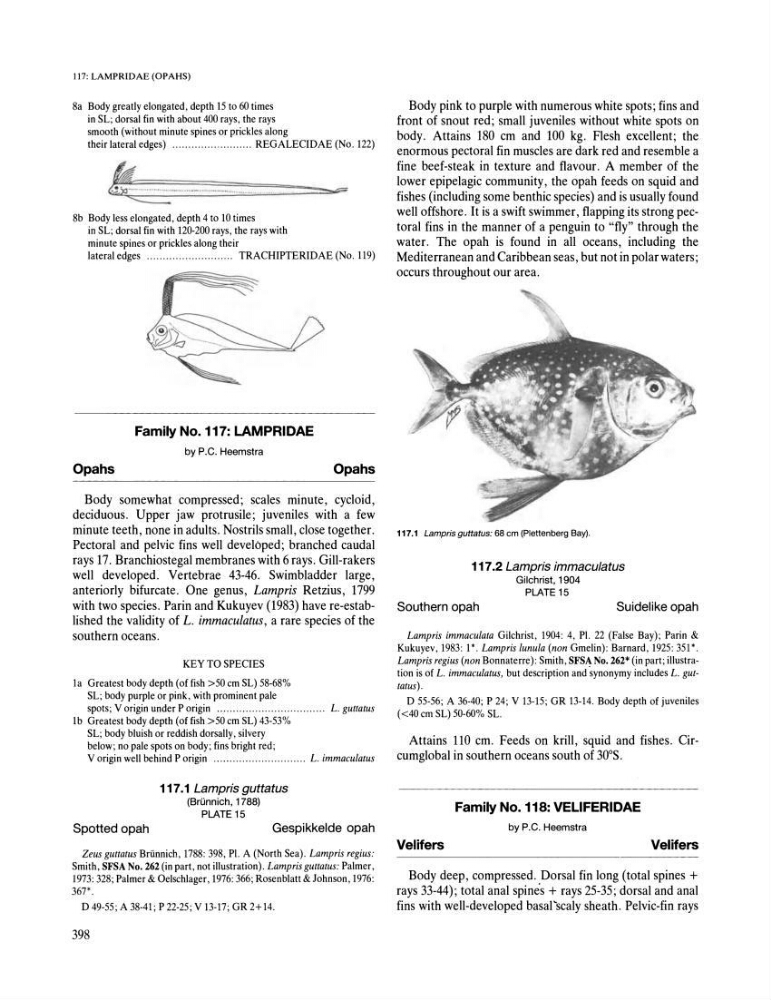
Body pink to purple with numerous white spots; fins and
front of snout red; small juveniles without white spots on
body. Attains 180 cm and 100 kg. Flesh excellent; the
enormous pectoral fin muscles are dark red and resemble a
fine beef-steak in texture and flavour. A member of the
lower epipelagic community, the opah feeds on squid and
fishes (including some benthic species) and is usually found
well offshore. It is a swift swimmer, flapping its strong pectoral fins in the manner of a penguin to "fly" through the
water. The opah is found in all oceans, including the
Mediterranean and Caribbean seas, but not in polar waters;
occurs throughout our area.
117.1 Lampris guttatus: 68 em (Plettenberg Bay).
117.2 Lampris immaculatus
Gilchrist, 1904
PLATE 15
Southern opah
Suidelike opah
Lampris immaculata Gilchrist, 1904: 4, PI. 22 (False Bay); Parin &
Kukuyev, 1983: 1 *. Lampris lunula (non Gmelin): Barnard, 1925: 351 *.
Lampris regius (non Bonnaterre): Smith, SFSA No. 262* (in part; illustration is of L. immaculatus, but description and synonymy includes L. guttatus).
D 55-56; A 36-40; P 24; V 13-15; GR 13-14. Body depth of juveniles
«40 cm SL) 50-60% SL.
Attains 110 cm. Feeds on krill, squid and fishes. Circumglobal in southern oceans south of 30 0 S.
Family No. 118: VELIFERIDAE
by P.C. Heemstra
Veliters
Veliters
Body deep, compressed. Dorsal fin long (total spines +
rays 33-44); total anal spines + rays 25-35; dorsal and anal
fins with well-developed basal'scaly sheath. Pelvic-fin rays
8a Body greatly elongated, depth 15 to 60 times
in SL; dorsal fin with about 400 rays, the rays
smooth (without minute spines or prickles along
their lateral edges) ......................... REGALECIDAE (No. 122)
l!z± . . . . . . . . . . . . . . . . . . . . . . . . . . . . . . . . . . . . . . . . .
8b Body less elongated, depth 4 to 10 times
in SL; dorsal fin with 120-200 rays, the rays with
minute spines or prickles along their
lateral edges ........................... TRACHIPTERIDAE (No. 119)
Family No. 117: LAMPRIDAE
by P.C. Heemstra
Opahs
Opahs
Body somewhat compressed; scales minute, cycloid,
deciduous. Upper jaw protrusile; juveniles with a few
minute teeth, none in adults. Nostrils small, close together.
Pectoral and pelvic fins well developed; branched caudal
rays 17. Branchiostegal membranes with 6 rays. Gill-rakers
well developed. Vertebrae 43-46. Swimbladder large,
anteriorly bifurcate. One genus, Lampris Retzius, 1799
with two species. Parin and Kukuyev (1983) have re-established the validity of L. immaculatus, a rare species of the
southern oceans.
KEY TO SPECIES
la Greatest body depth (of fish >50 cm SL) 58-68%
SL; body purple or pink, with prominent pale
spots; V origin under P origin .. .. .. .. ...... .. .. .. .. .... .. .. .... L. guttatus
Ib Greatest body depth (of fish >50 cm SL) 43-53%
SL; body bluish or reddish dorsally, silvery
below; no pale spots on body; fins bright red;
V origin well behind P origin ............................. L. immaculatus
Spotted opah
117.1 Lampris guttatus
(Brunnich, 1788)
PLATE 15
Gespikkelde opah
Zeus guttatus Briinnich, 1788: 398, PI. A (North Sea). Lampris regius:
Smith, SFSA No. 262 (in part, not illustration). Lampris guttatus: Palmer,
1973: 328; Palmer & Oelschlager, 1976: 366; Rosenblatt & Johnson, 1976:
367*.
D 49-55; A 38-41; P 22-25; V 13-17; GR 2+ 14.
398
Body pink to purple with numerous white spots; fins and
front of snout red; small juveniles without white spots on
body. Attains 180 cm and 100 kg. Flesh excellent; the
enormous pectoral fin muscles are dark red and resemble a
fine beef-steak in texture and flavour. A member of the
lower epipelagic community, the opah feeds on squid and
fishes (including some benthic species) and is usually found
well offshore. It is a swift swimmer, flapping its strong pectoral fins in the manner of a penguin to "fly" through the
water. The opah is found in all oceans, including the
Mediterranean and Caribbean seas, but not in polar waters;
occurs throughout our area.
117.1 Lampris guttatus: 68 em (Plettenberg Bay).
117.2 Lampris immaculatus
Gilchrist, 1904
PLATE 15
Southern opah
Suidelike opah
Lampris immaculata Gilchrist, 1904: 4, PI. 22 (False Bay); Parin &
Kukuyev, 1983: 1 *. Lampris lunula (non Gmelin): Barnard, 1925: 351 *.
Lampris regius (non Bonnaterre): Smith, SFSA No. 262* (in part; illustration is of L. immaculatus, but description and synonymy includes L. guttatus).
D 55-56; A 36-40; P 24; V 13-15; GR 13-14. Body depth of juveniles
«40 cm SL) 50-60% SL.
Attains 110 cm. Feeds on krill, squid and fishes. Circumglobal in southern oceans south of 30 0 S.
Family No. 118: VELIFERIDAE
by P.C. Heemstra
Veliters
Veliters
Body deep, compressed. Dorsal fin long (total spines +
rays 33-44); total anal spines + rays 25-35; dorsal and anal
fins with well-developed basal'scaly sheath. Pelvic-fin rays