

107: MELANOCETIDAE (DEVIL-ANGLERS)
1007*. Melanocoetus rotundatus: Smith , SFSA No. 1232*; Penrith , 1967:
187.
D 1,13-17; A 3-5; P 17-23; C 9. Esca slightly compressed with a low ,
rounded or conical distal prolongation nearly always darkly pigmented on
tip; a compressed posterior crest and a considerably smaller, compressed
anterior crest present in some specimens. Number of upper jaw teeth
48-134.
Attains 18 cm . Known from off all coasts of South Africa,
as well as from all major oceans. Most commonly taken
between 500 and 1 500 m.
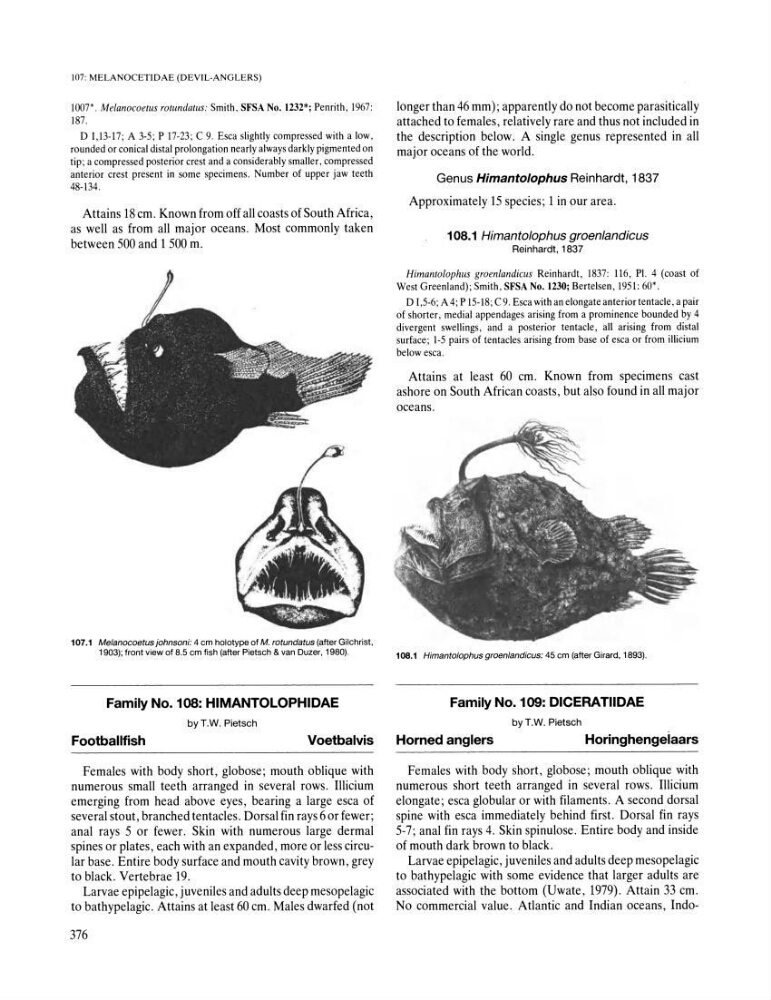
107.1 Me/anocoetus johnsoni: 4 cm holotype of M. rotundatus (after Gilchrist,
1903); front view of 8.5 cm fish (after Pietsch & van Duzer, 1980).
Family No. 108: HIMANTOLOPHIDAE
by rw. Pietsch
Footballfish
Voetbalvis
Females with body short, globose ; mouth oblique with
numerous small teeth arranged in several rows. Illicium
emerging from head above eyes, bearing a large esca of
several stout , branched tentacles. Dorsal fin rays 6 or fewer;
anal rays 5 or fewer. Skin with numerous large dermal
spines or plates, each with an expanded, more or less circular base. Entire body surface and mouth cavity brown, grey
to black. Vertebrae 19.
Larvae epipe\agic, juveniles and adults deep mesopelagic
to bathypelagic. Attains at least 60 cm. Males dwarfed (not
376
longer than 46 mm); apparently do not become parasitically
attached to females, relatively rare and thus not included in
the description below. A single genus represented in all
major oceans of the world.
Genus Himant%phus Reinhardt, 1837
Approximately 15 species; 1 in our area.
108.1 Himantolophus groenlandicus
Reinhardt, 1837
Himantolophus groenlandicus Reinhardt , 1837: 116, PI. 4 (coast of
West Greenland); Smith, SFSA No_ 1230; Bertelsen , 1951: 60*.
D 1,5-6; A4; P 15-18; C 9. Esca with an elongate anterior tentacle, a pair
of shorter, medial appendages arising from a prominence bounded by 4
divergent swellings, and a posterior tentacle , all arising from distal
surface; 1-5 pairs of tentacles arising from base of esca or from illicium
belowesca.
Attains at least 60 cm. Known from specimens cast
ashore on South African coasts, but also found in all major
oceans.
108.1 Himant%phus groen/andicus: 45 em (after Girard, 1893).
Family No. 109: DICERATIIDAE
by rw. Pietsch
Horned anglers
Horinghengelaars
Females with body short, globose; mouth oblique with
numerous short teeth arranged in several rows. Illicium
elongate; esca globular or with filaments. A second dorsal
spine with esca immediately behind first. Dorsal fin rays
5-7; anal fin rays 4. Skin spinulose. Entire body and inside
of mouth dark brown to black.
Larvae epipelagic, juveniles and adults deep mesope\agic
to bathypelagic with some evidence that larger adults are
associated with the bottom (Uwate, 1979) . Attain 33 cm.
No commercial value . Atlantic and Indian oceans, Indo-
1007*. Melanocoetus rotundatus: Smith , SFSA No. 1232*; Penrith , 1967:
187.
D 1,13-17; A 3-5; P 17-23; C 9. Esca slightly compressed with a low ,
rounded or conical distal prolongation nearly always darkly pigmented on
tip; a compressed posterior crest and a considerably smaller, compressed
anterior crest present in some specimens. Number of upper jaw teeth
48-134.
Attains 18 cm . Known from off all coasts of South Africa,
as well as from all major oceans. Most commonly taken
between 500 and 1 500 m.
107.1 Me/anocoetus johnsoni: 4 cm holotype of M. rotundatus (after Gilchrist,
1903); front view of 8.5 cm fish (after Pietsch & van Duzer, 1980).
Family No. 108: HIMANTOLOPHIDAE
by rw. Pietsch
Footballfish
Voetbalvis
Females with body short, globose ; mouth oblique with
numerous small teeth arranged in several rows. Illicium
emerging from head above eyes, bearing a large esca of
several stout , branched tentacles. Dorsal fin rays 6 or fewer;
anal rays 5 or fewer. Skin with numerous large dermal
spines or plates, each with an expanded, more or less circular base. Entire body surface and mouth cavity brown, grey
to black. Vertebrae 19.
Larvae epipe\agic, juveniles and adults deep mesopelagic
to bathypelagic. Attains at least 60 cm. Males dwarfed (not
376
longer than 46 mm); apparently do not become parasitically
attached to females, relatively rare and thus not included in
the description below. A single genus represented in all
major oceans of the world.
Genus Himant%phus Reinhardt, 1837
Approximately 15 species; 1 in our area.
108.1 Himantolophus groenlandicus
Reinhardt, 1837
Himantolophus groenlandicus Reinhardt , 1837: 116, PI. 4 (coast of
West Greenland); Smith, SFSA No_ 1230; Bertelsen , 1951: 60*.
D 1,5-6; A4; P 15-18; C 9. Esca with an elongate anterior tentacle, a pair
of shorter, medial appendages arising from a prominence bounded by 4
divergent swellings, and a posterior tentacle , all arising from distal
surface; 1-5 pairs of tentacles arising from base of esca or from illicium
belowesca.
Attains at least 60 cm. Known from specimens cast
ashore on South African coasts, but also found in all major
oceans.
108.1 Himant%phus groen/andicus: 45 em (after Girard, 1893).
Family No. 109: DICERATIIDAE
by rw. Pietsch
Horned anglers
Horinghengelaars
Females with body short, globose; mouth oblique with
numerous short teeth arranged in several rows. Illicium
elongate; esca globular or with filaments. A second dorsal
spine with esca immediately behind first. Dorsal fin rays
5-7; anal fin rays 4. Skin spinulose. Entire body and inside
of mouth dark brown to black.
Larvae epipelagic, juveniles and adults deep mesope\agic
to bathypelagic with some evidence that larger adults are
associated with the bottom (Uwate, 1979) . Attain 33 cm.
No commercial value . Atlantic and Indian oceans, Indo-