

105.3 Cryptopsaras couesii
Gill,1883
Cryptopsaras couesii Gill, 1883: 284 (off Long Island, New York);
Smith, SFSA No. 1229*; Bertelsen, 1951: 139*; Penrith, 1967: 186.
D 1,4 (rarely 5); A 4; P 14-18; C 8. Bony support for fishing apparatus
bearing an extremely short illicium , nearly completely enveloped by the
globular or pear-shaped esca with a single, distal filament. Skin covered
with small, close-set dermal spines.
Attains 44 cm. Known from off Cape of Good Hope, as
well as from all major oceans.
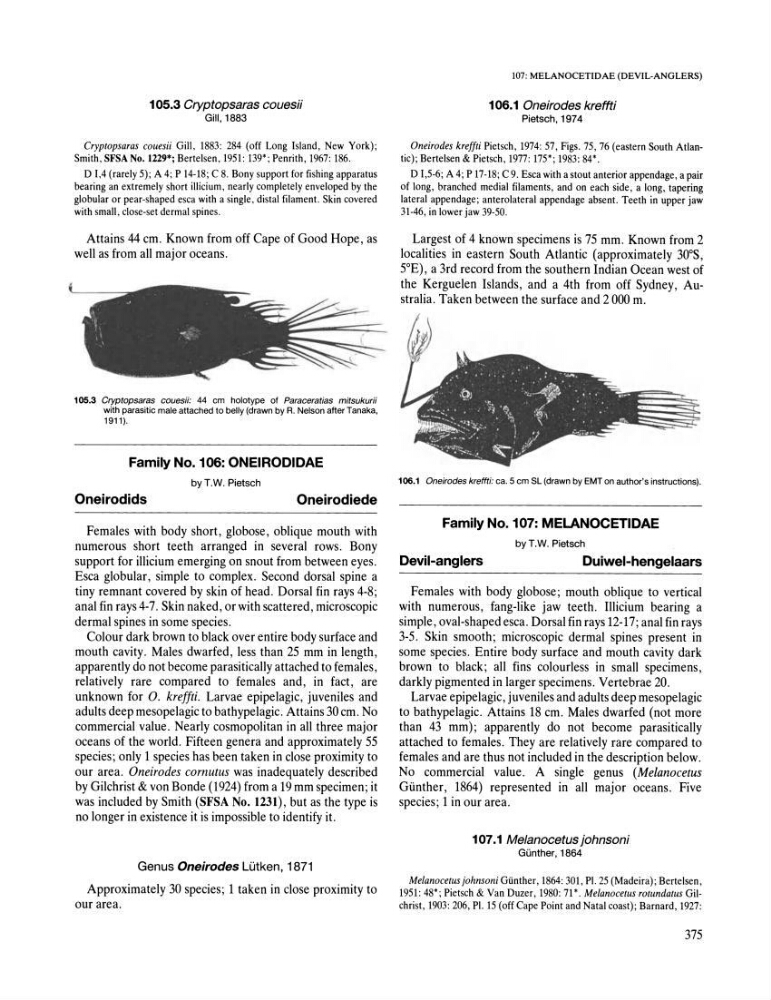
105.3 Cryptopsaras couesii: 44 cm holotype of Paraceratias mitsukurii
with parasitic male attached to belly (drawn by R. Nelson after Tanaka,
1911).
Family No. 106: ONEIRODIDAE
by T.w. Pietsch
Oneirodids
Oneirodiede
Females with body short, globose, oblique mouth with
numerous short teeth arranged in several rows. Bony
support for illicium emerging on snout from between eyes.
Esca globular, simple to complex. Second dorsal spine a
tiny remnant covered by skin of head. Dorsal fin rays 4-8;
anal fin rays 4-7. Skin naked, or with scattered, microscopic
dermal spines in some species.
Colour dark brown to black over entire body surface and
mouth cavity. Males dwarfed, less than 25 mm in length,
apparently do not become parasitically attached to females,
relatively rare compared to females and, in fact, are
unknown for O. kreffti. Larvae epipelagic, juveniles and
adults deep mesopelagic to bathypelagic. Attains 30 cm. No
commercial value. Nearly cosmopolitan in all three major
oceans of the world. Fifteen genera and approximately 55
species; only 1 species has been taken in close proximity to
our area. Oneirodes cornutus was inadequately described
by Gilchrist & von Bonde (1924) from a 19 mm specimen; it
was included by Smith (SFSA No. 1231), but as the type is
no longer in existence it is impossible to identify it.
Genus Oneirodes Lutken, 1871
Approximately 30 species; 1 taken in close proximity to
our area.
107: MELANOCETIDAE (DEVIL-ANGLERS)
106.1 Oneirodes kreffti
Pietsch,1974
Oneirodes kreffti Pietsch, 1974: 57, Figs. 75, 76 (eastern South Atlantic); Bertelsen & Pietsch, 1977: 175*; 1983: 84*.
D 1,5-6; A 4; P 17-18; C 9. Esca with a stout anterior appendage, a pair
of long, branched medial filaments, and on each side, a long, tapering
lateral appendage; anterolateral appendage absent. Teeth in upper jaw
31-46, in lower jaw 39-50.
Largest of 4 known specimens is 75 mm. Known from 2
localities in eastern South Atlantic (approximately 30 o S,
5°E), a 3rd record from the southern Indian Ocean west of
the Kerguelen Islands, and a 4th from off Sydney, Australia. Taken between the surface and 2 000 m.
106.1 Oneirodes kreffti: ca. 5 cm SL (drawn by EMT on author's instructions).
Family No. 107: MELANOCETIDAE
by T.W. Pietsch
Devil-anglers
Duiwel-hengelaars
Females with body globose; mouth oblique to vertical
with numerous, fang-like jaw teeth. Illicium bearing a
simple, oval-shaped esca. Dorsal fin rays 12-17; anal fin rays
3-5 . Skin smooth; microscopic dermal spines present in
some species. Entire body surface and mouth cavity dark
brown to black; all fins colourless in small specimens,
darkly pigmented in larger specimens. Vertebrae 20.
Larvae epipelagic, juveniles and adults deep mesopelagic
to bathypelagic. Attains 18 cm . Males dwarfed (not more
than 43 mm); apparently do not become parasitically
attached to females. They are relatively rare compared to
females and are thus not included in the description below.
No commercial value. A single genus (Melanocetus
Gunther, 1864) represented in all major oceans. Five
species; 1 in our area.
107.1 Melanocetus johnsoni
GOnther, 1864
Melanocetus johnsoni Giinther, 1864: 301, PI. 25 (Madeira); Bertelsen ,
1951 : 48*; Pietsch & Van Duzer, 1980: 71 *. Melanocetus rotundatus Gilchrist, 1903: 206, PI. 15 (off Cape Point and Natal coast); Barnard, 1927:
375
Gill,1883
Cryptopsaras couesii Gill, 1883: 284 (off Long Island, New York);
Smith, SFSA No. 1229*; Bertelsen, 1951: 139*; Penrith, 1967: 186.
D 1,4 (rarely 5); A 4; P 14-18; C 8. Bony support for fishing apparatus
bearing an extremely short illicium , nearly completely enveloped by the
globular or pear-shaped esca with a single, distal filament. Skin covered
with small, close-set dermal spines.
Attains 44 cm. Known from off Cape of Good Hope, as
well as from all major oceans.
105.3 Cryptopsaras couesii: 44 cm holotype of Paraceratias mitsukurii
with parasitic male attached to belly (drawn by R. Nelson after Tanaka,
1911).
Family No. 106: ONEIRODIDAE
by T.w. Pietsch
Oneirodids
Oneirodiede
Females with body short, globose, oblique mouth with
numerous short teeth arranged in several rows. Bony
support for illicium emerging on snout from between eyes.
Esca globular, simple to complex. Second dorsal spine a
tiny remnant covered by skin of head. Dorsal fin rays 4-8;
anal fin rays 4-7. Skin naked, or with scattered, microscopic
dermal spines in some species.
Colour dark brown to black over entire body surface and
mouth cavity. Males dwarfed, less than 25 mm in length,
apparently do not become parasitically attached to females,
relatively rare compared to females and, in fact, are
unknown for O. kreffti. Larvae epipelagic, juveniles and
adults deep mesopelagic to bathypelagic. Attains 30 cm. No
commercial value. Nearly cosmopolitan in all three major
oceans of the world. Fifteen genera and approximately 55
species; only 1 species has been taken in close proximity to
our area. Oneirodes cornutus was inadequately described
by Gilchrist & von Bonde (1924) from a 19 mm specimen; it
was included by Smith (SFSA No. 1231), but as the type is
no longer in existence it is impossible to identify it.
Genus Oneirodes Lutken, 1871
Approximately 30 species; 1 taken in close proximity to
our area.
107: MELANOCETIDAE (DEVIL-ANGLERS)
106.1 Oneirodes kreffti
Pietsch,1974
Oneirodes kreffti Pietsch, 1974: 57, Figs. 75, 76 (eastern South Atlantic); Bertelsen & Pietsch, 1977: 175*; 1983: 84*.
D 1,5-6; A 4; P 17-18; C 9. Esca with a stout anterior appendage, a pair
of long, branched medial filaments, and on each side, a long, tapering
lateral appendage; anterolateral appendage absent. Teeth in upper jaw
31-46, in lower jaw 39-50.
Largest of 4 known specimens is 75 mm. Known from 2
localities in eastern South Atlantic (approximately 30 o S,
5°E), a 3rd record from the southern Indian Ocean west of
the Kerguelen Islands, and a 4th from off Sydney, Australia. Taken between the surface and 2 000 m.
106.1 Oneirodes kreffti: ca. 5 cm SL (drawn by EMT on author's instructions).
Family No. 107: MELANOCETIDAE
by T.W. Pietsch
Devil-anglers
Duiwel-hengelaars
Females with body globose; mouth oblique to vertical
with numerous, fang-like jaw teeth. Illicium bearing a
simple, oval-shaped esca. Dorsal fin rays 12-17; anal fin rays
3-5 . Skin smooth; microscopic dermal spines present in
some species. Entire body surface and mouth cavity dark
brown to black; all fins colourless in small specimens,
darkly pigmented in larger specimens. Vertebrae 20.
Larvae epipelagic, juveniles and adults deep mesopelagic
to bathypelagic. Attains 18 cm . Males dwarfed (not more
than 43 mm); apparently do not become parasitically
attached to females. They are relatively rare compared to
females and are thus not included in the description below.
No commercial value. A single genus (Melanocetus
Gunther, 1864) represented in all major oceans. Five
species; 1 in our area.
107.1 Melanocetus johnsoni
GOnther, 1864
Melanocetus johnsoni Giinther, 1864: 301, PI. 25 (Madeira); Bertelsen ,
1951 : 48*; Pietsch & Van Duzer, 1980: 71 *. Melanocetus rotundatus Gilchrist, 1903: 206, PI. 15 (off Cape Point and Natal coast); Barnard, 1927:
375