

97: CARAPIDAE (PEARLFISHES)
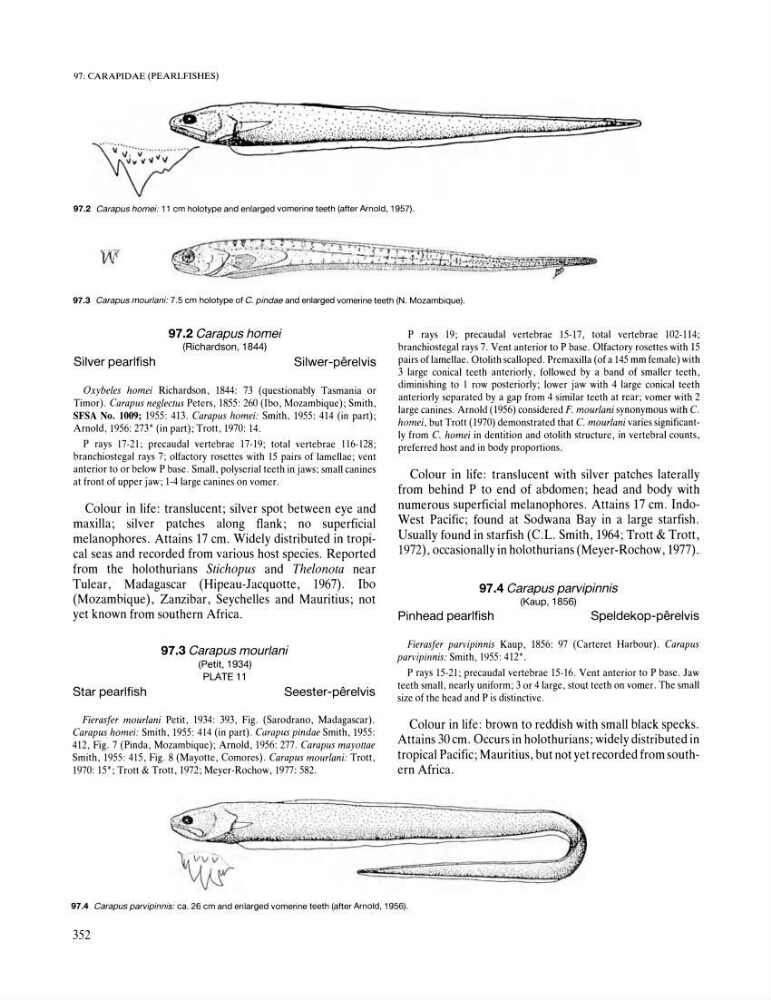
97.2 Carapus homei: 11 em holotype and enlarged vomerine teeth (after Arnold, 1957).
w
97.3 Carapus mourlani: 7.5 em holotype of C. pindae and enlarged vomerine teeth (N. Mozambique).
Silver pearl fish
97.2 Carapus homei
(Richardson, 1844)
Silwer-perelvis
Oxybeles homei Richardson, 1844: 73 (questionably Tasmania or
Timor). Carapus neglectus Peters, 1855: 260 (lbo, Mozambique); Smith,
SFSA No. 1009; 1955: 413. Carapus homei: Smith, 1955: 414 (in part);
Arnold, 1956: 273* (in part); Trott, 1970: 14.
Prays 17-21; precaudal vertebrae 17-19; total vertebrae 116-128'
branchiostegal rays 7; olfactory rosettes with 15 pairs of lamellae; ven;
anterior to or below P base. Small, polyserial teeth in jaws; small canines
at front of upper jaw; 1-4 large canines on vomer.
Colour in life: translucent; silver spot between eye and
maxilla; silver patches along flank; no superficial
melanophores. Attains 17 cm. Widely distributed in tropical seas and recorded from various host species. Reported
from the holothurians Stichopus and Thelonota near
Tulear, Madagascar (Hipeau-J acquotte, 1967). Ibo
(Mozambique), Zanzibar, Seychelles and Mauritius; not
yet known from southern Africa.
97.3 Carapus mourlani
(Petit, 1934)
PLATE 11
Star pearlfish
Seester-perelvis
Fiera,jer mourlani Petit, 1934: 393, Fig. (Sarodrano , Madagascar).
Carapus homei: Smith, 1955: 414 (in part). Carapus pindae Smith, 1955:
412, Fig. 7 (Pinda, Mozambique); Arnold, 1956: 277. Carapus mayottae
Smith, 1955: 415, Fig. 8 (Mayotte, Comores). Carapus mourlani: Trott,
1970: 15*; Trott & Trott, 1972; Meyer-Rochow, 1977: 582.
Prays 19; precaudal vertebrae 15-17, total vertebrae \02-114;
branchiostegal rays 7. Vent anterior to P base. Olfactory rosettes with 15
pairs of lamellae. Otolith scalloped. Premaxilla (of a 145 mm female) with
3 large conical teeth anteriorly, followed by a band of smaller teeth,
diminishing to 1 row posteriorly; lower jaw with 4 large conical teeth
anteriorly separated by a gap from 4 similar teeth at rear; vomer with 2
large canines. Arnold (1956) considered F. mourlani synonymous with C.
homei, but Trott (1970) demonstrated that C. mourlani varies significant1y from C. homei in dentition and otolith structure in vertebral counts
preferred host and in body proportions.'
,
Colour in life: translucent with silver patches laterally
from behind P to end of abdomen; head and body with
numerous superficial melanophores. Attains 17 cm. IndoWest Pacific; found at Sodwana Bay in a large starfish.
Usually found in starfish (C.L. Smith, 1964; Trott & Trott,
1972), occasionally in holothurians (Meyer-Rochow, 1977).
97.4 Carapus parvipinnis
(Kaup, 1856)
Pinhead pearlfish
Speldekop-perelvis
Fierasfer parvipinnis Kaup, 1856: 97 (Carteret Harbour). Carapus
parvipinnis: Smith, 1955: 412*.
Prays 15-21; precaudal vertebrae 15-16. Vent anterior to P base. Jaw
teeth small, nearly uniform; 3 or 4 large, stout teeth on vomer. The small
size of the head and P is distinctive.
Colour in life: brown to reddish with small black specks.
Attains 30 cm. Occurs in holothurians; widely distributed in
tropical Pacific; Mauritius, but not yet recorded from southern Africa.
97.4 Carapus parvipinnis: ca. 26 em and enlarged vomerine teeth (after Arnold, 1956).
352
97.2 Carapus homei: 11 em holotype and enlarged vomerine teeth (after Arnold, 1957).
w
97.3 Carapus mourlani: 7.5 em holotype of C. pindae and enlarged vomerine teeth (N. Mozambique).
Silver pearl fish
97.2 Carapus homei
(Richardson, 1844)
Silwer-perelvis
Oxybeles homei Richardson, 1844: 73 (questionably Tasmania or
Timor). Carapus neglectus Peters, 1855: 260 (lbo, Mozambique); Smith,
SFSA No. 1009; 1955: 413. Carapus homei: Smith, 1955: 414 (in part);
Arnold, 1956: 273* (in part); Trott, 1970: 14.
Prays 17-21; precaudal vertebrae 17-19; total vertebrae 116-128'
branchiostegal rays 7; olfactory rosettes with 15 pairs of lamellae; ven;
anterior to or below P base. Small, polyserial teeth in jaws; small canines
at front of upper jaw; 1-4 large canines on vomer.
Colour in life: translucent; silver spot between eye and
maxilla; silver patches along flank; no superficial
melanophores. Attains 17 cm. Widely distributed in tropical seas and recorded from various host species. Reported
from the holothurians Stichopus and Thelonota near
Tulear, Madagascar (Hipeau-J acquotte, 1967). Ibo
(Mozambique), Zanzibar, Seychelles and Mauritius; not
yet known from southern Africa.
97.3 Carapus mourlani
(Petit, 1934)
PLATE 11
Star pearlfish
Seester-perelvis
Fiera,jer mourlani Petit, 1934: 393, Fig. (Sarodrano , Madagascar).
Carapus homei: Smith, 1955: 414 (in part). Carapus pindae Smith, 1955:
412, Fig. 7 (Pinda, Mozambique); Arnold, 1956: 277. Carapus mayottae
Smith, 1955: 415, Fig. 8 (Mayotte, Comores). Carapus mourlani: Trott,
1970: 15*; Trott & Trott, 1972; Meyer-Rochow, 1977: 582.
Prays 19; precaudal vertebrae 15-17, total vertebrae \02-114;
branchiostegal rays 7. Vent anterior to P base. Olfactory rosettes with 15
pairs of lamellae. Otolith scalloped. Premaxilla (of a 145 mm female) with
3 large conical teeth anteriorly, followed by a band of smaller teeth,
diminishing to 1 row posteriorly; lower jaw with 4 large conical teeth
anteriorly separated by a gap from 4 similar teeth at rear; vomer with 2
large canines. Arnold (1956) considered F. mourlani synonymous with C.
homei, but Trott (1970) demonstrated that C. mourlani varies significant1y from C. homei in dentition and otolith structure in vertebral counts
preferred host and in body proportions.'
,
Colour in life: translucent with silver patches laterally
from behind P to end of abdomen; head and body with
numerous superficial melanophores. Attains 17 cm. IndoWest Pacific; found at Sodwana Bay in a large starfish.
Usually found in starfish (C.L. Smith, 1964; Trott & Trott,
1972), occasionally in holothurians (Meyer-Rochow, 1977).
97.4 Carapus parvipinnis
(Kaup, 1856)
Pinhead pearlfish
Speldekop-perelvis
Fierasfer parvipinnis Kaup, 1856: 97 (Carteret Harbour). Carapus
parvipinnis: Smith, 1955: 412*.
Prays 15-21; precaudal vertebrae 15-16. Vent anterior to P base. Jaw
teeth small, nearly uniform; 3 or 4 large, stout teeth on vomer. The small
size of the head and P is distinctive.
Colour in life: brown to reddish with small black specks.
Attains 30 cm. Occurs in holothurians; widely distributed in
tropical Pacific; Mauritius, but not yet recorded from southern Africa.
97.4 Carapus parvipinnis: ca. 26 em and enlarged vomerine teeth (after Arnold, 1956).
352