

Supramaxillary bone absent. Pectoral fins usually present
(absent in some Encheliophis). Pelvic fins usually absent
(present in Pyramodon). Unique pelagic larval stage, the
vexillifer, characterised by a long, variously ornamented,
predorsal filament (Olney & Markle, 1979; Markle &
Olney, 1980; Govoni et aI., 1984).
Pearlfishes are a highly specialised family of shallow to
moderately deep-dwelling fishes with worldwide distribution and greatest abundance and diversity in tropical seas.
Although some deep-water species (Pyramodon) are freeliving, adults of most species live within the body cavity of
invertebrate hosts such as sea cucumbers (which they enter
tail first through the anus), starfish and molluscs (hence
"pearlfish"). These inquiline (from the Latin inquilinus,
tenant) fishes display remarkable behaviour including pair
formation, host parasitism (some species have been shown
to eat the gonads of the sea cucumber in which they live),
and cannibalism.
The biology of a few species is well treated by Arnold
(1956), c.L. Smith (1964), C.L. Smith & Tyler (1969),
Trott (1970) and Trott & Trott (1972). The group is poorly
known, in part due to rarity of adult specimens in collections. Pearlfish eggs and larvae are reported to occur in
False Bay and Hout Bay (Brownell, 1979). A review of the
genera is provided by Cohen & Nielsen (1978), and a
limited revision ofthe family by Arnold (1956). Trott (1981)
has recently reviewed the systematics, ecology and behaviour of carapine fishes, and Williams (1983) has reviewed the Pyramodontinae. Western Indian Ocean
carapids were described by J.L.B. Smith (1955). See also
two papers published in 1984 by J.T. Williams.
Pearlfishes are morphologically conservative, hence difficult to identify. The family needs revision, and the species
here recognised should be considered tentative. At least 6
genera containing about 30 species, with 4 genera and 11
species in our region.
KEY TO GENERA
la Gill membranes united; upper jaw bound by skin to
side of head . . . . . . . . . . . . . . . . . . . . . . . . . .. Encheliophis
1 b Gill membranes separate; upper jaw free .. . . . . . . . . . . . . . . 2
2a Prays 24-30; V present; precaudal vertebrae 14-19 ... Pyramodon
2b Prays 14-22; V absent; precaudal vertebrae 15-25 .......... 3
97: CARAPIDAE (PEARLFISHES)
3a Body slightly compressed or cylindrical; teeth in bands
or single continous row with no pronounced gap near
front of jaw; enlarged teeth at front of jaws present
or absent, no median rocker bone at anterior end of
swimbladder ............................. Carapus
3b Body strongly compressed; pronounced gap separating
large fang-like canines at front of jaws from a
following band of smaller teeth; median rocker bone
at anterior end of swim bladder . . . . . . . . . . . . . . . . . Onuxodon
Genus Carapus Rafinesque, 1810
Fifteen nominal species; 4 species in our area, currently
under study, and the key, which is based on preserved
material, is tentative.
KEY TO SPECIES
la No enlarged teeth on jaws; head 9-11 % TL; Pless
than lj head length ...................... C. parvipinnis
Ib Enlarged teeth on upper and/or lower jaw; head greater
than 11 % TL; P more than lj head length . . . . . . . . . . . . . . . . 2
2a P 15; precaudal vertebrae 25 .................. C. cinereus
2b P 17-21; precaudal vertebrae 15-19 .................... 3
3a Darkly pigmented and usually inhabiting the
cushion starfish, Culcita; precaudal vertebrae
15-17 ................................ C. mourlani
3b Pigment generally absent except on head; usually
inhabiting sea cucumbers (holothurians); precaudal
vertebrae 17-19 . . . . . . . . . . . . . . . . . . . . . . . . . . . . C. homei
Eel pearlfish
97.1 Carapus cinereus
Smith, 1955
Paling-perelvis
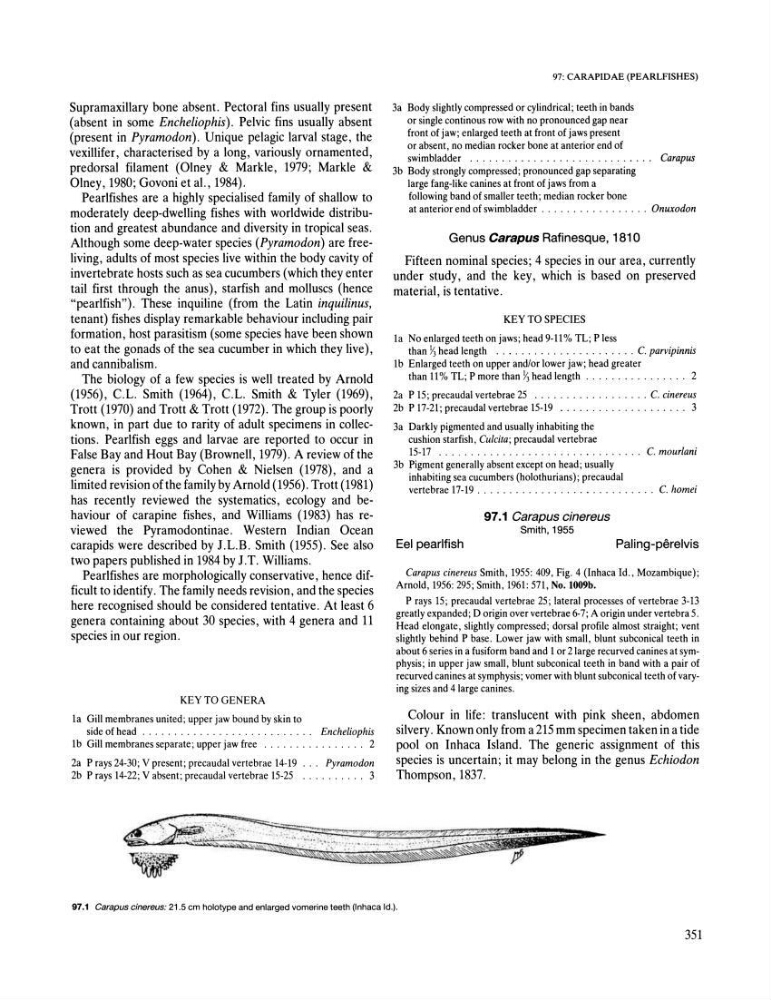
Carapus cinereus Smith, 1955: 409, Fig. 4 (Inhaca Id., Mozambique);
Arnold, 1956: 295; Smith, 1961: 571, No. lOO9b.
Prays 15; precaudal vertebrae 25; lateral processes of vertebrae 3-13
greatly expanded; D origin over vertebrae 6-7; A origin under vertebra 5.
Head elongate, slightly compressed; dorsal profile almost straight; vent
slightly behind P base. Lower jaw with small, blunt subconical teeth in
about 6 series in a fusiform band and 1 or 2 large recurved canines at symphysis; in upper jaw small, blunt subconical teeth in band with a pair of
recurved canines at symphysis; vomer with blunt subconical teeth of varying sizes and 4 large canines.
Colour in life: translucent with pink sheen, abdomen
silvery. Known only from a 215 mm specimen taken in a tide
pool on Inhaca Island. The generic assignment of this
species is uncertain; it may belong in the genus Echiodon
Thompson, 1837.
97.1 Carapus cinereus: 21.5 em holotype and enlarged vomerine teeth (Inhaea Id.).
351
(absent in some Encheliophis). Pelvic fins usually absent
(present in Pyramodon). Unique pelagic larval stage, the
vexillifer, characterised by a long, variously ornamented,
predorsal filament (Olney & Markle, 1979; Markle &
Olney, 1980; Govoni et aI., 1984).
Pearlfishes are a highly specialised family of shallow to
moderately deep-dwelling fishes with worldwide distribution and greatest abundance and diversity in tropical seas.
Although some deep-water species (Pyramodon) are freeliving, adults of most species live within the body cavity of
invertebrate hosts such as sea cucumbers (which they enter
tail first through the anus), starfish and molluscs (hence
"pearlfish"). These inquiline (from the Latin inquilinus,
tenant) fishes display remarkable behaviour including pair
formation, host parasitism (some species have been shown
to eat the gonads of the sea cucumber in which they live),
and cannibalism.
The biology of a few species is well treated by Arnold
(1956), c.L. Smith (1964), C.L. Smith & Tyler (1969),
Trott (1970) and Trott & Trott (1972). The group is poorly
known, in part due to rarity of adult specimens in collections. Pearlfish eggs and larvae are reported to occur in
False Bay and Hout Bay (Brownell, 1979). A review of the
genera is provided by Cohen & Nielsen (1978), and a
limited revision ofthe family by Arnold (1956). Trott (1981)
has recently reviewed the systematics, ecology and behaviour of carapine fishes, and Williams (1983) has reviewed the Pyramodontinae. Western Indian Ocean
carapids were described by J.L.B. Smith (1955). See also
two papers published in 1984 by J.T. Williams.
Pearlfishes are morphologically conservative, hence difficult to identify. The family needs revision, and the species
here recognised should be considered tentative. At least 6
genera containing about 30 species, with 4 genera and 11
species in our region.
KEY TO GENERA
la Gill membranes united; upper jaw bound by skin to
side of head . . . . . . . . . . . . . . . . . . . . . . . . . .. Encheliophis
1 b Gill membranes separate; upper jaw free .. . . . . . . . . . . . . . . 2
2a Prays 24-30; V present; precaudal vertebrae 14-19 ... Pyramodon
2b Prays 14-22; V absent; precaudal vertebrae 15-25 .......... 3
97: CARAPIDAE (PEARLFISHES)
3a Body slightly compressed or cylindrical; teeth in bands
or single continous row with no pronounced gap near
front of jaw; enlarged teeth at front of jaws present
or absent, no median rocker bone at anterior end of
swimbladder ............................. Carapus
3b Body strongly compressed; pronounced gap separating
large fang-like canines at front of jaws from a
following band of smaller teeth; median rocker bone
at anterior end of swim bladder . . . . . . . . . . . . . . . . . Onuxodon
Genus Carapus Rafinesque, 1810
Fifteen nominal species; 4 species in our area, currently
under study, and the key, which is based on preserved
material, is tentative.
KEY TO SPECIES
la No enlarged teeth on jaws; head 9-11 % TL; Pless
than lj head length ...................... C. parvipinnis
Ib Enlarged teeth on upper and/or lower jaw; head greater
than 11 % TL; P more than lj head length . . . . . . . . . . . . . . . . 2
2a P 15; precaudal vertebrae 25 .................. C. cinereus
2b P 17-21; precaudal vertebrae 15-19 .................... 3
3a Darkly pigmented and usually inhabiting the
cushion starfish, Culcita; precaudal vertebrae
15-17 ................................ C. mourlani
3b Pigment generally absent except on head; usually
inhabiting sea cucumbers (holothurians); precaudal
vertebrae 17-19 . . . . . . . . . . . . . . . . . . . . . . . . . . . . C. homei
Eel pearlfish
97.1 Carapus cinereus
Smith, 1955
Paling-perelvis
Carapus cinereus Smith, 1955: 409, Fig. 4 (Inhaca Id., Mozambique);
Arnold, 1956: 295; Smith, 1961: 571, No. lOO9b.
Prays 15; precaudal vertebrae 25; lateral processes of vertebrae 3-13
greatly expanded; D origin over vertebrae 6-7; A origin under vertebra 5.
Head elongate, slightly compressed; dorsal profile almost straight; vent
slightly behind P base. Lower jaw with small, blunt subconical teeth in
about 6 series in a fusiform band and 1 or 2 large recurved canines at symphysis; in upper jaw small, blunt subconical teeth in band with a pair of
recurved canines at symphysis; vomer with blunt subconical teeth of varying sizes and 4 large canines.
Colour in life: translucent with pink sheen, abdomen
silvery. Known only from a 215 mm specimen taken in a tide
pool on Inhaca Island. The generic assignment of this
species is uncertain; it may belong in the genus Echiodon
Thompson, 1837.
97.1 Carapus cinereus: 21.5 em holotype and enlarged vomerine teeth (Inhaea Id.).
351