

86: MYCTOPHIDAE (LANTERNFISHES)
1b VOzlevel or elevated, but not anteriorly displaced to
above VOl ..................................................................... 2
2a Branchiostegal membrane with small serial
photophores between branchiostegal rays ............................. 3
2b Branchiostegal membrane without serial photophores ............. 5
3a Adipose fin without luminous gland; VLO
midway between LL and V base; GR 3+(9-10),
total 12-13; SL < 43 mm ....................................... L. pusillus
3b Adipose fin with luminous gland at origin; VLO at or
about 1 photophore diameter below LL; total GR 12-23 ........... 4
4a GR (2-4)+(8-10), total 12-14; AO (5-7)+(5-8),
total 11-13; P 11-13; A origin under penultimate
Dray ................................................................... L. alatus
4b GR (5-7)+(13-16), total 20-23; AO (6-9)+(6-9),
total 14-16; P 13-15; A origin under 3rd or 4th
last Dray .......................................................... L. australis
5a One or more photophores on cheek ..................................... 6
5b No photophores on cheek .................................................. 9
6a Luminous gland at origin of adipose fin absent;
P04 midway between P03-POS and level with
VLO ............................................................ L. photonotus
6b Luminous gland at origin of adipose fin present; P04
nearer to P03 than to POs and below level of VLO ....... .. ........ 7
7a Total GR 24-30; AOa series level or only
slightly arched ............................................... L. macdonaldi
7b Total GR 13-16; AOa! and/or AOa 2 depressed ....................... 8
8a P reaching A origin; vertical distance between
margin of orbit and upper lip, taken at middle
of eye, 2 or more times in length of P base;
CPD less than "head depth" (taken on vertical
through middle of orbit) ..................................... L. intricarius
8b P not reaching A origin; vertical distance
between margin of orbit and upper lip, taken
at middle of eye, about equal to length of P
base; CPD equal to or greater than "head depth" . L. lepidolychnus
9a P extending to at least A origin .......................................... 10
9b P absent or weakly developed, not extending beyond
vertical at outer base of V ................................................. 13
lOa VLO about 1 photophore-diameter below LL ......... L. steinbecki
lOb VLO more than 3 photophore-diameters below LL ................ 11
11a PrcZ-Prc4 forming a straight, oblique line or an arc
with concavity directed posteriorly and ventrally ......... L. nobilis
11b PrcZ-Prc4 forming an arc with concavity directed anteriorly
and dorsally .................................................................. 12
12a VO series level; infracaudal gland not extending
entire distance from procurrent C rays to A base;
Prc3 at level of Prc!; P 13-14; AO 12-13 ................ L. tenuiformis
12b VO series arched; infracaudal gland extending
from procurrent C rays to A base; Prc3 above level
ofPrc!; P 15-17; AO 15-16 ...................................... L.festivus
13a PrcZ-Prc4 forming a straight, oblique line; SAO!
midway between V03-V04 or nearer V04;
supracaudal and infracaudal glands with black
cap on rear margin ............................................... L. lineatus
13b Prc2-Prc4 forming a right angle, with Prc3 almost directly
below Prc4; SAO! usually midway between VOz-V03 or
nearer V02 or nearer V03; supracaudal and infracaudal
glands without black cap on rear margin .............................. 14
306
14a Pol on or slightly before vertical at origin of adipose fin; origin
of adipose fin well in advance of vertical at base of last A ray .... 15
14b Pol well in front of vertical at origin of adipose fin; origin of
adipose fin on or slightly behind vertical at base of last A ray .... 16
15a LL 36-39; total GR 16-18; AO (6-8)+(6-9), total
12-15; SA02 closer to V04 than to AOa! ....................... L. ater
15b LL 29-32; total GR 14-17; AO (4-6)+ (5-7), total
9-12; SA02 midway between V04 and AOa! or
closer to V04 ......................................................... L. sp. A
16a GR (5-6)+(12-14), total 17-20; distance from tip of
snout to origin of D less than 50% SL; size at sexual
maturity 150 mm .................................................. L. achirus
16b GR (4-5)+(11-12), total 15-17; distance tip of snout
to D origin greater than 50% SL; size at sexual
maturity 90 mm ........ .............................................. L. sp. B
86.73 Lampanyctus achirus
Andriashev, 1962
Lampanyctus ater (non Ti'ming): Norman, 1930: 331. Lampanyctus
achirus Andriashev, 1962: 256, Fig. 27 (64°36'S, 108°52'W); Nafpaktitis&
Nafpaktitis, 1969: 45* (in part); McGinnis, 1974: 143*; Wisner, 1976: 176*
(in part); Hulley, 1981: 182*; 1984: 78*.
D 14-16; A 16-20; GR (5-6)+(12-14); AO (6-8)+(7-9).
Attains 162 mm. High-oceanic, bathypelagic; usually
below 500 m, but shallower in upwelling regions. In southern Benguela Upwelling Region and off south and east
coasts, north to about 31°S. Circumglobal from about Subtropical Convergence to south of Antarctic Polar Front,
with northern extensions to 21°S in eastern boundary currents.
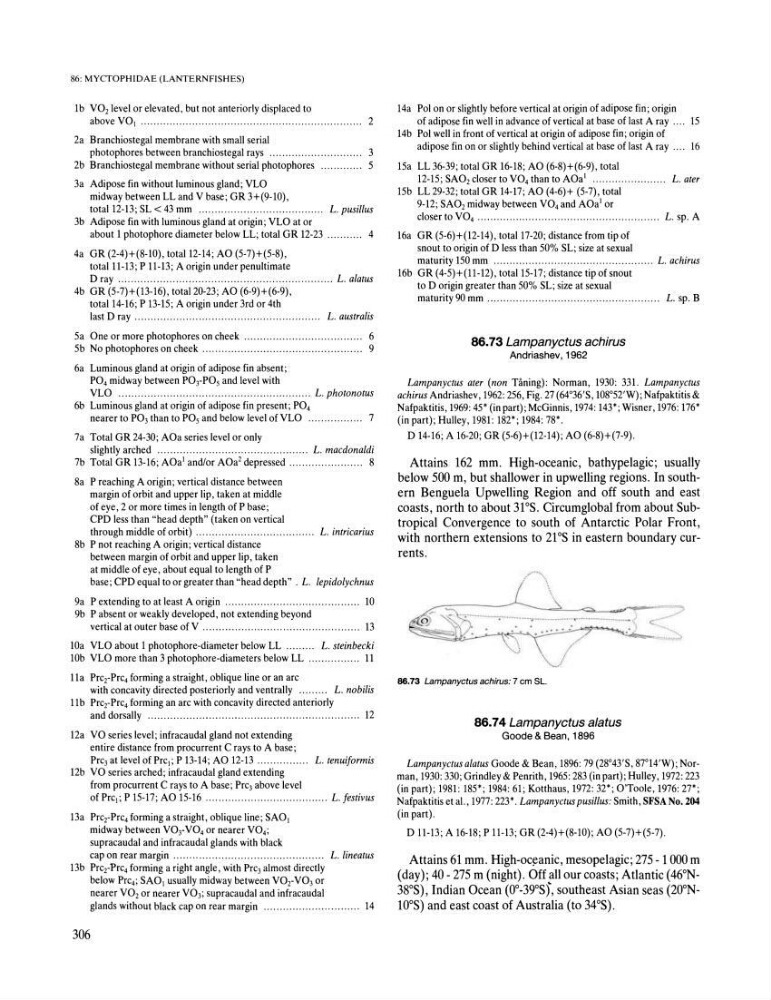
86.73 Lampanyelus aehirus: 7 em Sl.
86.74 Lampanyctus alatus
Goode & Bean, 1896
Lampanyctus alatus Goode & Bean, 1896: 79 (28°43'S, 87°14'W); Norman, 1930: 330; Grindley & Penrith, 1965: 283 (in part); Hulley, 1972: 223
(in part); 1981: 185*; 1984: 61; Kotthaus, 1972: 32*; O'Toole, 1976: 27*;
Nafpaktitis et al., 1977: 223*. Lampanyctus pusillus: Smith, SFSA No. 204
(in part).
D 11-13; A 16-18; P 11-13; GR (2-4)+(8-10); AO (5-7)+(5-7).
Attains 61 mm. High-oq:anic, mesopelagic; 275 -1 000 m
(day); 40 - 275 m (night). Off all our coasts; Atlantic (46°N38°S), Indian Ocean W-39°S)", southeast Asian seas (200NlOOS) and east coast of Australia (to 34°S).
1b VOzlevel or elevated, but not anteriorly displaced to
above VOl ..................................................................... 2
2a Branchiostegal membrane with small serial
photophores between branchiostegal rays ............................. 3
2b Branchiostegal membrane without serial photophores ............. 5
3a Adipose fin without luminous gland; VLO
midway between LL and V base; GR 3+(9-10),
total 12-13; SL < 43 mm ....................................... L. pusillus
3b Adipose fin with luminous gland at origin; VLO at or
about 1 photophore diameter below LL; total GR 12-23 ........... 4
4a GR (2-4)+(8-10), total 12-14; AO (5-7)+(5-8),
total 11-13; P 11-13; A origin under penultimate
Dray ................................................................... L. alatus
4b GR (5-7)+(13-16), total 20-23; AO (6-9)+(6-9),
total 14-16; P 13-15; A origin under 3rd or 4th
last Dray .......................................................... L. australis
5a One or more photophores on cheek ..................................... 6
5b No photophores on cheek .................................................. 9
6a Luminous gland at origin of adipose fin absent;
P04 midway between P03-POS and level with
VLO ............................................................ L. photonotus
6b Luminous gland at origin of adipose fin present; P04
nearer to P03 than to POs and below level of VLO ....... .. ........ 7
7a Total GR 24-30; AOa series level or only
slightly arched ............................................... L. macdonaldi
7b Total GR 13-16; AOa! and/or AOa 2 depressed ....................... 8
8a P reaching A origin; vertical distance between
margin of orbit and upper lip, taken at middle
of eye, 2 or more times in length of P base;
CPD less than "head depth" (taken on vertical
through middle of orbit) ..................................... L. intricarius
8b P not reaching A origin; vertical distance
between margin of orbit and upper lip, taken
at middle of eye, about equal to length of P
base; CPD equal to or greater than "head depth" . L. lepidolychnus
9a P extending to at least A origin .......................................... 10
9b P absent or weakly developed, not extending beyond
vertical at outer base of V ................................................. 13
lOa VLO about 1 photophore-diameter below LL ......... L. steinbecki
lOb VLO more than 3 photophore-diameters below LL ................ 11
11a PrcZ-Prc4 forming a straight, oblique line or an arc
with concavity directed posteriorly and ventrally ......... L. nobilis
11b PrcZ-Prc4 forming an arc with concavity directed anteriorly
and dorsally .................................................................. 12
12a VO series level; infracaudal gland not extending
entire distance from procurrent C rays to A base;
Prc3 at level of Prc!; P 13-14; AO 12-13 ................ L. tenuiformis
12b VO series arched; infracaudal gland extending
from procurrent C rays to A base; Prc3 above level
ofPrc!; P 15-17; AO 15-16 ...................................... L.festivus
13a PrcZ-Prc4 forming a straight, oblique line; SAO!
midway between V03-V04 or nearer V04;
supracaudal and infracaudal glands with black
cap on rear margin ............................................... L. lineatus
13b Prc2-Prc4 forming a right angle, with Prc3 almost directly
below Prc4; SAO! usually midway between VOz-V03 or
nearer V02 or nearer V03; supracaudal and infracaudal
glands without black cap on rear margin .............................. 14
306
14a Pol on or slightly before vertical at origin of adipose fin; origin
of adipose fin well in advance of vertical at base of last A ray .... 15
14b Pol well in front of vertical at origin of adipose fin; origin of
adipose fin on or slightly behind vertical at base of last A ray .... 16
15a LL 36-39; total GR 16-18; AO (6-8)+(6-9), total
12-15; SA02 closer to V04 than to AOa! ....................... L. ater
15b LL 29-32; total GR 14-17; AO (4-6)+ (5-7), total
9-12; SA02 midway between V04 and AOa! or
closer to V04 ......................................................... L. sp. A
16a GR (5-6)+(12-14), total 17-20; distance from tip of
snout to origin of D less than 50% SL; size at sexual
maturity 150 mm .................................................. L. achirus
16b GR (4-5)+(11-12), total 15-17; distance tip of snout
to D origin greater than 50% SL; size at sexual
maturity 90 mm ........ .............................................. L. sp. B
86.73 Lampanyctus achirus
Andriashev, 1962
Lampanyctus ater (non Ti'ming): Norman, 1930: 331. Lampanyctus
achirus Andriashev, 1962: 256, Fig. 27 (64°36'S, 108°52'W); Nafpaktitis&
Nafpaktitis, 1969: 45* (in part); McGinnis, 1974: 143*; Wisner, 1976: 176*
(in part); Hulley, 1981: 182*; 1984: 78*.
D 14-16; A 16-20; GR (5-6)+(12-14); AO (6-8)+(7-9).
Attains 162 mm. High-oceanic, bathypelagic; usually
below 500 m, but shallower in upwelling regions. In southern Benguela Upwelling Region and off south and east
coasts, north to about 31°S. Circumglobal from about Subtropical Convergence to south of Antarctic Polar Front,
with northern extensions to 21°S in eastern boundary currents.
86.73 Lampanyelus aehirus: 7 em Sl.
86.74 Lampanyctus alatus
Goode & Bean, 1896
Lampanyctus alatus Goode & Bean, 1896: 79 (28°43'S, 87°14'W); Norman, 1930: 330; Grindley & Penrith, 1965: 283 (in part); Hulley, 1972: 223
(in part); 1981: 185*; 1984: 61; Kotthaus, 1972: 32*; O'Toole, 1976: 27*;
Nafpaktitis et al., 1977: 223*. Lampanyctus pusillus: Smith, SFSA No. 204
(in part).
D 11-13; A 16-18; P 11-13; GR (2-4)+(8-10); AO (5-7)+(5-7).
Attains 61 mm. High-oq:anic, mesopelagic; 275 -1 000 m
(day); 40 - 275 m (night). Off all our coasts; Atlantic (46°N38°S), Indian Ocean W-39°S)", southeast Asian seas (200NlOOS) and east coast of Australia (to 34°S).