

D 13-14; A 13-14; P 14-15; GR (7-8)+(17-20); AO (5-7)+(2-3).
Attains 139 mm. High-oceanic, mesopelagic; about 700
m (day); below 60 m (night). Off east coast and Cape Peninsula; convergence species in all 3 oceans (30 0 -47°S).
86.70 Lampadena pontifex
Krefft, 1970
Lampadena ponti/ex Krefft, 1970: 277, Figs. 1-3 (W31'N, 17°39'W);
Karrer, 1975: 69; Hulley, 1981: 178*.
D 14; A 14-15; P 13-15; GR 7+(15-16); AO (6-7)+(3-4). Supracaudal
gland subequal to length of infracaudal gland; distance from A base to infracaudal gland less than Yz length of gland.
Attains 110 mm. Pseudoceanic, pelagic; 275 - 750 m
(day); 90 - 275 m (night). Recorded from west coast continental shelf at about 25°S, the Mauritanian Upwelling
Region and near St. Helena.
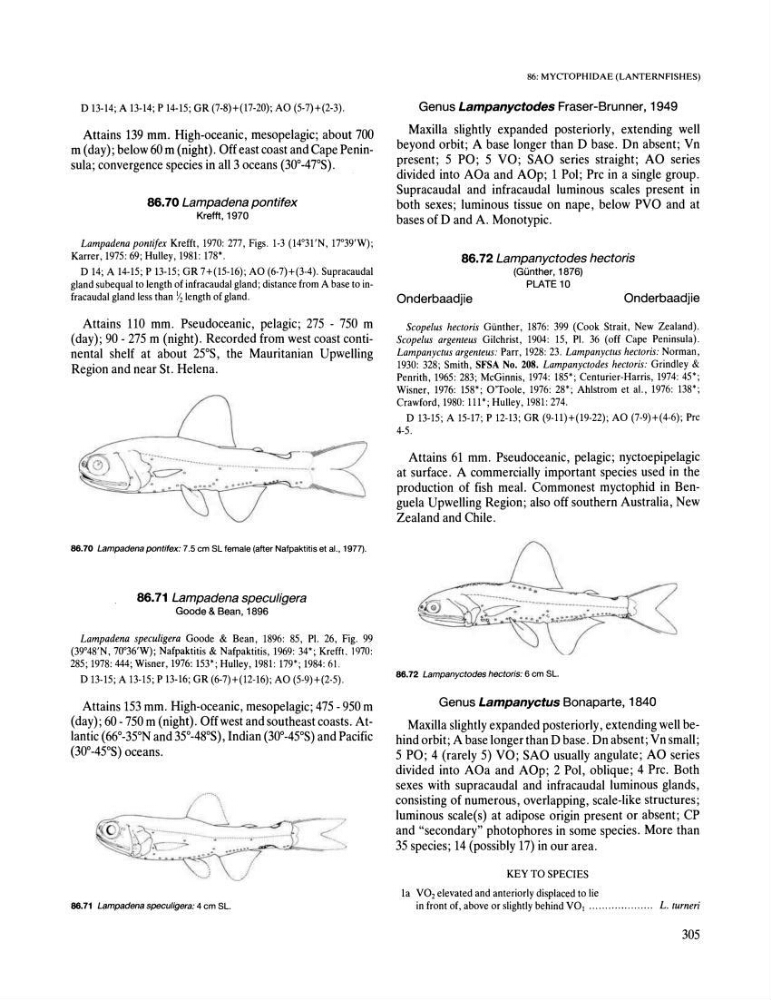
86.70 Lampadena pontifex: 7.5 em SL female (after Nafpaktitis et aI., 1977).
86.71 Lampadena specu/igera
Goode & Bean, 1896
Lampadena specu/igera Goode & Bean, 1896: 85, PI. 26, Fig. 99
(39°48'N, 70 0 36'W); Nafpaktitis & Nafpaktitis, 1969: 34*; Kreffl. 1970:
285; 1978: 444; Wisner, 1976: 153*; Hulley, 1981: 179*; 1984: 61.
D 13-15; A 13-15; P 13-16; GR (6-7)+(12-16); AO (5-9)+(2-5).
Attains 153 mm. High-oceanic, mesopelagic; 475 - 950 m
(day); 60 - 750 m (night). Off west and southeast coasts. Atlantic (66°-35°N and 35°-48°S), Indian (30 0 -45°S) and Pacific
(30
0
-45°S) oceans.
.. '
<~~
~--!!--=---=--~-.... ">
86.71 Lampadena speculigera: 4 em SL.
86: MYCfOPHIDAE (LANTERN FISHES)
Genus Lampanyctodes Fraser-Brunner, 1949
Maxilla slightly expanded posteriorly, extending well
beyond orbit; A base longer than Dbase. Dn absent; Vn
present; 5 PO; 5 VO; SAO series straight; AO series
divided into AOa and AOp; 1 Pol; Prc in a single group.
Supracaudal and infracaudal luminous scales present in
both sexes; luminous tissue on nape, below PVO and at
bases of D and A. Monotypic.
86.72 Lampanyctodes hectoris
(Gunther, 1876)
PLATE 10
Onderbaadjie
Onderbaadjie
Scope/us hectoris Gunther, 1876: 399 (Cook Strait, New Zealand).
Scope/us argenteus Gilchrist, 1904: 15, PI. 36 (off Cape Peninsula).
Lampanyctus argenteus: Parr, 1928: 23. Lampanyctus hectoris: Norman,
1930: 328; Smith, SFSA No. 208. Lampanyctodes hectoris: Grindley &
Penrith, 1965: 283; McGinnis, 1974: 185*; Centurier-Harris, 1974: 45*;
Wisner, 1976: 158*; O'Toole, 1976: 28*; Ahlstrom et a!., 1976: 138*;
Crawford, 1980: 111*; Hulley, 1981: 274.
D 13-15; A 15-17; P 12-13; GR (9-11)+(19-22); AO (7-9)+(4-6); Prc
4-5.
Attains 61 mm. Pseudoceanic, pelagic; nyctoepipelagic
at surface. A commercially important species used in the
production of fish meal. Commonest myctophid in Benguela Upwelling Region; also off southern Australia, New
Zealand and Chile.
86.72 Lampanyctodes hectoris: 6 em SL.
Genus Lampanyctus Bonaparte, 1840
Maxilla slightly expanded posteriorly, extending well behind orbit; A base longer than Dbase. Dn absent; Vn small;
5 PO; 4 (rarely 5) VO; SAO usually angulate; AO series
divided into AOa and AOp; 2 Pol, oblique; 4 Prc. Both
sexes with supra caudal and infracaudal luminous glands,
consisting of numerous, overlapping, scale-like structures;
luminous scale(s) at adipose origin present or absent; CP
and "secondary" photophores in some species. More than
35 species; 14 (possibly 17) in our area.
KEY TO SPECIES
1a V02 elevated and anteriorly displaced to lie
in front of, above or slightly behind VOl .................... L. turneri
305
Attains 139 mm. High-oceanic, mesopelagic; about 700
m (day); below 60 m (night). Off east coast and Cape Peninsula; convergence species in all 3 oceans (30 0 -47°S).
86.70 Lampadena pontifex
Krefft, 1970
Lampadena ponti/ex Krefft, 1970: 277, Figs. 1-3 (W31'N, 17°39'W);
Karrer, 1975: 69; Hulley, 1981: 178*.
D 14; A 14-15; P 13-15; GR 7+(15-16); AO (6-7)+(3-4). Supracaudal
gland subequal to length of infracaudal gland; distance from A base to infracaudal gland less than Yz length of gland.
Attains 110 mm. Pseudoceanic, pelagic; 275 - 750 m
(day); 90 - 275 m (night). Recorded from west coast continental shelf at about 25°S, the Mauritanian Upwelling
Region and near St. Helena.
86.70 Lampadena pontifex: 7.5 em SL female (after Nafpaktitis et aI., 1977).
86.71 Lampadena specu/igera
Goode & Bean, 1896
Lampadena specu/igera Goode & Bean, 1896: 85, PI. 26, Fig. 99
(39°48'N, 70 0 36'W); Nafpaktitis & Nafpaktitis, 1969: 34*; Kreffl. 1970:
285; 1978: 444; Wisner, 1976: 153*; Hulley, 1981: 179*; 1984: 61.
D 13-15; A 13-15; P 13-16; GR (6-7)+(12-16); AO (5-9)+(2-5).
Attains 153 mm. High-oceanic, mesopelagic; 475 - 950 m
(day); 60 - 750 m (night). Off west and southeast coasts. Atlantic (66°-35°N and 35°-48°S), Indian (30 0 -45°S) and Pacific
(30
0
-45°S) oceans.
.. '
<~~
~--!!--=---=--~-.... ">
86.71 Lampadena speculigera: 4 em SL.
86: MYCfOPHIDAE (LANTERN FISHES)
Genus Lampanyctodes Fraser-Brunner, 1949
Maxilla slightly expanded posteriorly, extending well
beyond orbit; A base longer than Dbase. Dn absent; Vn
present; 5 PO; 5 VO; SAO series straight; AO series
divided into AOa and AOp; 1 Pol; Prc in a single group.
Supracaudal and infracaudal luminous scales present in
both sexes; luminous tissue on nape, below PVO and at
bases of D and A. Monotypic.
86.72 Lampanyctodes hectoris
(Gunther, 1876)
PLATE 10
Onderbaadjie
Onderbaadjie
Scope/us hectoris Gunther, 1876: 399 (Cook Strait, New Zealand).
Scope/us argenteus Gilchrist, 1904: 15, PI. 36 (off Cape Peninsula).
Lampanyctus argenteus: Parr, 1928: 23. Lampanyctus hectoris: Norman,
1930: 328; Smith, SFSA No. 208. Lampanyctodes hectoris: Grindley &
Penrith, 1965: 283; McGinnis, 1974: 185*; Centurier-Harris, 1974: 45*;
Wisner, 1976: 158*; O'Toole, 1976: 28*; Ahlstrom et a!., 1976: 138*;
Crawford, 1980: 111*; Hulley, 1981: 274.
D 13-15; A 15-17; P 12-13; GR (9-11)+(19-22); AO (7-9)+(4-6); Prc
4-5.
Attains 61 mm. Pseudoceanic, pelagic; nyctoepipelagic
at surface. A commercially important species used in the
production of fish meal. Commonest myctophid in Benguela Upwelling Region; also off southern Australia, New
Zealand and Chile.
86.72 Lampanyctodes hectoris: 6 em SL.
Genus Lampanyctus Bonaparte, 1840
Maxilla slightly expanded posteriorly, extending well behind orbit; A base longer than Dbase. Dn absent; Vn small;
5 PO; 4 (rarely 5) VO; SAO usually angulate; AO series
divided into AOa and AOp; 2 Pol, oblique; 4 Prc. Both
sexes with supra caudal and infracaudal luminous glands,
consisting of numerous, overlapping, scale-like structures;
luminous scale(s) at adipose origin present or absent; CP
and "secondary" photophores in some species. More than
35 species; 14 (possibly 17) in our area.
KEY TO SPECIES
1a V02 elevated and anteriorly displaced to lie
in front of, above or slightly behind VOl .................... L. turneri
305