

73: PHOTICHTHYIDAE (LIGHTFISHES)
rear margin of A; A base sub equal to or shorter than D
base, its origin below middle or end of D base. V insertion
slightly in advance of D origin. Five species, 3 from our
area.
KEY TO SPECIES
(for fish >20 mm SL)
la SO present; premaxilla with 6-10 small subequal
teeth ... ... .............. ... ........................... .. ............ V. nimbaria
Ib SO absent; premaxilla with 3 or 4 long teeth and a few
smaller ones .... ........ ... ... .. ......... ........ ... ....... ...... ..... ..... ...... 2
2a Total GR 14-16; eyes normal, lateral; dark streak
at lower jaw symphysis ... .. .... ............ .... .. ...... ..... .. . V. poweriae
2b Total GR 19-22; eyes slightly tubular; no dark
streak at lower jaw symphysis ............. .... ............... V. attenuata
73.7 Vinciguerria attenuata
(Cocco, 1838)
Maurolicus attenuatus Cocco, 1838: 193, PI. 8, Fig. 3 (Mediterranean
Sea). Vinciguerria attenuata: Grey, 1964: 143*; Grindley & Penrith, 1965:
282 (in part); Hulley, 1972: 205. Vinciguerria lucetia (non Garman);
Smith, SFSA No. 157.
D 13-15; A 13-16; P 8-10; V 6-7; total GR 19-22; vertebrae 40-41; eyes
slightly tubular. Interorbital width narrow. Photophores: SO absent, BR
7-10, IV 22-24, VAV 7-10, AC 12-14, IC 44-45 , OA 21- 23. Anus under
6th-7th YAY.
Dark dorsum, silvery flanks; lower jaw symphysis, premaxilla and fin rays lacking pigment streaks. Medial caudal
melanophore present in juveniles. Attains at least 45 mm.
Juveniles and adults mainly in 250 - 600 m by day and
100 - 500 m by night in all 3 major oceans, Mediterranean
Sea; off Cape Point, and off Inhaca Id.
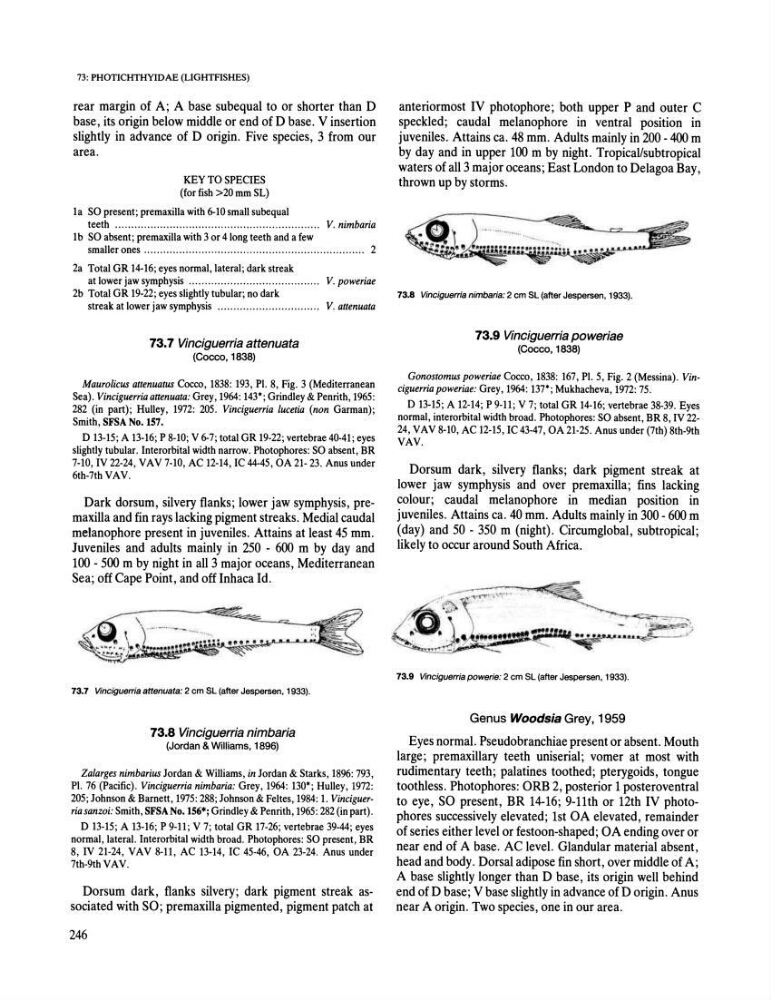
73.7 Vinciguerria attenuata: 2 em SL (after Jespersen, 1933).
73.8 Vinciguerria nimbaria
(Jordan & Williams, 1896)
Zalarges nimbarius Jordan & Williams, in Jordan & Starks, 1896: 793,
PI. 76 (Pacific). Vinciguerria nimbaria: Grey, 1964: 130*; Hulley, 1972:
205; Johnson & Barnett, 1975: 288; Johnson & Feltes, 1984: 1. Vinciguerria sanzoi: Smith, SFSA No. 156*; Grindley & Penrith, 1965: 282 (in part) .
D 13-15; A 13-16; P 9-11; V 7; total GR 17-26; vertebrae 39-44; eyes
normal, lateral. Interorbital width broad. Photophores: SO present, BR
8, IV 21-24, VA V 8-11, AC 13-14, IC 45-46, OA 23-24. Anus under
7th-9th V A V.
Dorsum dark, flanks silvery; dark pigment streak associated with SO; premaxilla pigmented, pigment patch at
246
anteriormost IV photophore; both upper P and outer C
speckled; caudal melanophore in ventral position in
juveniles. Attains ca. 48 mm. Adults mainly in 200 - 400 m
by day and in upper 100 m by night. Tropical/subtropical
waters of all 3 major oceans; East London to Delagoa Bay,
thrown up by storms.
73.8 Vinciguerria nimbaria: 2 em SL (after Jespersen, 1933).
73.9 Vinciguerria poweriae
(Cocco, 1838)
Gonostomus poweriae Cocco, 1838: 167, PI. 5, Fig. 2 (Messina). Vinciguerria poweriae: Grey, 1964: 137*; Mukhacheva, 1972: 75.
D 13-15; A 12-14; P 9-11 ; V 7; total GR 14-16; vertebrae 38-39. Eyes
normal, interorbital width broad. Photophores: SO absent, BR 8, IV 2224, VA V 8-10, AC 12-15, IC 43-47, OA 21-25. Anus under (7th) 8th-9th
YAY.
Dorsum dark, silvery flanks; dark pigment streak at
lower jaw symphysis and over premaxilla; fins lacking
colour; caudal melanophore in median position in
juveniles. Attains ca. 40 mm. Adults mainly in 300 - 600 m
(day) and 50 - 350 m (night). Circumglobal, subtropical;
likely to occur around South Africa.
--. - .
. ' ~;
73.9 Vinciguerria powerie: 2 em SL (after Jespersen, 1933).
Genus Woodsia Grey, 1959
Eyes normal. Pseudobranchiae present or absent. Mouth
large; premaxillary teeth uniserial; vomer at most with
rudimentary teeth; palatines toothed; pterygoids, tongue
toothless. Photophores: ORB 2, posterior 1 posteroventral
to eye, SO present, BR 14-16; 9-11th or 12th IV photophores successively elevated; 1st OA elevated, remainder
of series either level or festoon-shaped; OA ending over or
near end of A base. AC level. Glandular material absent,
head and body. Dorsal adipose fin short, over middle of A;
A base slightly longer than D base, its origin well behind
end of D base; V base slightly in advance of D origin . Anus
near A origin. Two species, one in our area.
rear margin of A; A base sub equal to or shorter than D
base, its origin below middle or end of D base. V insertion
slightly in advance of D origin. Five species, 3 from our
area.
KEY TO SPECIES
(for fish >20 mm SL)
la SO present; premaxilla with 6-10 small subequal
teeth ... ... .............. ... ........................... .. ............ V. nimbaria
Ib SO absent; premaxilla with 3 or 4 long teeth and a few
smaller ones .... ........ ... ... .. ......... ........ ... ....... ...... ..... ..... ...... 2
2a Total GR 14-16; eyes normal, lateral; dark streak
at lower jaw symphysis ... .. .... ............ .... .. ...... ..... .. . V. poweriae
2b Total GR 19-22; eyes slightly tubular; no dark
streak at lower jaw symphysis ............. .... ............... V. attenuata
73.7 Vinciguerria attenuata
(Cocco, 1838)
Maurolicus attenuatus Cocco, 1838: 193, PI. 8, Fig. 3 (Mediterranean
Sea). Vinciguerria attenuata: Grey, 1964: 143*; Grindley & Penrith, 1965:
282 (in part); Hulley, 1972: 205. Vinciguerria lucetia (non Garman);
Smith, SFSA No. 157.
D 13-15; A 13-16; P 8-10; V 6-7; total GR 19-22; vertebrae 40-41; eyes
slightly tubular. Interorbital width narrow. Photophores: SO absent, BR
7-10, IV 22-24, VAV 7-10, AC 12-14, IC 44-45 , OA 21- 23. Anus under
6th-7th YAY.
Dark dorsum, silvery flanks; lower jaw symphysis, premaxilla and fin rays lacking pigment streaks. Medial caudal
melanophore present in juveniles. Attains at least 45 mm.
Juveniles and adults mainly in 250 - 600 m by day and
100 - 500 m by night in all 3 major oceans, Mediterranean
Sea; off Cape Point, and off Inhaca Id.
73.7 Vinciguerria attenuata: 2 em SL (after Jespersen, 1933).
73.8 Vinciguerria nimbaria
(Jordan & Williams, 1896)
Zalarges nimbarius Jordan & Williams, in Jordan & Starks, 1896: 793,
PI. 76 (Pacific). Vinciguerria nimbaria: Grey, 1964: 130*; Hulley, 1972:
205; Johnson & Barnett, 1975: 288; Johnson & Feltes, 1984: 1. Vinciguerria sanzoi: Smith, SFSA No. 156*; Grindley & Penrith, 1965: 282 (in part) .
D 13-15; A 13-16; P 9-11; V 7; total GR 17-26; vertebrae 39-44; eyes
normal, lateral. Interorbital width broad. Photophores: SO present, BR
8, IV 21-24, VA V 8-11, AC 13-14, IC 45-46, OA 23-24. Anus under
7th-9th V A V.
Dorsum dark, flanks silvery; dark pigment streak associated with SO; premaxilla pigmented, pigment patch at
246
anteriormost IV photophore; both upper P and outer C
speckled; caudal melanophore in ventral position in
juveniles. Attains ca. 48 mm. Adults mainly in 200 - 400 m
by day and in upper 100 m by night. Tropical/subtropical
waters of all 3 major oceans; East London to Delagoa Bay,
thrown up by storms.
73.8 Vinciguerria nimbaria: 2 em SL (after Jespersen, 1933).
73.9 Vinciguerria poweriae
(Cocco, 1838)
Gonostomus poweriae Cocco, 1838: 167, PI. 5, Fig. 2 (Messina). Vinciguerria poweriae: Grey, 1964: 137*; Mukhacheva, 1972: 75.
D 13-15; A 12-14; P 9-11 ; V 7; total GR 14-16; vertebrae 38-39. Eyes
normal, interorbital width broad. Photophores: SO absent, BR 8, IV 2224, VA V 8-10, AC 12-15, IC 43-47, OA 21-25. Anus under (7th) 8th-9th
YAY.
Dorsum dark, silvery flanks; dark pigment streak at
lower jaw symphysis and over premaxilla; fins lacking
colour; caudal melanophore in median position in
juveniles. Attains ca. 40 mm. Adults mainly in 300 - 600 m
(day) and 50 - 350 m (night). Circumglobal, subtropical;
likely to occur around South Africa.
--. - .
. ' ~;
73.9 Vinciguerria powerie: 2 em SL (after Jespersen, 1933).
Genus Woodsia Grey, 1959
Eyes normal. Pseudobranchiae present or absent. Mouth
large; premaxillary teeth uniserial; vomer at most with
rudimentary teeth; palatines toothed; pterygoids, tongue
toothless. Photophores: ORB 2, posterior 1 posteroventral
to eye, SO present, BR 14-16; 9-11th or 12th IV photophores successively elevated; 1st OA elevated, remainder
of series either level or festoon-shaped; OA ending over or
near end of A base. AC level. Glandular material absent,
head and body. Dorsal adipose fin short, over middle of A;
A base slightly longer than D base, its origin well behind
end of D base; V base slightly in advance of D origin . Anus
near A origin. Two species, one in our area.