

Order GONORHYNCHIFORMES
Mouth small, toothless; epibranchial organs (bilateral
pouches behind fourth gill arch) present; pelvic fins abdominal; pectoral fin base horizontal; well-developed scaly axillary process at base of pectoral and pelvic fins; no fin spines;
eye covered with skin; neural arch of first vertebra enlarged
and forms an extensive joint with the cranium.
Gonorhynchiforms are thought to be closely related to
the dominant freshwater group known as the ostariophysan
fishes (Fink & Fink, 1981). The ostariophysans comprise
the Cypriniformes (minnows, etc.), Characiformes (characins) and the Siluriformes (gymnotids and catfishes); altogether they represent about three-quarters of the world's
freshwater fishes.
Four families of gonorhynchiforms are recognised (Nelson, 1984); two families occur in our area, and the other two
in freshwaters of tropical Africa.
Family No. 57: GONORHYNCHIDAE
by M.M. Smith
Beaked sandfish
Spitsbek-sandvis
Elongate, tapered body with pointed snout; mouth
inferior; jaws toothless; barbel below end of snout; epibranchial organs behind 4th gill arch; gill openings narrow;
branchiostegals 4; no gasbladder; fish entirely covered by
small ctenoid scales. A single genus, Gonorhynchus
Scopoli, 1777, with 7 nominal species, which most recent
authors consider synonyms of G. gonorhynchus; but as
this fish is anti-tropical there could be 2 or more species.
Fortunately the oldest name was given to the fish described
from the Cape of Good Hope.
57.1 Gonorhynchus gonorhynchus
(Linnaeus, 1766)
PLATE 9
Beaked sandfish
Spitsbek -sand vis
Cyprinus gonorhynchus Linnaeus, 1766: 528 (Cape of Good Hope).
Gonorhynchus gonorhynchus: Smith, SFSA No. 102*.
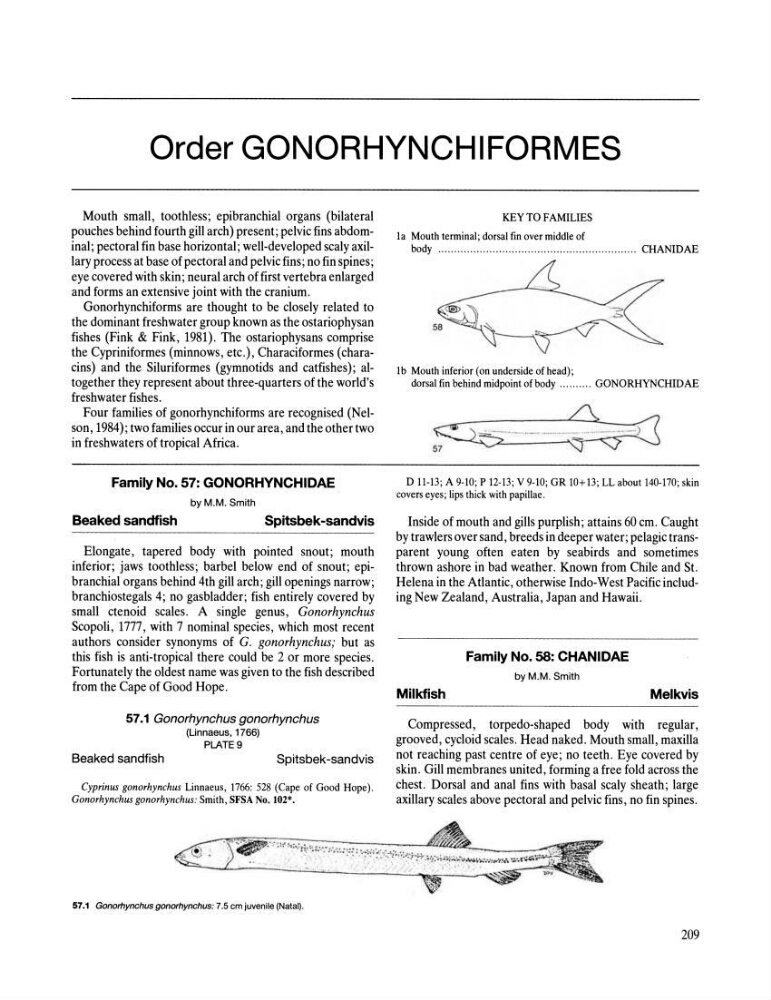
57.1 Gonorhynchus gonorhynchus: 7.5 em juvenile (Natal).
KEY TO FAMILIES
la Mouth terminal; dorsal fin over middle of
body ................. .. ........................................ ... CHANIDAE
Ib Mouth inferior (on underside of head);
dorsal fin behind midpoint of body .......... GONORHYNCHIDAE
D 11-13; A 9-10; P 12-13; V 9-10; GR 10+ 13; LL about 140-170; skin
covers eyes; lips thick with papillae.
Inside of mouth and gills purplish; attains 60 cm. Caught
by trawlers over sand, breeds in deeper water; pelagic transparent young often eaten by seabirds and sometimes
thrown ashore in bad weather. Known from Chile and St.
Helena in the Atlantic, otherwise Indo-West Pacific including New Zealand, Australia, Japan and Hawaii.
Milkfish
Family No. 58: CHANIDAE
by M.M. Smith
Melkvis
Compressed, torpedo-shaped body with regular,
grooved, cycloid scales. Head naked. Mouth small, maxilla
not reaching past centre of eye; no teeth. Eye covered by
skin. Gill membranes united, forming a free fold across the
chest. Dorsal and anal fins with basal scaly sheath; large
axillary scales above pectoral and pelvic fins, no fin spines.
209
Mouth small, toothless; epibranchial organs (bilateral
pouches behind fourth gill arch) present; pelvic fins abdominal; pectoral fin base horizontal; well-developed scaly axillary process at base of pectoral and pelvic fins; no fin spines;
eye covered with skin; neural arch of first vertebra enlarged
and forms an extensive joint with the cranium.
Gonorhynchiforms are thought to be closely related to
the dominant freshwater group known as the ostariophysan
fishes (Fink & Fink, 1981). The ostariophysans comprise
the Cypriniformes (minnows, etc.), Characiformes (characins) and the Siluriformes (gymnotids and catfishes); altogether they represent about three-quarters of the world's
freshwater fishes.
Four families of gonorhynchiforms are recognised (Nelson, 1984); two families occur in our area, and the other two
in freshwaters of tropical Africa.
Family No. 57: GONORHYNCHIDAE
by M.M. Smith
Beaked sandfish
Spitsbek-sandvis
Elongate, tapered body with pointed snout; mouth
inferior; jaws toothless; barbel below end of snout; epibranchial organs behind 4th gill arch; gill openings narrow;
branchiostegals 4; no gasbladder; fish entirely covered by
small ctenoid scales. A single genus, Gonorhynchus
Scopoli, 1777, with 7 nominal species, which most recent
authors consider synonyms of G. gonorhynchus; but as
this fish is anti-tropical there could be 2 or more species.
Fortunately the oldest name was given to the fish described
from the Cape of Good Hope.
57.1 Gonorhynchus gonorhynchus
(Linnaeus, 1766)
PLATE 9
Beaked sandfish
Spitsbek -sand vis
Cyprinus gonorhynchus Linnaeus, 1766: 528 (Cape of Good Hope).
Gonorhynchus gonorhynchus: Smith, SFSA No. 102*.
57.1 Gonorhynchus gonorhynchus: 7.5 em juvenile (Natal).
KEY TO FAMILIES
la Mouth terminal; dorsal fin over middle of
body ................. .. ........................................ ... CHANIDAE
Ib Mouth inferior (on underside of head);
dorsal fin behind midpoint of body .......... GONORHYNCHIDAE
D 11-13; A 9-10; P 12-13; V 9-10; GR 10+ 13; LL about 140-170; skin
covers eyes; lips thick with papillae.
Inside of mouth and gills purplish; attains 60 cm. Caught
by trawlers over sand, breeds in deeper water; pelagic transparent young often eaten by seabirds and sometimes
thrown ashore in bad weather. Known from Chile and St.
Helena in the Atlantic, otherwise Indo-West Pacific including New Zealand, Australia, Japan and Hawaii.
Milkfish
Family No. 58: CHANIDAE
by M.M. Smith
Melkvis
Compressed, torpedo-shaped body with regular,
grooved, cycloid scales. Head naked. Mouth small, maxilla
not reaching past centre of eye; no teeth. Eye covered by
skin. Gill membranes united, forming a free fold across the
chest. Dorsal and anal fins with basal scaly sheath; large
axillary scales above pectoral and pelvic fins, no fin spines.
209