

52: NOTACANTHIDAE (SPINY EELS)
Genus Polyacanthonotus Bleeker, 1874
Three species, 2 in our area.
KEY TO SPECIES
la Maxilla reaches to or beyond front margin of eye
P. africanus
Ib Maxilla not reaching eye .................... P. rissoanus
52.2 Polyacanthonotus africanus
(Gilchrist & von Bonde, 1924)
Macdonaldia africana Gilchrist & von Bonde, 1924: 11, PI. 3, Fig. 4 (off
Table Bay, 2 231 m); Barnard, 1925: 173. Macdonaldia rostrata (non
Collette): Barnard, 1925: 172 (in part, not Fig.); Smith, SFSA No. 168 (in
part, not description or Fig.). Polyacanthonotus (Gnathonotacanthus)
african us: McDowell, 1973: 164*.
D XXVI-XL; VI,6-9; PI,1O-14; BR6-8; pyloric caeca 3, very short; GR
(total) 16-19; premaxillary teeth 25-46, hooked and movable; not
expanded distally. Snout length ca. twice eye diameter. Nostrils broadly
separate. First D spine inserted behind P origin.
Bod\' a uniform off-white, tan or grey; LL darker; softrayed portion of A dark brown. Mouth bluish in front, black
behind. Opercular flap and underside of head bluish. Attains ca. 36 cm. Off Cape Point, 2231 m. Occurs widely in
eastern Atlantic and in western Atlantic from New Jersey to
Caribbean (700 - 3 000 m).
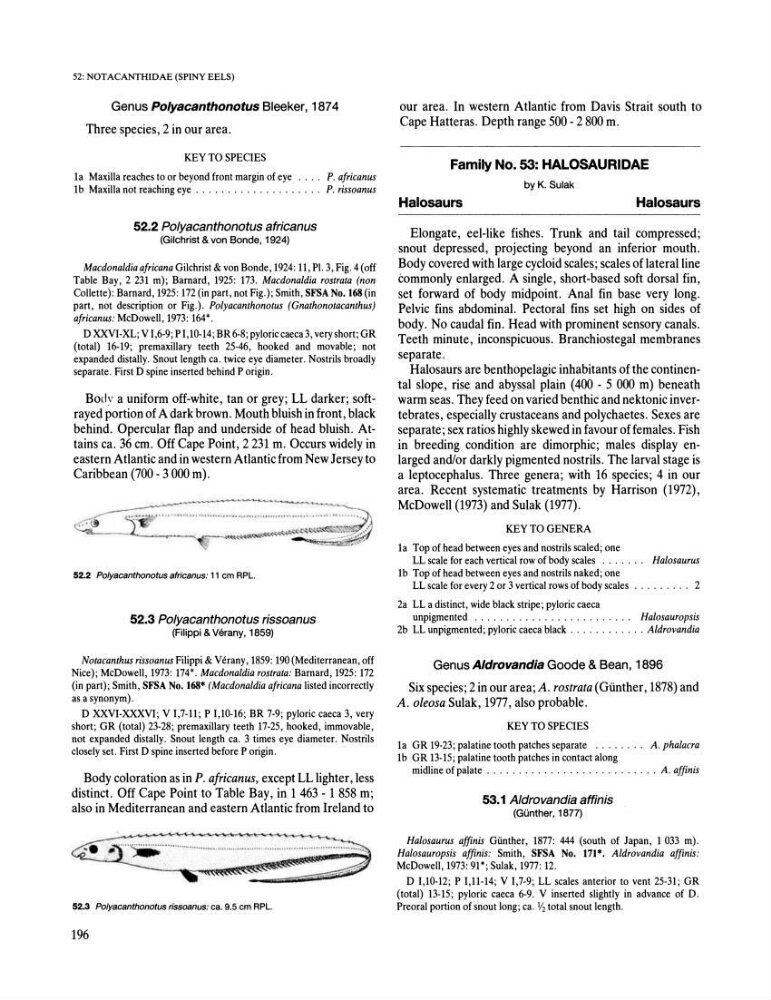
52.2 Polyacanthonotus africanus: 11 em RPL.
52.3 Polyacanthonotus rissoanus
(Filippi & Verany, 1859)
Notacanthus rissoanus Filippi & Verany, 1859: 190 (Mediterranean, off
Nice); McDowell, 1973: 174*. Macdonaldia rostrata: Barnard, 1925: 172
(in part); Smith, SFSA No. 168* (Macdonaldia africana listed incorrectly
as a synonym).
D XXVI-XXXVI; V 1,7-11; P 1,10-16; BR 7-9; pyloric caeca 3, very
short; GR (total) 23-28; premaxillary teeth 17-25, hooked, immovable,
not expanded distally. Snout length ca. 3 times eye diameter. Nostrils
closely set. First D spine inserted before P origin.
Body coloration as in P. africanus, except LL lighter, less
distinct. Off Cape Point to Table Bay, in 1 463 - 1 858 m;
also in Mediterranean and eastern Atlantic from Ireland to
52.3 Polyacanthonotus rissoanus: ea. 9.5 em RPL.
196
our area. In western Atlantic from Davis Strait south to
Cape Hatteras. Depth range 500 - 2 800 m.
Family No. 53: HALOSAURIDAE
byK. Sulak
Halosaurs
Halosaurs
Elongate, eel-like fishes. Trunk and tail compressed;
snout depressed, projecting beyond an inferior mouth.
Body covered with large cycloid scales; scales of lateral line
commonly enlarged. A single, short-based soft dorsal fin,
set forward of body midpoint. Anal fin base very long.
Pelvic fins abdominal. Pectoral fins set high on sides of
body. No caudal fin. Head with prominent sensory canals.
Teeth minute, inconspicuous. Branchiostegal membranes
separate.
Halosaurs are benthopelagic inhabitants of the continental slope, rise and abyssal plain (400 - 5 000 m) beneath
warm seas. They feed on varied benthic and nektonic invertebrates, especially crustaceans and polychaetes. Sexes are
separate; sex ratios highly skewed in favour offemales. Fish
in breeding condition are dimorphic; males display enlarged and/or darkly pigmented nostrils. The larval stage is
a leptocephalus. Three genera; with 16 species; 4 in our
area. Recent systematic treatments by Harrison (1972),
McDowell (1973) and Sulak (1977).
KEY TO GENERA
la Top of head between eyes and nostrils scaled; one
LL scale for each vertical row of body scales . . . . . .. Halosaurus
Ib Top of head between eyes and nostrils naked; one
LL scale for every 2 or 3 vertical rows of body scales . . . . . . . . . 2
2a LL a distinct, wide black stripe; pyloric caeca
unpigmented ......................... Halosauropsis
2b LL unpigmented; pyloric caeca black ............ Aldrovandia
Genus Aldrovandia Goode & Bean, 1896
Six species; 2 in our area; A. rostrata (Gunther, 1878) and
A. oleosa Sulak, 1977, also probable.
KEY TO SPECIES
la GR 19-23; palatine tooth patches separate ........ A. phalacra
Ib GR 13-15; palatine tooth patches in contact along
midline of palate ........................... A. affinis
53.1 Aldrovandia affinis
(Gunther, 1877)
Halosaurus affinis Gunther, 1877: 444 (south of Japan, 1 033 m).
Halosauropsis affinis: Smith, SFSA No. 171*. Aldrovandia affinis:
McDowell, 1973: 91*; Sulak, 1977: 12.
D 1,10-12; P 1,11-14; V 1,7-9; LL scales anterior to vent 25-31; GR
(total) 13-15; pyloric caeca 6-9. V inserted slightly in advance of D.
Preoral portion of snout long; ca. 1/2 total snout length.
Genus Polyacanthonotus Bleeker, 1874
Three species, 2 in our area.
KEY TO SPECIES
la Maxilla reaches to or beyond front margin of eye
P. africanus
Ib Maxilla not reaching eye .................... P. rissoanus
52.2 Polyacanthonotus africanus
(Gilchrist & von Bonde, 1924)
Macdonaldia africana Gilchrist & von Bonde, 1924: 11, PI. 3, Fig. 4 (off
Table Bay, 2 231 m); Barnard, 1925: 173. Macdonaldia rostrata (non
Collette): Barnard, 1925: 172 (in part, not Fig.); Smith, SFSA No. 168 (in
part, not description or Fig.). Polyacanthonotus (Gnathonotacanthus)
african us: McDowell, 1973: 164*.
D XXVI-XL; VI,6-9; PI,1O-14; BR6-8; pyloric caeca 3, very short; GR
(total) 16-19; premaxillary teeth 25-46, hooked and movable; not
expanded distally. Snout length ca. twice eye diameter. Nostrils broadly
separate. First D spine inserted behind P origin.
Bod\' a uniform off-white, tan or grey; LL darker; softrayed portion of A dark brown. Mouth bluish in front, black
behind. Opercular flap and underside of head bluish. Attains ca. 36 cm. Off Cape Point, 2231 m. Occurs widely in
eastern Atlantic and in western Atlantic from New Jersey to
Caribbean (700 - 3 000 m).
52.2 Polyacanthonotus africanus: 11 em RPL.
52.3 Polyacanthonotus rissoanus
(Filippi & Verany, 1859)
Notacanthus rissoanus Filippi & Verany, 1859: 190 (Mediterranean, off
Nice); McDowell, 1973: 174*. Macdonaldia rostrata: Barnard, 1925: 172
(in part); Smith, SFSA No. 168* (Macdonaldia africana listed incorrectly
as a synonym).
D XXVI-XXXVI; V 1,7-11; P 1,10-16; BR 7-9; pyloric caeca 3, very
short; GR (total) 23-28; premaxillary teeth 17-25, hooked, immovable,
not expanded distally. Snout length ca. 3 times eye diameter. Nostrils
closely set. First D spine inserted before P origin.
Body coloration as in P. africanus, except LL lighter, less
distinct. Off Cape Point to Table Bay, in 1 463 - 1 858 m;
also in Mediterranean and eastern Atlantic from Ireland to
52.3 Polyacanthonotus rissoanus: ea. 9.5 em RPL.
196
our area. In western Atlantic from Davis Strait south to
Cape Hatteras. Depth range 500 - 2 800 m.
Family No. 53: HALOSAURIDAE
byK. Sulak
Halosaurs
Halosaurs
Elongate, eel-like fishes. Trunk and tail compressed;
snout depressed, projecting beyond an inferior mouth.
Body covered with large cycloid scales; scales of lateral line
commonly enlarged. A single, short-based soft dorsal fin,
set forward of body midpoint. Anal fin base very long.
Pelvic fins abdominal. Pectoral fins set high on sides of
body. No caudal fin. Head with prominent sensory canals.
Teeth minute, inconspicuous. Branchiostegal membranes
separate.
Halosaurs are benthopelagic inhabitants of the continental slope, rise and abyssal plain (400 - 5 000 m) beneath
warm seas. They feed on varied benthic and nektonic invertebrates, especially crustaceans and polychaetes. Sexes are
separate; sex ratios highly skewed in favour offemales. Fish
in breeding condition are dimorphic; males display enlarged and/or darkly pigmented nostrils. The larval stage is
a leptocephalus. Three genera; with 16 species; 4 in our
area. Recent systematic treatments by Harrison (1972),
McDowell (1973) and Sulak (1977).
KEY TO GENERA
la Top of head between eyes and nostrils scaled; one
LL scale for each vertical row of body scales . . . . . .. Halosaurus
Ib Top of head between eyes and nostrils naked; one
LL scale for every 2 or 3 vertical rows of body scales . . . . . . . . . 2
2a LL a distinct, wide black stripe; pyloric caeca
unpigmented ......................... Halosauropsis
2b LL unpigmented; pyloric caeca black ............ Aldrovandia
Genus Aldrovandia Goode & Bean, 1896
Six species; 2 in our area; A. rostrata (Gunther, 1878) and
A. oleosa Sulak, 1977, also probable.
KEY TO SPECIES
la GR 19-23; palatine tooth patches separate ........ A. phalacra
Ib GR 13-15; palatine tooth patches in contact along
midline of palate ........................... A. affinis
53.1 Aldrovandia affinis
(Gunther, 1877)
Halosaurus affinis Gunther, 1877: 444 (south of Japan, 1 033 m).
Halosauropsis affinis: Smith, SFSA No. 171*. Aldrovandia affinis:
McDowell, 1973: 91*; Sulak, 1977: 12.
D 1,10-12; P 1,11-14; V 1,7-9; LL scales anterior to vent 25-31; GR
(total) 13-15; pyloric caeca 6-9. V inserted slightly in advance of D.
Preoral portion of snout long; ca. 1/2 total snout length.