

Order NOTACANTH I FORM ES
Maxilla with a retrorse spine on dorsal edge of distal part;
pelvic fins abdominal, connected by a membrane (at least at
the base); eye covered with transparent skin continuous
with that of the head; tail long and tapering; "caudal fin"
minute or absent; mouth inferior; swimbladder present;
oviducts absent, the eggs being released into the abdominal
cavity to be passed out via a pair of abdominal pores near
the anus.
This order comprises 3 families, of which 2 are represented in our area. The Lipogenyidae (one species, known
from both sides of the North Atlantic) is characterised by a
small, round, sucker-like mouth with no teeth; maxillae
curved downward and forward round the corner of the
mouth; and the short dorsal fin of9-11 rays, the anterior 4-6
rays spine-like and contiguous with the posterior, segmented, branched soft-rays.
KEY TO FAMILIES
la Dorsal fin base short, entirely before anal fin;
dorsal and anal fins without distinct spines;
maxillae toothed ...................................... HALOSAURIDAE
--=~~/)
~=-- V~ --- S29
Ib Dorsal fin of numerous, short, isolated spines;
anterior anal fin rays are spine-like; maxillae
toothless .............................................. NOTACANTHIDAE
Family No. 52: NOTACANTHIDAE
byK. Sulak
Spiny eels
Stekelpalings
Small to moderate-sized eel-like fishes with numerous,
short, isolated dorsal fin spines. Body and head strongly
compressed, completely covered with minute, adherent
cycloid scales. Mouth small and inferior; snout projecting.
Anal fin very long, grading from spines anteriorly to softrays posteriorly. Pelvic fins abdominal. Caudal fin minute.
Head lacking prominent sensory canals. Branchiostegal
membranes united. Premaxillary teeth set in a single comblike row.
Spiny eels hover just above the bottom at depths of 125 -
3 500 m; they range from tropical seas to subpolar waters,
and feed on benthic polychaetes and coelenterates, as well
as small nektonic crustaceans. Breeding condition males
have darkened nostrils. Females greatly outnumber males.
Giant leptocephalus larvae probably pertain to notacanth
species (Castle, 1959; Nielsen & Larson, 1970; Smith,
1970). Two genera with 3 species in our area. Recent
systematic treatment by McDowell (1973).
KEY TO GENERA
la D spines 6-15 ........................... Notacanthus
Ib D spines 26-40 ...................... Polyacanthonotus
Genus Notacanthus Bloch, 1788
Six species; 1 in our area.
52.1 Notacanthus sexspinis
Richardson, 1846
Notacanthus sexspinis Richardson, 1846: 54, PI. 32, Fig. 4 (King
George's Sound, Australia); Smith, SFSA No. 166*; Karrer, 1973: 217;
McDowell, 1973: 186*. Notacanthus moseleyi: Smith, SFSA No. 167.
Notacanthus annectens Boulenger, 1904: 167* (off Cape Peninsula, 457 m);
Thompson, 1916: 84. Notacanthus sp. Pakhorukov, 1976: 326.
D V-IX; AX-XVIII,150-160; V 1-11,6-8; P9-12; BR 7-11; pyloric caeca
6-7; premaxillary teeth 24-31, tips in contact and forming a continuous
serrate cutting edge. Palatine and dentary teeth in 1 row. V spines never
bifid. Branchiostegal membranes broadly united, free from isthmus.
Colour brown, mouth and soft-rayed portion of A
darker. A small, slender species; attains 50-60 cm. Walvis
Bay to Durban, 360 - 1 100 m; and off southern Brazil,
Chile, New Zealand and Australia.
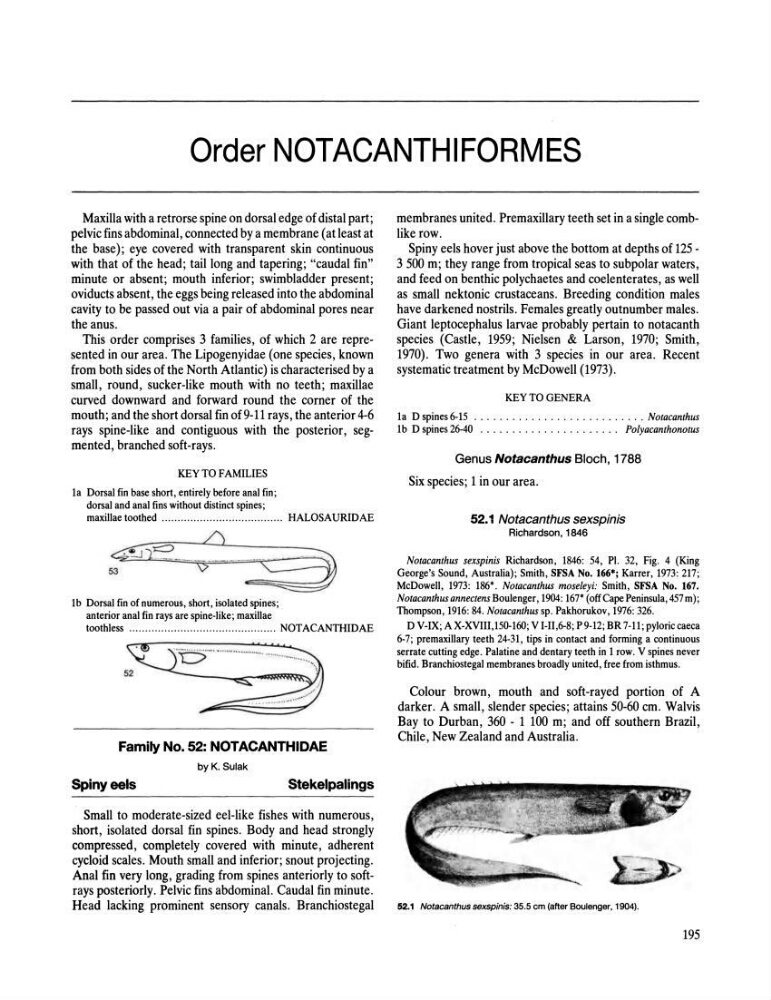
52.1 Notacanthus sexspinis: 35.5 em (after Boulenger, 1904).
195
Maxilla with a retrorse spine on dorsal edge of distal part;
pelvic fins abdominal, connected by a membrane (at least at
the base); eye covered with transparent skin continuous
with that of the head; tail long and tapering; "caudal fin"
minute or absent; mouth inferior; swimbladder present;
oviducts absent, the eggs being released into the abdominal
cavity to be passed out via a pair of abdominal pores near
the anus.
This order comprises 3 families, of which 2 are represented in our area. The Lipogenyidae (one species, known
from both sides of the North Atlantic) is characterised by a
small, round, sucker-like mouth with no teeth; maxillae
curved downward and forward round the corner of the
mouth; and the short dorsal fin of9-11 rays, the anterior 4-6
rays spine-like and contiguous with the posterior, segmented, branched soft-rays.
KEY TO FAMILIES
la Dorsal fin base short, entirely before anal fin;
dorsal and anal fins without distinct spines;
maxillae toothed ...................................... HALOSAURIDAE
--=~~/)
~=-- V~ --- S29
Ib Dorsal fin of numerous, short, isolated spines;
anterior anal fin rays are spine-like; maxillae
toothless .............................................. NOTACANTHIDAE
Family No. 52: NOTACANTHIDAE
byK. Sulak
Spiny eels
Stekelpalings
Small to moderate-sized eel-like fishes with numerous,
short, isolated dorsal fin spines. Body and head strongly
compressed, completely covered with minute, adherent
cycloid scales. Mouth small and inferior; snout projecting.
Anal fin very long, grading from spines anteriorly to softrays posteriorly. Pelvic fins abdominal. Caudal fin minute.
Head lacking prominent sensory canals. Branchiostegal
membranes united. Premaxillary teeth set in a single comblike row.
Spiny eels hover just above the bottom at depths of 125 -
3 500 m; they range from tropical seas to subpolar waters,
and feed on benthic polychaetes and coelenterates, as well
as small nektonic crustaceans. Breeding condition males
have darkened nostrils. Females greatly outnumber males.
Giant leptocephalus larvae probably pertain to notacanth
species (Castle, 1959; Nielsen & Larson, 1970; Smith,
1970). Two genera with 3 species in our area. Recent
systematic treatment by McDowell (1973).
KEY TO GENERA
la D spines 6-15 ........................... Notacanthus
Ib D spines 26-40 ...................... Polyacanthonotus
Genus Notacanthus Bloch, 1788
Six species; 1 in our area.
52.1 Notacanthus sexspinis
Richardson, 1846
Notacanthus sexspinis Richardson, 1846: 54, PI. 32, Fig. 4 (King
George's Sound, Australia); Smith, SFSA No. 166*; Karrer, 1973: 217;
McDowell, 1973: 186*. Notacanthus moseleyi: Smith, SFSA No. 167.
Notacanthus annectens Boulenger, 1904: 167* (off Cape Peninsula, 457 m);
Thompson, 1916: 84. Notacanthus sp. Pakhorukov, 1976: 326.
D V-IX; AX-XVIII,150-160; V 1-11,6-8; P9-12; BR 7-11; pyloric caeca
6-7; premaxillary teeth 24-31, tips in contact and forming a continuous
serrate cutting edge. Palatine and dentary teeth in 1 row. V spines never
bifid. Branchiostegal membranes broadly united, free from isthmus.
Colour brown, mouth and soft-rayed portion of A
darker. A small, slender species; attains 50-60 cm. Walvis
Bay to Durban, 360 - 1 100 m; and off southern Brazil,
Chile, New Zealand and Australia.
52.1 Notacanthus sexspinis: 35.5 em (after Boulenger, 1904).
195