

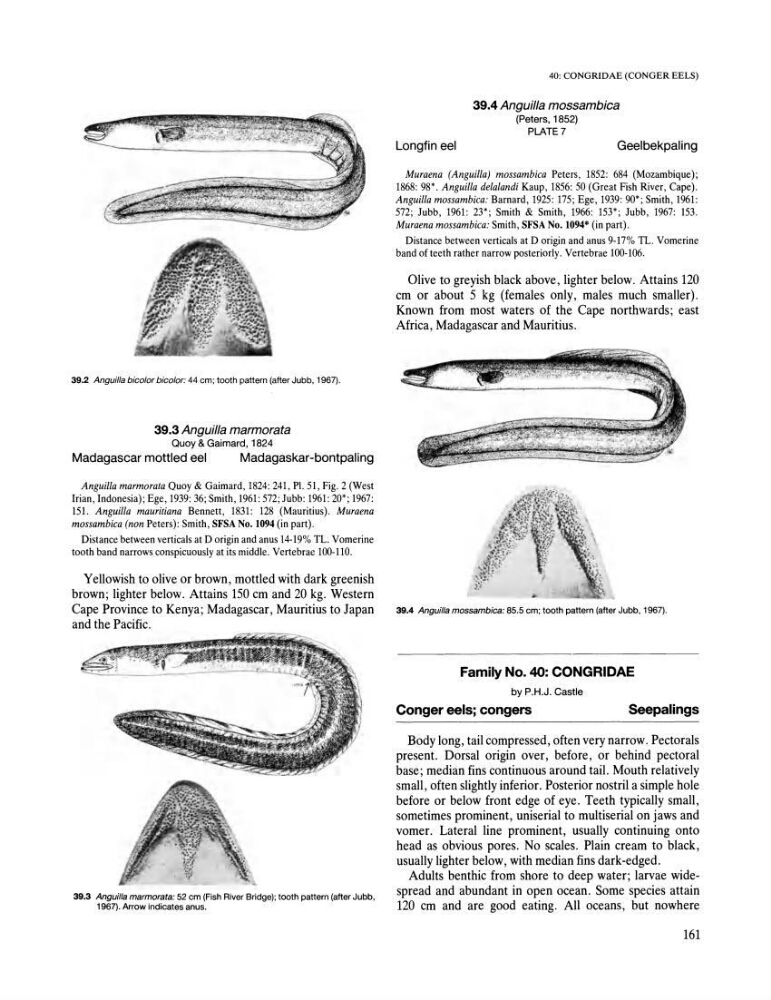
39.2 Anguilla bicolor bicolor: 44 em; tooth pattern (after Jubb, 1967).
39.3 Anguilla marmorata
Quoy& Gaimard, 1824
Madagascar mottled eel
Madagaskar-bontpaling
Anguilla marmorata Quoy & Gaimard, 1824: 241, PI. 51, Fig. 2 (West
Irian, Indonesia); Ege, 1939: 36; Smith, 1961: 572; Jubb: 1961: 20*; 1967:
151. Anguilla mauritiana Bennett, 1831: 128 (Mauritius). Muraena
mossambica (non Peters): Smith, SFSA No. 1094 (in part).
Distance between verticals at D origin and anus 14-19% TL. Vomerine
tooth band narrows conspicuously at its middle. Vertebrae 100-110.
Yellowish to olive or brown, mottled with dark greenish
brown; lighter below. Attains 150 cm and 20 kg. Western
Cape Province to Kenya; Madagascar, Mauritius to Japan
and the Pacific.
39.3 Anguilla marmorata: 52 em (Fish River Bridge); tooth pattern (after Jubb,
1967). Arrow indicates anus.
Longtin eel
40: CONGRIDAE (CONGER EELS)
39.4 Anguilla mossambica
(Peters, 1852)
PLATE 7
Geelbekpaling
Muraena (Anguilla) mossambica Peters, 1852: 684 (Mozambique);
1868: 98*. Anguilla delalandi Kaup, 1856: 50 (Great Fish River, Cape).
Anguilla mossambica: Barnard, 1925: 175; Ege, 1939: 90*; Smith, 1961:
572; Jubb, 1961: 23*; Smith & Smith, 1966: 153*; Jubb, 1967: 153.
Muraena mossambica: Smith, SFSA No. 1094* (in part).
Distance between verticals at D origin and anus 9-17% TL. Vomerine
band of teeth rather narrow posteriorly. Vertebrae 100-106.
Olive to greyish black above, lighter below. Attains 120
cm or about 5 kg (females only, males much smaller).
Known from most waters of the Cape northwards; east
Africa, Madagascar and Mauritius.
39.4 Anguilla mossambica: 85.5 em; tooth pattern (after Jubb, 1967).
Family No. 40: CONGRIDAE
by P.H.J. Castle
Conger eels; congers
Seepalings
Body long, tail compressed, often very narrow. Pectorals
present. Dorsal origin over, before, or behind pectoral
base; median fins continuous around tail. Mouth relatively
small, often slightly inferior. Posterior nostril a simple hole
before or below front edge of eye. Teeth typically small,
sometimes prominent, uniserial to multiserial on jaws and
vomer. Lateral line prominent, usually continuing onto
head as obvious pores. No scales. Plain cream to black,
usually lighter below, with median fins dark-edged.
Adults benthic from shore to deep water; larvae widespread and abundant in open ocean. Some species attain
120 cm and are good eating. All oceans, but nowhere
161
39.3 Anguilla marmorata
Quoy& Gaimard, 1824
Madagascar mottled eel
Madagaskar-bontpaling
Anguilla marmorata Quoy & Gaimard, 1824: 241, PI. 51, Fig. 2 (West
Irian, Indonesia); Ege, 1939: 36; Smith, 1961: 572; Jubb: 1961: 20*; 1967:
151. Anguilla mauritiana Bennett, 1831: 128 (Mauritius). Muraena
mossambica (non Peters): Smith, SFSA No. 1094 (in part).
Distance between verticals at D origin and anus 14-19% TL. Vomerine
tooth band narrows conspicuously at its middle. Vertebrae 100-110.
Yellowish to olive or brown, mottled with dark greenish
brown; lighter below. Attains 150 cm and 20 kg. Western
Cape Province to Kenya; Madagascar, Mauritius to Japan
and the Pacific.
39.3 Anguilla marmorata: 52 em (Fish River Bridge); tooth pattern (after Jubb,
1967). Arrow indicates anus.
Longtin eel
40: CONGRIDAE (CONGER EELS)
39.4 Anguilla mossambica
(Peters, 1852)
PLATE 7
Geelbekpaling
Muraena (Anguilla) mossambica Peters, 1852: 684 (Mozambique);
1868: 98*. Anguilla delalandi Kaup, 1856: 50 (Great Fish River, Cape).
Anguilla mossambica: Barnard, 1925: 175; Ege, 1939: 90*; Smith, 1961:
572; Jubb, 1961: 23*; Smith & Smith, 1966: 153*; Jubb, 1967: 153.
Muraena mossambica: Smith, SFSA No. 1094* (in part).
Distance between verticals at D origin and anus 9-17% TL. Vomerine
band of teeth rather narrow posteriorly. Vertebrae 100-106.
Olive to greyish black above, lighter below. Attains 120
cm or about 5 kg (females only, males much smaller).
Known from most waters of the Cape northwards; east
Africa, Madagascar and Mauritius.
39.4 Anguilla mossambica: 85.5 em; tooth pattern (after Jubb, 1967).
Family No. 40: CONGRIDAE
by P.H.J. Castle
Conger eels; congers
Seepalings
Body long, tail compressed, often very narrow. Pectorals
present. Dorsal origin over, before, or behind pectoral
base; median fins continuous around tail. Mouth relatively
small, often slightly inferior. Posterior nostril a simple hole
before or below front edge of eye. Teeth typically small,
sometimes prominent, uniserial to multiserial on jaws and
vomer. Lateral line prominent, usually continuing onto
head as obvious pores. No scales. Plain cream to black,
usually lighter below, with median fins dark-edged.
Adults benthic from shore to deep water; larvae widespread and abundant in open ocean. Some species attain
120 cm and are good eating. All oceans, but nowhere
161