

39: ANGUILLIDAE (FRESHWATER EELS)
Family No. 39: ANGUILLIDAE
by P.H.J. Castle
Freshwater eels
Varswaterpalings
Body robust; tail compressed. Small embedded scales
present, but not developed in juveniles. Pectoral fins
present. Dorsal fin origin about midway between pectoral
base and anus, or about over anus; median fins continuous
around tail. Mouth reaching to or below rear edge of eye;
lips thick; teeth small, in bands on jaws and vomer. Lateral
line complete, but pores very small.
Juveniles plain olive to black, lighter below, or mottled;
adults silvery below, with eye enlarged. Some species attain
180 cm and a weight of 20 kg. Spawning occurs in the open
ocean; after drifting in the surface waters for several weeks,
the larvae (called leptocephali) are carried near shore
where they metamorphose to the tiny, transparent glass eel
stage and enter rivers on our south and east coasts during
December-February. Once in freshwater, the glass eel becomes pigmented and is called an elver; the elvers migrate
well up the rivers, and have been observed wriggling up wet
vertical cliffs and dam walls. After 10-15 years in freshwater, the eels migrate to sea as adults to spawn far offshore
and presumably die.
One genus, Anguilla Schrank, 1798 with 19 species and
subspecies worldwide; 4 species in our area. A fifth species,
A. obseura Gunther, 1871, has been reported from the
Buffalo River, Cape Province, from a single specimen
(Jubb, 1957). It is "short-finned", having the dorsal origin
just in front of the level of the anus and broad bands of
teeth. It is therefore very like A . bieolor bieolor except that
the specimen apparently had 103 vertebrae (compared with
106-115 in A. bieolor bieolor). It is possible that the specimen was misidentified, as the data can be interpreted
differently. However, it is also possible , though highly unlikely, that A. obseura is present in very small numbers in
the local eel population. Comprehensive taxonomic review
by Ege (1939); Tesch (1977) has summarised the biology,
fishery and culture of freshwater eels.
KEY TO SPECIES*
la D origin above or just in front of anus ............... A. bicolor bicolor
Ib D origin about midway between P base and anus ...................... 2
2a Body plain olive to brownish black above, lighter
below; band of teeth on each jaw broad, without a
toothless groove between innermost row and outer
rows .. .. ....................... ... ... ................... ......... A. mossambica
2b Body mottled with yellow and brown markings; band
of teeth on each jaw narrow, with a toothless groove
between inner row and outer rows ........................... ... ... ... .... 3
* Juveniles of the three "long-finned" species are difficult to identify because the body colour and the definitive pattern of teeth are late to develop.
160
3a D origin nearer P base than anus ........ ..... ............. A. marmorata
3b D origin nearer anus than P base .... .... ........ A. bengalensis labiata
39.1 Anguilla bengalensis labiata
(Peters, 1852)
PLATE 7
African mottled eel
Afrikaanse bontpaling
Muraena (Anguilla) labiata Peters, 1852: 684 (Mozambique). Anguilla
labiata Peters, 1868: 94*. Anguilla nebulosa labiata: Ege, 1939: 36*;
Smith, 1961: 572; Jubb, 1961: 23*; 1967: 151 *. Muraena mossambica (non
Peters) : Smith, SFSA No. 1094 (in part).
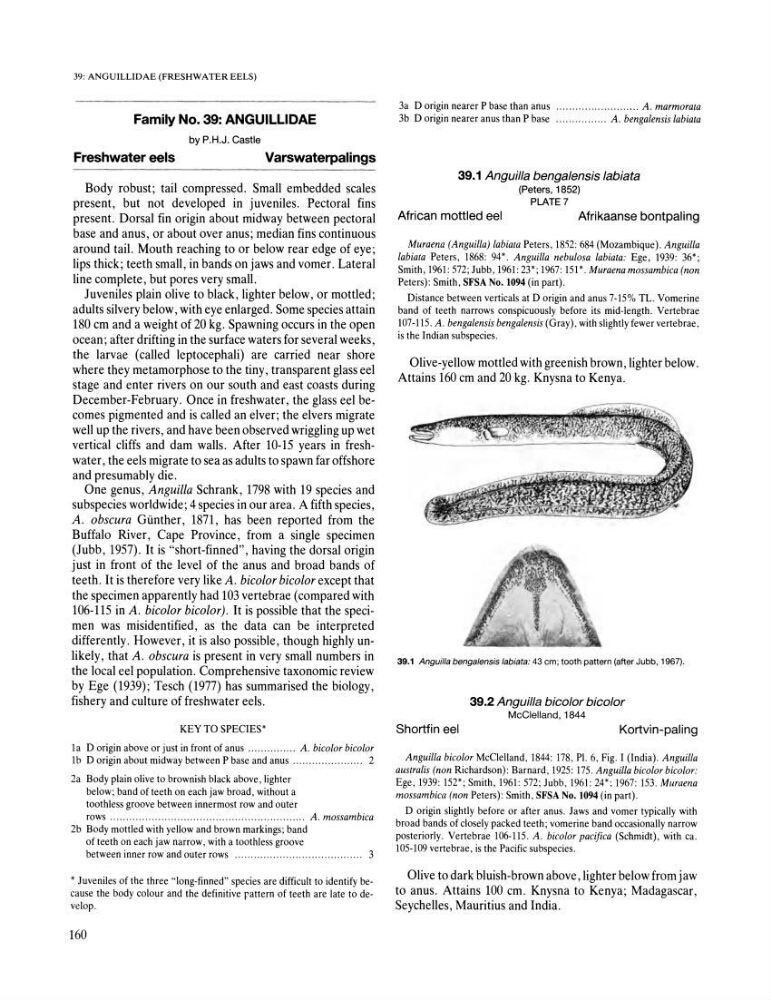
Distance between verticals at D origin and anus 7-15% TL. Vomerine
band of teeth narrows conspicuously before its mid-length. Vertebrae
107-115. A. bengalensis bengalensis (Gray), with slightly fewer vertebrae,
is the Indian subspecies.
Olive-yellow mottled with greenish brown, lighter below.
Attains 160 cm and 20 kg. Knysna to Kenya.
39.1 Anguilla bengalensis labiata: 43 cm; tooth pattern (after Jubb, 1967).
Shortfin eel
39.2 Anguilla bicolor bic%r
McClelland, 1844
Kortvin-paling
Anguilla bicolor McClelland, 1844: 178, PI. 6, Fig. I (India). Anguilla
australis (non Richardson) : Barnard, 1925: 175. Anguilla bicolor bicolor:
Ege, 1939: 152*; Smith, 1961: 572; Jubb, 1961: 24*; 1967: 153. Muraena
mossambica (non Peters): Smith, SFSA No. 1094 (in part).
D origin slightly before or after anus. Jaws and vomer typically with
broad bands of closely packed teeth; vomerine band occasionally narrow
posteriorly. Vertebrae 106-115. A. bicolor pacifica (Schmidt), with ca.
105-109 vertebrae, is the Pacific subspecies.
Olive to dark bluish-brown above , lighter below from jaw
to anus. Attains 100 cm. Knysna to Kenya; Madagascar,
Seychelles, Mauritius and India.
Family No. 39: ANGUILLIDAE
by P.H.J. Castle
Freshwater eels
Varswaterpalings
Body robust; tail compressed. Small embedded scales
present, but not developed in juveniles. Pectoral fins
present. Dorsal fin origin about midway between pectoral
base and anus, or about over anus; median fins continuous
around tail. Mouth reaching to or below rear edge of eye;
lips thick; teeth small, in bands on jaws and vomer. Lateral
line complete, but pores very small.
Juveniles plain olive to black, lighter below, or mottled;
adults silvery below, with eye enlarged. Some species attain
180 cm and a weight of 20 kg. Spawning occurs in the open
ocean; after drifting in the surface waters for several weeks,
the larvae (called leptocephali) are carried near shore
where they metamorphose to the tiny, transparent glass eel
stage and enter rivers on our south and east coasts during
December-February. Once in freshwater, the glass eel becomes pigmented and is called an elver; the elvers migrate
well up the rivers, and have been observed wriggling up wet
vertical cliffs and dam walls. After 10-15 years in freshwater, the eels migrate to sea as adults to spawn far offshore
and presumably die.
One genus, Anguilla Schrank, 1798 with 19 species and
subspecies worldwide; 4 species in our area. A fifth species,
A. obseura Gunther, 1871, has been reported from the
Buffalo River, Cape Province, from a single specimen
(Jubb, 1957). It is "short-finned", having the dorsal origin
just in front of the level of the anus and broad bands of
teeth. It is therefore very like A . bieolor bieolor except that
the specimen apparently had 103 vertebrae (compared with
106-115 in A. bieolor bieolor). It is possible that the specimen was misidentified, as the data can be interpreted
differently. However, it is also possible , though highly unlikely, that A. obseura is present in very small numbers in
the local eel population. Comprehensive taxonomic review
by Ege (1939); Tesch (1977) has summarised the biology,
fishery and culture of freshwater eels.
KEY TO SPECIES*
la D origin above or just in front of anus ............... A. bicolor bicolor
Ib D origin about midway between P base and anus ...................... 2
2a Body plain olive to brownish black above, lighter
below; band of teeth on each jaw broad, without a
toothless groove between innermost row and outer
rows .. .. ....................... ... ... ................... ......... A. mossambica
2b Body mottled with yellow and brown markings; band
of teeth on each jaw narrow, with a toothless groove
between inner row and outer rows ........................... ... ... ... .... 3
* Juveniles of the three "long-finned" species are difficult to identify because the body colour and the definitive pattern of teeth are late to develop.
160
3a D origin nearer P base than anus ........ ..... ............. A. marmorata
3b D origin nearer anus than P base .... .... ........ A. bengalensis labiata
39.1 Anguilla bengalensis labiata
(Peters, 1852)
PLATE 7
African mottled eel
Afrikaanse bontpaling
Muraena (Anguilla) labiata Peters, 1852: 684 (Mozambique). Anguilla
labiata Peters, 1868: 94*. Anguilla nebulosa labiata: Ege, 1939: 36*;
Smith, 1961: 572; Jubb, 1961: 23*; 1967: 151 *. Muraena mossambica (non
Peters) : Smith, SFSA No. 1094 (in part).
Distance between verticals at D origin and anus 7-15% TL. Vomerine
band of teeth narrows conspicuously before its mid-length. Vertebrae
107-115. A. bengalensis bengalensis (Gray), with slightly fewer vertebrae,
is the Indian subspecies.
Olive-yellow mottled with greenish brown, lighter below.
Attains 160 cm and 20 kg. Knysna to Kenya.
39.1 Anguilla bengalensis labiata: 43 cm; tooth pattern (after Jubb, 1967).
Shortfin eel
39.2 Anguilla bicolor bic%r
McClelland, 1844
Kortvin-paling
Anguilla bicolor McClelland, 1844: 178, PI. 6, Fig. I (India). Anguilla
australis (non Richardson) : Barnard, 1925: 175. Anguilla bicolor bicolor:
Ege, 1939: 152*; Smith, 1961: 572; Jubb, 1961: 24*; 1967: 153. Muraena
mossambica (non Peters): Smith, SFSA No. 1094 (in part).
D origin slightly before or after anus. Jaws and vomer typically with
broad bands of closely packed teeth; vomerine band occasionally narrow
posteriorly. Vertebrae 106-115. A. bicolor pacifica (Schmidt), with ca.
105-109 vertebrae, is the Pacific subspecies.
Olive to dark bluish-brown above , lighter below from jaw
to anus. Attains 100 cm. Knysna to Kenya; Madagascar,
Seychelles, Mauritius and India.