

14: LAMNIDAE (MACKEREL SHARKS)
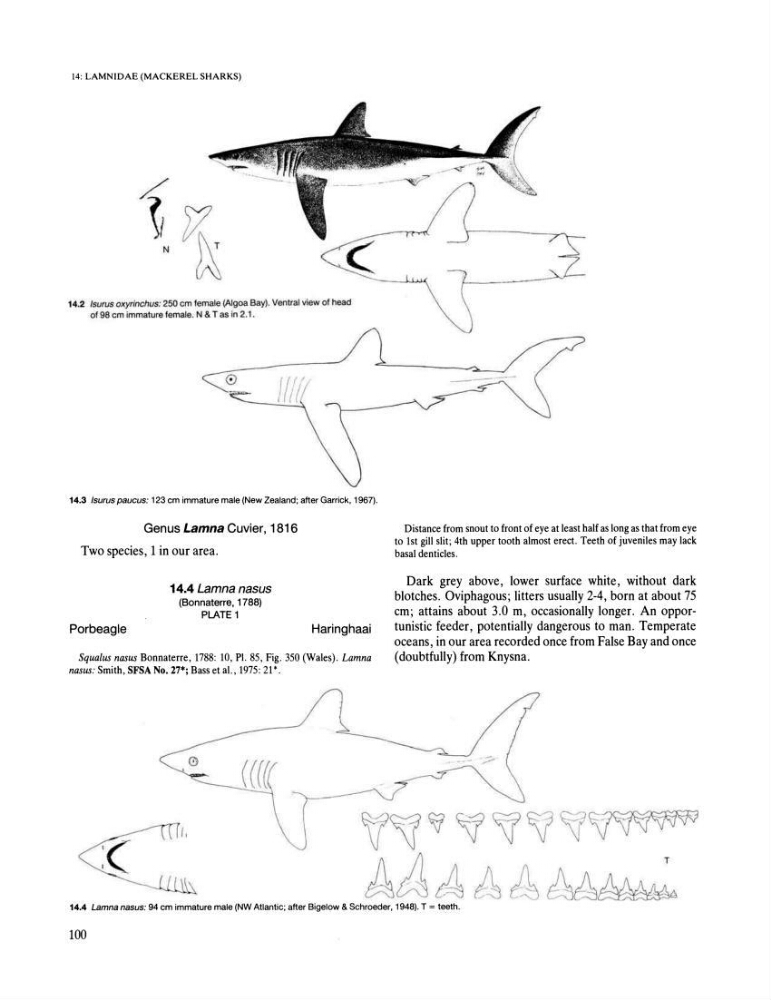
14.2 Isurus oxyrinchus: 250 cm female (Algoa Bay). Ventral view of head
of 98 cm immature female. N & T as in 2.1 .
14.3 Isurus paucus: 123 cm immature male (New Zealand; after Garrick, 1967).
Genus Lamna Cuvier, 1816
Two species, 1 in our area.
Porbeagle
14.4 Lamna nasus
(Bonnaterre, 1788)
PLATE 1
Haringhaai
Squalus nasus Bonnaterre, 1788: 10, PI. 85, Fig. 350 (Wales). Lamna
nasus: Smith, SFSA No. 27*; Bass et aI., 1975: 21*.
Distance from snout to front of eye at least half as long as that from eye
to 1st gill slit; 4th upper tooth almost erect. Teeth of juveniles may lack
basal dentic\es.
Dark grey above, lower surface white, without dark
blotches. Oviphagous; litters usually 2-4, born at about 75
cm; attains about 3.0 m, occasionally longer. An opportunistic feeder, potentially dangerous to man. Temperate
oceans, in our area recorded once from False Bay and once
(doubtfully) from Knysna.
\f\l9 v'\lvv~
AAAAA~
14.4 Lamna nasus: 94 cm immature male (NW Atlantic; after Bigelow & Schroeder, 1948). T = teeth.
100
14.2 Isurus oxyrinchus: 250 cm female (Algoa Bay). Ventral view of head
of 98 cm immature female. N & T as in 2.1 .
14.3 Isurus paucus: 123 cm immature male (New Zealand; after Garrick, 1967).
Genus Lamna Cuvier, 1816
Two species, 1 in our area.
Porbeagle
14.4 Lamna nasus
(Bonnaterre, 1788)
PLATE 1
Haringhaai
Squalus nasus Bonnaterre, 1788: 10, PI. 85, Fig. 350 (Wales). Lamna
nasus: Smith, SFSA No. 27*; Bass et aI., 1975: 21*.
Distance from snout to front of eye at least half as long as that from eye
to 1st gill slit; 4th upper tooth almost erect. Teeth of juveniles may lack
basal dentic\es.
Dark grey above, lower surface white, without dark
blotches. Oviphagous; litters usually 2-4, born at about 75
cm; attains about 3.0 m, occasionally longer. An opportunistic feeder, potentially dangerous to man. Temperate
oceans, in our area recorded once from False Bay and once
(doubtfully) from Knysna.
\f\l9 v'\lvv~
AAAAA~
14.4 Lamna nasus: 94 cm immature male (NW Atlantic; after Bigelow & Schroeder, 1948). T = teeth.
100