

Dark grey or blue-grey above, white below. All oceans,
probably anti-equatorial, in our area concentrated in temperate areas of western and southern Cape. Young (less
than 3 m) move north to Natal in winter and spring while
adults are found there in small numbers throughout year.
Inshore, rarely in the open ocean. Live-bearing; born at less
than 140 cm; mature at about 3 m (males) and about 4 m
(females); usual maximum about 6 m. Larger sharks up to
7.5 or 8 m may exist, but largest reliable record is 6.4 m. Extremely dangerous, has attacked boats and bathers in our
region.
(Note by M.M. Smith) This is the shark most feared by
man, particularly because of the hyperbole about it in films
such as Jaws. It often eats sea mammals like seals and small
dolphins. Divers report it to be ferocious, and it must be
treated with respect, as the large teeth and powerful jaws
enable adults to sever a limb in one bite.
When Durban still had its whaling station, great whites
used to follow the huge carcasses in, and many of these
sharks were caught by anglers fishing with just a short stout
rod from the breakwater on the southern side of the Bay.
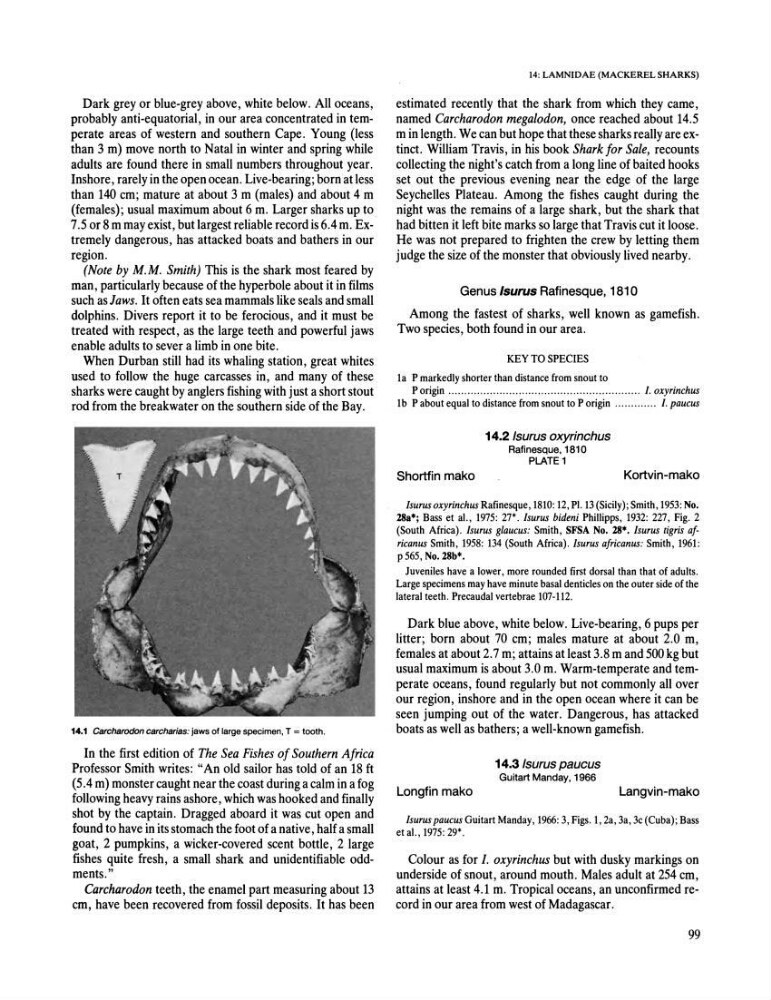
14.1 Carcharodon carcharias: jaws of large specimen, T = tooth.
In the first edition of The Sea Fishes of Southern Africa
Professor Smith writes: "An old sailor has told of an 18 ft
(5.4 m) monster caught near the coast during a calm in a fog
following heavy rains ashore, which was hooked and finally
shot by the captain. Dragged aboard it was cut open and
found to have in its stomach the foot of a native, half a small
goat, 2 pumpkins, a wicker-covered scent bottle, 2 large
fishes quite fresh, a small shark and unidentifiable oddments."
Carcharodon teeth, the enamel part measuring about 13
cm, have been recovered from fossil deposits. It has been
14: LAMNIDAE (MACKEREL SHARKS)
estimated recently that the shark from which they came,
named Carcharodon megalodon, once reached about 14.5
m in length. We can but hope that these sharks really are extinct. William Travis, in his book Shark for Sale, recounts
collecting the night's catch from a long line of baited hooks
set out the previous evening near the edge of the large
Seychelles Plateau. Among the fishes caught during the
night was the remains of a large shark, but the shark that
had bitten it left bite marks so large that Travis cut it loose.
He was not prepared to frighten the crew by letting them
judge the size of the monster that obviously lived nearby.
Genus Isurus Ratinesque, 1810
Among the fastest of sharks, well known as gamefish.
Two species, both found in our area.
KEY TO SPECIES
la P markedly shorter than distance from snout to
P origin ............................................................ I. oxyrinchus
Ib P about equal to distance from snout to P origin ............. I. paucus
Shortfin mako
14.2 Isurus oxyrinchus
RafinesQue, 1810
PLATE 1
Kortvin-mako
Isurus oxyrinchus Rafinesque, 1810: 12, PI. 13 (Sicily); Smith, 1953: No.
28a*; Bass et aI., 1975: 27*. Isurus bideni Phillipps, 1932: 227, Fig. 2
(South Africa). Isurus glaucus: Smith, SFSA No. 28*. Isurus tigris africanus Smith, 1958: 134 (South Africa). Isurus africanus: Smith, 1961:
p 565, No. 28b*.
Juveniles have a lower, more rounded first dorsal than that of adults.
Large specimens may have minute basal denticles on the outer side of the
lateral teeth. Precaudal vertebrae 107-112.
Dark blue above, white below. Live-bearing, 6 pups per
litter; born about 70 cm; males mature at about 2.0 m,
females at about 2.7 m; attains at least 3.8 m and 500 kg but
usual maximum is about 3.0 m. Warm-temperate and temperate oceans, found regularly but not commonly all over
our region, inshore and in the open ocean where it can be
seen jumping out of the water. Dangerous, has attacked
boats as well as bathers; a well-known gamefish.
Longtin mako
14.3 Isurus paucus
Guitart Manday, 1966
Langvin-mako
Isurus paucus Guitart Manday, 1966: 3, Figs. 1, 2a, 3a, 3c (Cuba); Bass
et aI., 1975: 29*.
Colour as for I. oxyrinchus but with dusky markings on
underside of snout, around mouth. Males adult at 254 cm,
attains at least 4.1 m. Tropical oceans, an unconfirmed record in our area from west of Madagascar.
99
probably anti-equatorial, in our area concentrated in temperate areas of western and southern Cape. Young (less
than 3 m) move north to Natal in winter and spring while
adults are found there in small numbers throughout year.
Inshore, rarely in the open ocean. Live-bearing; born at less
than 140 cm; mature at about 3 m (males) and about 4 m
(females); usual maximum about 6 m. Larger sharks up to
7.5 or 8 m may exist, but largest reliable record is 6.4 m. Extremely dangerous, has attacked boats and bathers in our
region.
(Note by M.M. Smith) This is the shark most feared by
man, particularly because of the hyperbole about it in films
such as Jaws. It often eats sea mammals like seals and small
dolphins. Divers report it to be ferocious, and it must be
treated with respect, as the large teeth and powerful jaws
enable adults to sever a limb in one bite.
When Durban still had its whaling station, great whites
used to follow the huge carcasses in, and many of these
sharks were caught by anglers fishing with just a short stout
rod from the breakwater on the southern side of the Bay.
14.1 Carcharodon carcharias: jaws of large specimen, T = tooth.
In the first edition of The Sea Fishes of Southern Africa
Professor Smith writes: "An old sailor has told of an 18 ft
(5.4 m) monster caught near the coast during a calm in a fog
following heavy rains ashore, which was hooked and finally
shot by the captain. Dragged aboard it was cut open and
found to have in its stomach the foot of a native, half a small
goat, 2 pumpkins, a wicker-covered scent bottle, 2 large
fishes quite fresh, a small shark and unidentifiable oddments."
Carcharodon teeth, the enamel part measuring about 13
cm, have been recovered from fossil deposits. It has been
14: LAMNIDAE (MACKEREL SHARKS)
estimated recently that the shark from which they came,
named Carcharodon megalodon, once reached about 14.5
m in length. We can but hope that these sharks really are extinct. William Travis, in his book Shark for Sale, recounts
collecting the night's catch from a long line of baited hooks
set out the previous evening near the edge of the large
Seychelles Plateau. Among the fishes caught during the
night was the remains of a large shark, but the shark that
had bitten it left bite marks so large that Travis cut it loose.
He was not prepared to frighten the crew by letting them
judge the size of the monster that obviously lived nearby.
Genus Isurus Ratinesque, 1810
Among the fastest of sharks, well known as gamefish.
Two species, both found in our area.
KEY TO SPECIES
la P markedly shorter than distance from snout to
P origin ............................................................ I. oxyrinchus
Ib P about equal to distance from snout to P origin ............. I. paucus
Shortfin mako
14.2 Isurus oxyrinchus
RafinesQue, 1810
PLATE 1
Kortvin-mako
Isurus oxyrinchus Rafinesque, 1810: 12, PI. 13 (Sicily); Smith, 1953: No.
28a*; Bass et aI., 1975: 27*. Isurus bideni Phillipps, 1932: 227, Fig. 2
(South Africa). Isurus glaucus: Smith, SFSA No. 28*. Isurus tigris africanus Smith, 1958: 134 (South Africa). Isurus africanus: Smith, 1961:
p 565, No. 28b*.
Juveniles have a lower, more rounded first dorsal than that of adults.
Large specimens may have minute basal denticles on the outer side of the
lateral teeth. Precaudal vertebrae 107-112.
Dark blue above, white below. Live-bearing, 6 pups per
litter; born about 70 cm; males mature at about 2.0 m,
females at about 2.7 m; attains at least 3.8 m and 500 kg but
usual maximum is about 3.0 m. Warm-temperate and temperate oceans, found regularly but not commonly all over
our region, inshore and in the open ocean where it can be
seen jumping out of the water. Dangerous, has attacked
boats as well as bathers; a well-known gamefish.
Longtin mako
14.3 Isurus paucus
Guitart Manday, 1966
Langvin-mako
Isurus paucus Guitart Manday, 1966: 3, Figs. 1, 2a, 3a, 3c (Cuba); Bass
et aI., 1975: 29*.
Colour as for I. oxyrinchus but with dusky markings on
underside of snout, around mouth. Males adult at 254 cm,
attains at least 4.1 m. Tropical oceans, an unconfirmed record in our area from west of Madagascar.
99