

60
ANDREAS PLESCH
- One-chip color cameras use one third of the available pixels per color
channel (R,G,B) and provide insufficient resolution. 3-chip color cameras use three separate CCD sensors to achieve a resolution equivalent
to black and white CCDs. 3-chip CCD cameras are very expensive.
For low light level applications like FISH, CCD cameras need the capability
oflong-term exposure or on-chip integration. In this operation mode the
individual sensor elements will collect the incident light for a certain time,
the exposure or integration time, before the pixels are read out.
Increased sensor noise is an unwanted side effect of long-term exposure. In addition to the electric charge generated by the incident light,
thermally generated charges will show up as bright pixels making very
long exposure times impractical. Cooling the CCD sensor reduces thermal
noise and allows the use of very long integration times. Cooling does not
increase the sensitivity of the CCD. A cooled CCD will require the same
integration time as an uncooled camera, but it will add less noise to the
image.
CCD cameras come in different chip sizes and resolutions. The chip
size is usually defined by the diagonal in inches, e.g. 2/3"or 112". Typical
chip resolutions are 768x576 pixels and 1280x 1024 pixels; typical pixel
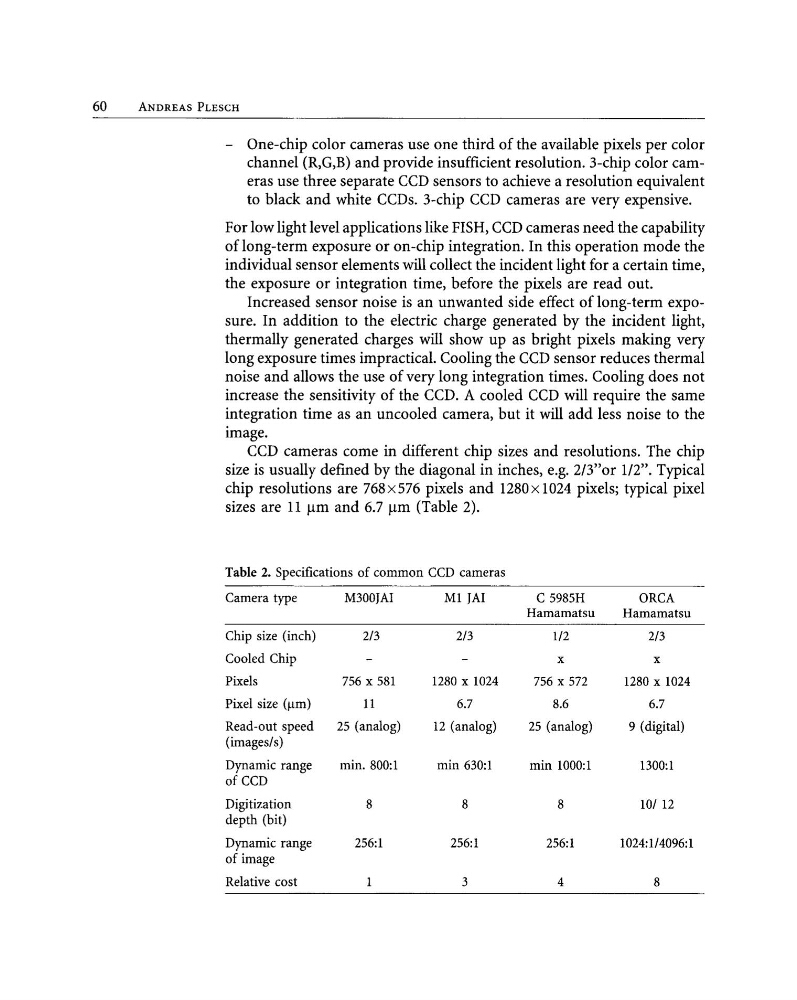
sizes are 11 /lm and 6.7 /lm (Table 2).
Table 2. Specifications of common CCD cameras
Camera type
M300JAI
Ml JAI
C 5985H
ORCA
Hamamatsu
Hamamatsu
Chip size (inch)
2/3
2/3
1/2
2/3
Cooled Chip
x
x
Pixels
756 x 581
1280 x 1024
756 x 572
1280 x 1024
Pixel size (/lm)
11
6.7
8.6
6.7
Read-out speed
25 (analog)
12 (analog)
25 (analog)
9 (digital)
(images/s)
Dynamic range
min. 800:1
min 630:1
min 1000:1
1300:1
ofCCD
Digitization
8
8
8
10/12
depth (bit)
Dynamic range
256:1
256:1
256:1
1024:1/4096:1
of image
Relative cost
3
4
8
ANDREAS PLESCH
- One-chip color cameras use one third of the available pixels per color
channel (R,G,B) and provide insufficient resolution. 3-chip color cameras use three separate CCD sensors to achieve a resolution equivalent
to black and white CCDs. 3-chip CCD cameras are very expensive.
For low light level applications like FISH, CCD cameras need the capability
oflong-term exposure or on-chip integration. In this operation mode the
individual sensor elements will collect the incident light for a certain time,
the exposure or integration time, before the pixels are read out.
Increased sensor noise is an unwanted side effect of long-term exposure. In addition to the electric charge generated by the incident light,
thermally generated charges will show up as bright pixels making very
long exposure times impractical. Cooling the CCD sensor reduces thermal
noise and allows the use of very long integration times. Cooling does not
increase the sensitivity of the CCD. A cooled CCD will require the same
integration time as an uncooled camera, but it will add less noise to the
image.
CCD cameras come in different chip sizes and resolutions. The chip
size is usually defined by the diagonal in inches, e.g. 2/3"or 112". Typical
chip resolutions are 768x576 pixels and 1280x 1024 pixels; typical pixel
sizes are 11 /lm and 6.7 /lm (Table 2).
Table 2. Specifications of common CCD cameras
Camera type
M300JAI
Ml JAI
C 5985H
ORCA
Hamamatsu
Hamamatsu
Chip size (inch)
2/3
2/3
1/2
2/3
Cooled Chip
x
x
Pixels
756 x 581
1280 x 1024
756 x 572
1280 x 1024
Pixel size (/lm)
11
6.7
8.6
6.7
Read-out speed
25 (analog)
12 (analog)
25 (analog)
9 (digital)
(images/s)
Dynamic range
min. 800:1
min 630:1
min 1000:1
1300:1
ofCCD
Digitization
8
8
8
10/12
depth (bit)
Dynamic range
256:1
256:1
256:1
1024:1/4096:1
of image
Relative cost
3
4
8