

2 Microscopy and Imaging Systems
59
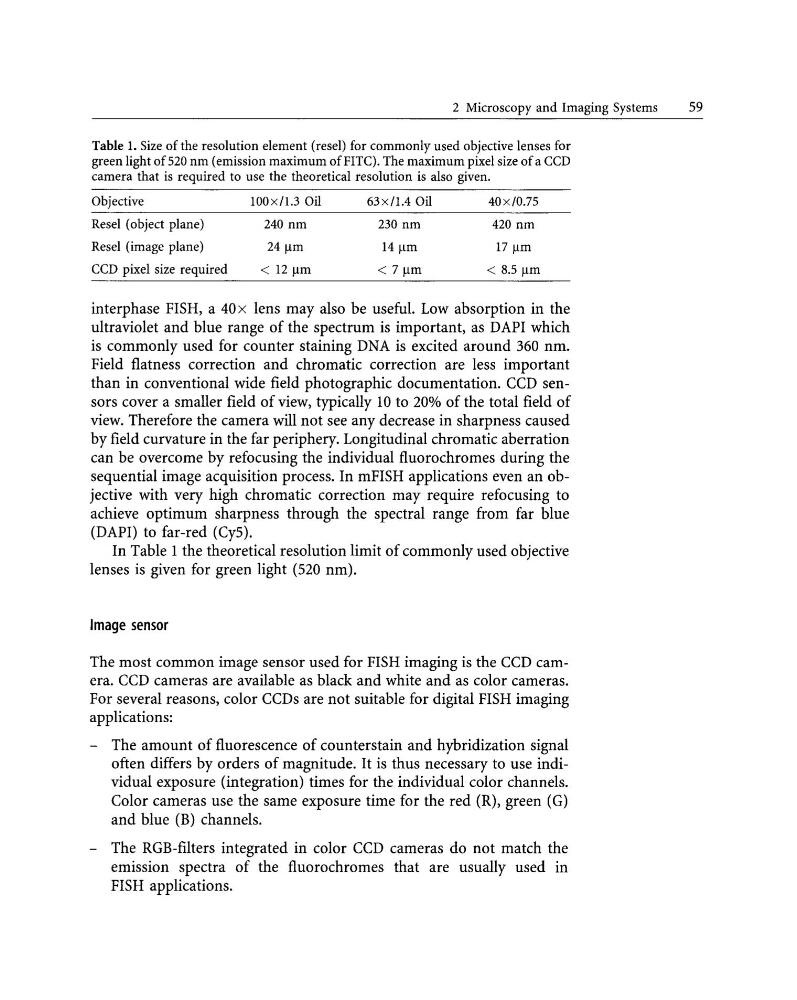
Table 1. Size of the resolution element (resel) for commonly used objective lenses for
green light of520 nm (emission maximum of FITC). The maximum pixel size of a CCD
camera that is required to use the theoretical resolution is also given.
Objective
IOOx/1.3 Oil
63x/1.4 Oil
40 x 10.75
Resel (object plane)
240 nm
230 nm
420 nm
Resel (image plane)
24 ~m
14 ~m
17 ~m
CCD pixel size required
< 12 ~m
< 7 ~m
< 8.5 ~m
interphase FISH, a 40x lens may also be useful. Low absorption in the
ultraviolet and blue range of the spectrum is important, as DAPI which
is commonly used for counter staining DNA is excited around 360 nm.
Field flatness correction and chromatic correction are less important
than in conventional wide field photographic documentation. CCD sensors cover a smaller field of view, typically 10 to 20% of the total field of
view. Therefore the camera will not see any decrease in sharpness caused
by field curvature in the far periphery. Longitudinal chromatic aberration
can be overcome by refocusing the individual fluorochromes during the
sequential image acquisition process. In mFISH applications even an objective with very high chromatic correction may require refocusing to
achieve optimum sharpness through the spectral range from far blue
(DAPI) to far-red (Cy5).
In Table 1 the theoretical resolution limit of commonly used objective
lenses is given for green light (520 nm).
Image sensor
The most common image sensor used for FISH imaging is the CCD camera. CCD cameras are available as black and white and as color cameras.
For several reasons, color CCDs are not suitable for digital FISH imaging
applications:
- The amount of fluorescence of counterstain and hybridization signal
often differs by orders of magnitude. It is thus necessary to use individual exposure (integration) times for the individual color channels.
Color cameras use the same exposure time for the red (R), green (G)
and blue (B) channels.
- The RGB-filters integrated in color CCD cameras do not match the
emission spectra of the fluorochromes that are usually used in
FISH applications.
59
Table 1. Size of the resolution element (resel) for commonly used objective lenses for
green light of520 nm (emission maximum of FITC). The maximum pixel size of a CCD
camera that is required to use the theoretical resolution is also given.
Objective
IOOx/1.3 Oil
63x/1.4 Oil
40 x 10.75
Resel (object plane)
240 nm
230 nm
420 nm
Resel (image plane)
24 ~m
14 ~m
17 ~m
CCD pixel size required
< 12 ~m
< 7 ~m
< 8.5 ~m
interphase FISH, a 40x lens may also be useful. Low absorption in the
ultraviolet and blue range of the spectrum is important, as DAPI which
is commonly used for counter staining DNA is excited around 360 nm.
Field flatness correction and chromatic correction are less important
than in conventional wide field photographic documentation. CCD sensors cover a smaller field of view, typically 10 to 20% of the total field of
view. Therefore the camera will not see any decrease in sharpness caused
by field curvature in the far periphery. Longitudinal chromatic aberration
can be overcome by refocusing the individual fluorochromes during the
sequential image acquisition process. In mFISH applications even an objective with very high chromatic correction may require refocusing to
achieve optimum sharpness through the spectral range from far blue
(DAPI) to far-red (Cy5).
In Table 1 the theoretical resolution limit of commonly used objective
lenses is given for green light (520 nm).
Image sensor
The most common image sensor used for FISH imaging is the CCD camera. CCD cameras are available as black and white and as color cameras.
For several reasons, color CCDs are not suitable for digital FISH imaging
applications:
- The amount of fluorescence of counterstain and hybridization signal
often differs by orders of magnitude. It is thus necessary to use individual exposure (integration) times for the individual color channels.
Color cameras use the same exposure time for the red (R), green (G)
and blue (B) channels.
- The RGB-filters integrated in color CCD cameras do not match the
emission spectra of the fluorochromes that are usually used in
FISH applications.