

0,8
0,6
0,4
0,2
°
'rf
~ ~~CCD2
lit
1- FCCD 1
r-t t t
lll;_
2 Microscopy and Imaging Systems
55
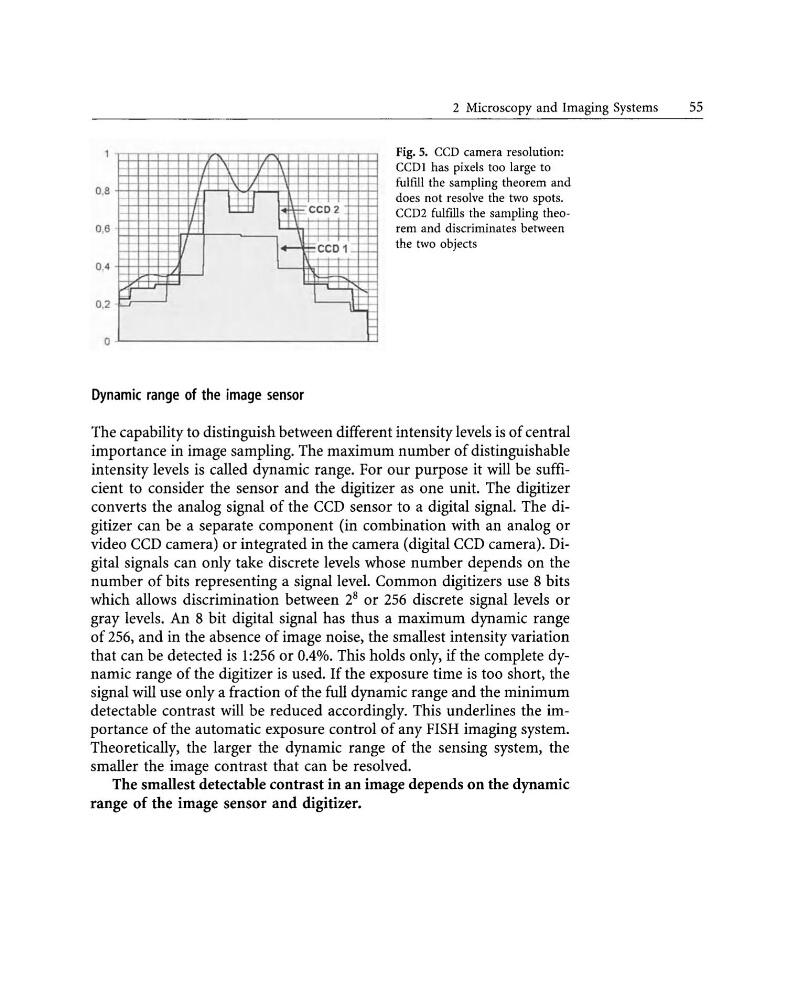
Fig. 5. CCO camera resolution:
CCO1 has pixels too large to
fulfIll the sampling theorem and
does not resolve the two spots.
CC02 fulfills the sampling theorem and discriminates between
the two objects
Dynamic range of the image sensor
The capability to distinguish between different intensity levels is of central
importance in image sampling. The maximum number of distinguishable
intensity levels is called dynamic range. For our purpose it will be sufficient to consider the sensor and the digitizer as one unit. The digitizer
converts the analog signal of the CCD sensor to a digital signal. The digitizer can be a separate component (in combination with an analog or
video CCD camera) or integrated in the camera (digital CCD camera). Digital signals can only take discrete levels whose number depends on the
number of bits representing a signal level. Common digitizers use 8 bits
which allows discrimination between 2
8
or 256 discrete signal levels or
gray levels. An 8 bit digital signal has thus a maximum dynamic range
of 256, and in the absence of image noise, the smallest intensity variation
that can be detected is 1:256 or 0.4%. This holds only, if the complete dynamic range of the digitizer is used. If the exposure time is too short, the
signal will use only a fraction of the full dynamic range and the minimum
detectable contrast will be reduced accordingly. This underlines the importance of the automatic exposure control of any FISH imaging system.
Theoretically, the larger the dynamic range of the sensing system, the
smaller the image contrast that can be resolved.
The smallest detectable contrast in an image depends on the dynamic
range of the image sensor and digitizer.
0,6
0,4
0,2
°
'rf
~ ~~CCD2
lit
1- FCCD 1
r-t t t
lll;_
2 Microscopy and Imaging Systems
55
Fig. 5. CCO camera resolution:
CCO1 has pixels too large to
fulfIll the sampling theorem and
does not resolve the two spots.
CC02 fulfills the sampling theorem and discriminates between
the two objects
Dynamic range of the image sensor
The capability to distinguish between different intensity levels is of central
importance in image sampling. The maximum number of distinguishable
intensity levels is called dynamic range. For our purpose it will be sufficient to consider the sensor and the digitizer as one unit. The digitizer
converts the analog signal of the CCD sensor to a digital signal. The digitizer can be a separate component (in combination with an analog or
video CCD camera) or integrated in the camera (digital CCD camera). Digital signals can only take discrete levels whose number depends on the
number of bits representing a signal level. Common digitizers use 8 bits
which allows discrimination between 2
8
or 256 discrete signal levels or
gray levels. An 8 bit digital signal has thus a maximum dynamic range
of 256, and in the absence of image noise, the smallest intensity variation
that can be detected is 1:256 or 0.4%. This holds only, if the complete dynamic range of the digitizer is used. If the exposure time is too short, the
signal will use only a fraction of the full dynamic range and the minimum
detectable contrast will be reduced accordingly. This underlines the importance of the automatic exposure control of any FISH imaging system.
Theoretically, the larger the dynamic range of the sensing system, the
smaller the image contrast that can be resolved.
The smallest detectable contrast in an image depends on the dynamic
range of the image sensor and digitizer.