

54
ANDREAS PLESCH
08
0.6
0.'
0.2
o
T
T
,.......
~ -, I
l
t
II \
~t!~ \
. <. 0
1 2 I
t :.-t.
If
I--+- 1-1--' 'r-I - f_ .-::\-:4
+.
<
.
-f1\;
h
I •
.
I • It .\.
~
A"
1.1 'd
~~ -
.
f
F.
.!
,
~
-
1
. I -
I
..
.
"
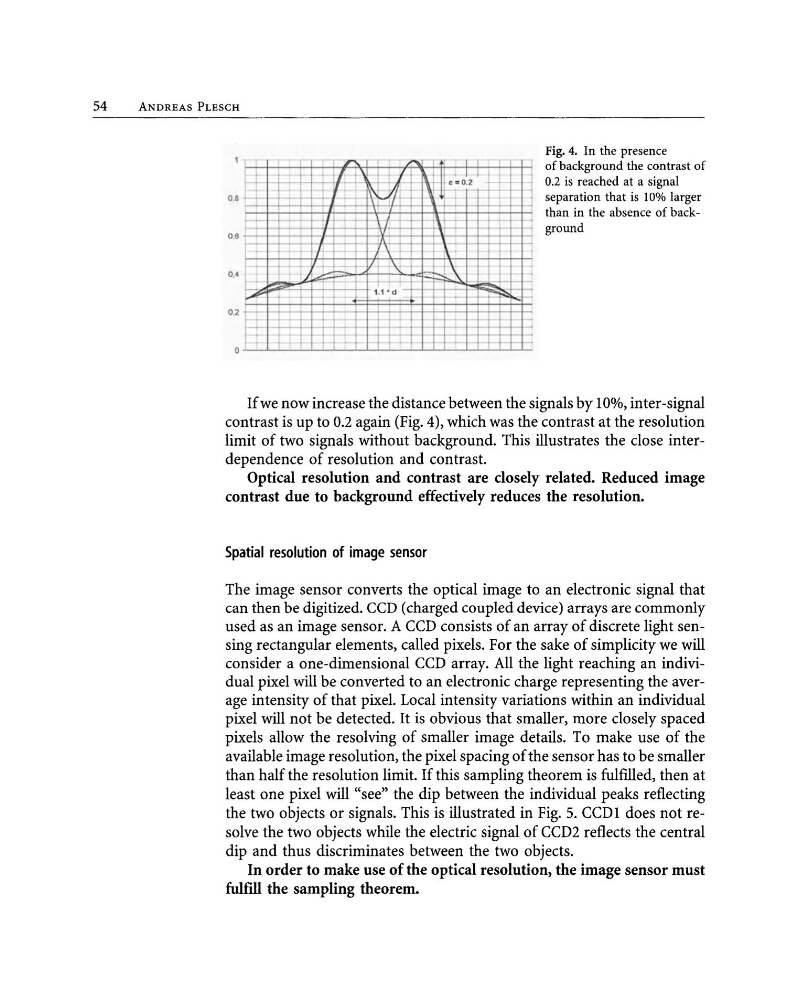
Fig.4. In the presence
of background the contrast of
0.2 is reached at a signal
separation that is 10% larger
than in the absence of background
Ifwe now increase the distance between the signals by 10%, inter-signal
contrast is up to 0.2 again (Fig. 4), which was the contrast at the resolution
limit of two signals without background. This illustrates the close interdependence of resolution and contrast.
Optical resolution and contrast are closely related. Reduced image
contrast due to background effectively reduces the resolution.
Spatial resolution of image sensor
The image sensor converts the optical image to an electronic signal that
can then be digitized. CCD (charged coupled device) arrays are commonly
used as an image sensor. A CCD consists of an array of discrete light sensing rectangular elements, called pixels. For the sake of simplicity we will
consider a one-dimensional CCD array. All the light reaching an individual pixel will be converted to an electronic charge representing the average intensity of that pixel. Local intensity variations within an individual
pixel will not be detected. It is obvious that smaller, more closely spaced
pixels allow the resolving of smaller image details. To make use of the
available image resolution, the pixel spacing ofthe sensor has to be smaller
than half the resolution limit. If this sampling theorem is fulfllled, then at
least one pixel will "see" the dip between the individual peaks reflecting
the two objects or signals. This is illustrated in Fig. 5. CCDI does not resolve the two objects while the electric signal of CCD2 reflects the central
dip and thus discriminates between the two objects.
In order to make use of the optical resolution, the image sensor must
fulfill the sampling theorem.
ANDREAS PLESCH
08
0.6
0.'
0.2
o
T
T
,.......
~ -, I
l
t
II \
~t!~ \
. <. 0
1 2 I
t :.-t.
If
I--+- 1-1--' 'r-I - f_ .-::\-:4
+.
<
.
-f1\;
h
I •
.
I • It .\.
~
A"
1.1 'd
~~ -
.
f
F.
.!
,
~
-
1
. I -
I
..
.
"
Fig.4. In the presence
of background the contrast of
0.2 is reached at a signal
separation that is 10% larger
than in the absence of background
Ifwe now increase the distance between the signals by 10%, inter-signal
contrast is up to 0.2 again (Fig. 4), which was the contrast at the resolution
limit of two signals without background. This illustrates the close interdependence of resolution and contrast.
Optical resolution and contrast are closely related. Reduced image
contrast due to background effectively reduces the resolution.
Spatial resolution of image sensor
The image sensor converts the optical image to an electronic signal that
can then be digitized. CCD (charged coupled device) arrays are commonly
used as an image sensor. A CCD consists of an array of discrete light sensing rectangular elements, called pixels. For the sake of simplicity we will
consider a one-dimensional CCD array. All the light reaching an individual pixel will be converted to an electronic charge representing the average intensity of that pixel. Local intensity variations within an individual
pixel will not be detected. It is obvious that smaller, more closely spaced
pixels allow the resolving of smaller image details. To make use of the
available image resolution, the pixel spacing ofthe sensor has to be smaller
than half the resolution limit. If this sampling theorem is fulfllled, then at
least one pixel will "see" the dip between the individual peaks reflecting
the two objects or signals. This is illustrated in Fig. 5. CCDI does not resolve the two objects while the electric signal of CCD2 reflects the central
dip and thus discriminates between the two objects.
In order to make use of the optical resolution, the image sensor must
fulfill the sampling theorem.