

would allow for the extension of the comparative chromosome painting
approach to more distantly related mammals. The generation of plasmid
and PCR amplifiable human chromosome specific DNA libraries (Collins
et al. 1991, Vooijs et al. 1993) eventually allowed such concentrated WCP
probes to be generated. These, in combination with optimal chromosome
preparations and extended hybridization times, which favor the hybridization of single copy sequences, finally allowed the extension of the comparative chromosome painting approach to phylogenetically more distant
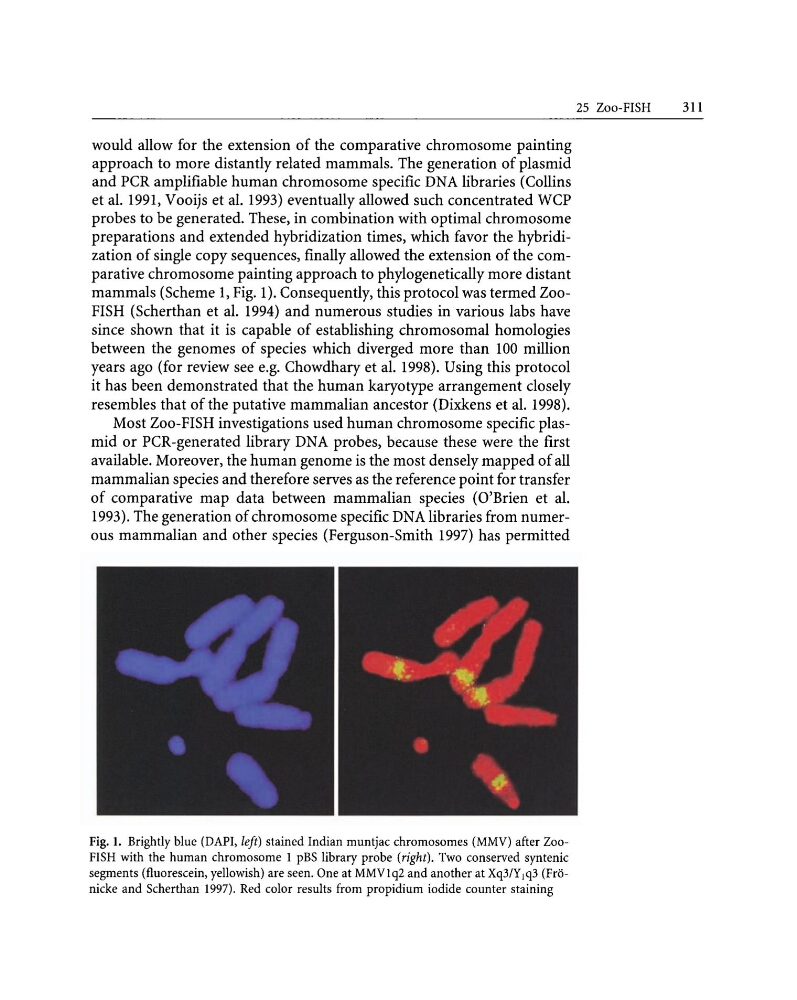
mammals (Scheme 1, Fig. 1). Consequently, this protocol was termed ZooFISH (Scherthan et al. 1994) and numerous studies in various labs have
since shown that it is capable of establishing chromosomal homologies
between the genomes of species which diverged more than 100 million
years ago (for review see e.g. Chowdhary et al. 1998). Using this protocol
it has been demonstrated that the human karyotype arrangement closely
resembles that of the putative mammalian ancestor (Dixkens et aI. 1998).
Most Zoo-FISH investigations used human chromosome specific plasmid or PCR-generated library DNA probes, because these were the first
available. Moreover, the human genome is the most densely mapped of all
mammalian species and therefore serves as the reference point for transfer
of comparative map data between mammalian species (O'Brien et al.
1993). The generation of chromosome specific DNA libraries from numerous mammalian and other species (Ferguson-Smith 1997) has permitted
25 Zoo-FISH
311
Fig. I. Brightly blue (DAPI, left) stained Indian muntjac chromosomes (MMV) after ZooFISH with the human chromosome I pBS library probe (right). Two conserved syntenic
segments (fluorescein, yellowish) are seen. One at MMVlq2 and another at Xq3/Y 1 q3 (Fronicke and Scherthan 1997). Red color results from propidium iodide counter staining
approach to more distantly related mammals. The generation of plasmid
and PCR amplifiable human chromosome specific DNA libraries (Collins
et al. 1991, Vooijs et al. 1993) eventually allowed such concentrated WCP
probes to be generated. These, in combination with optimal chromosome
preparations and extended hybridization times, which favor the hybridization of single copy sequences, finally allowed the extension of the comparative chromosome painting approach to phylogenetically more distant
mammals (Scheme 1, Fig. 1). Consequently, this protocol was termed ZooFISH (Scherthan et al. 1994) and numerous studies in various labs have
since shown that it is capable of establishing chromosomal homologies
between the genomes of species which diverged more than 100 million
years ago (for review see e.g. Chowdhary et al. 1998). Using this protocol
it has been demonstrated that the human karyotype arrangement closely
resembles that of the putative mammalian ancestor (Dixkens et aI. 1998).
Most Zoo-FISH investigations used human chromosome specific plasmid or PCR-generated library DNA probes, because these were the first
available. Moreover, the human genome is the most densely mapped of all
mammalian species and therefore serves as the reference point for transfer
of comparative map data between mammalian species (O'Brien et al.
1993). The generation of chromosome specific DNA libraries from numerous mammalian and other species (Ferguson-Smith 1997) has permitted
25 Zoo-FISH
311
Fig. I. Brightly blue (DAPI, left) stained Indian muntjac chromosomes (MMV) after ZooFISH with the human chromosome I pBS library probe (right). Two conserved syntenic
segments (fluorescein, yellowish) are seen. One at MMVlq2 and another at Xq3/Y 1 q3 (Fronicke and Scherthan 1997). Red color results from propidium iodide counter staining