

Evolution of the Tribe Electronini (Myctophifonnes, Myctophidae)
77
Myctophiformes, derived from 1300 bp of the mitochondrial 16SrRNA
gene, confirm the ancestral nature of this monotypic genus in the
Electronini (Misaki Miya, personal communication). All character states
could be ordered except for the Prc spacing (Table 1: Character 13).
Results
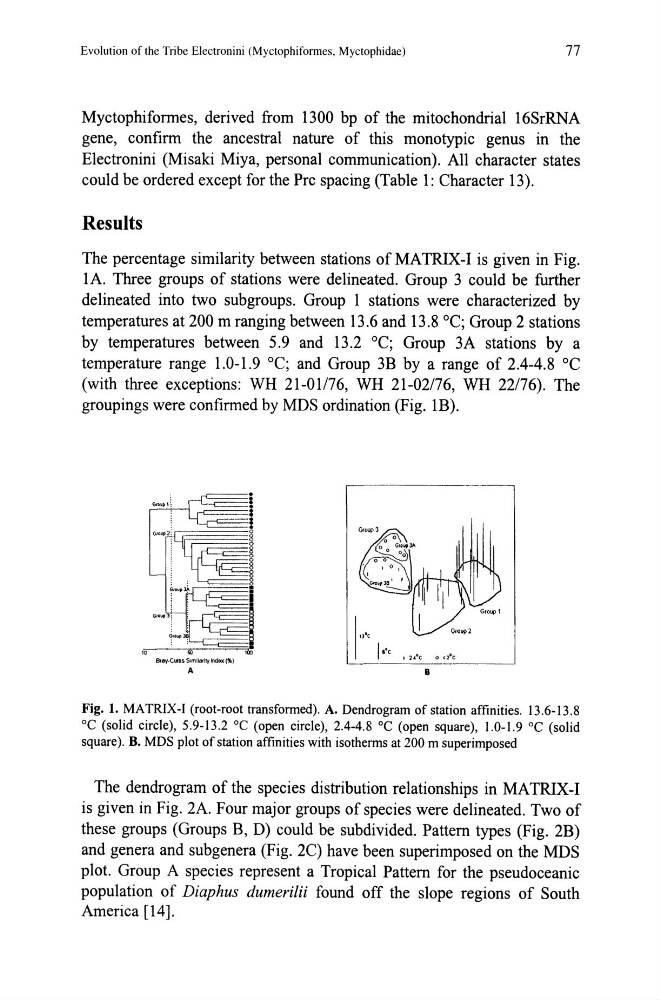
The percentage similarity between stations of MATRIX-I is given in Fig.
1A. Three groups of stations were delineated. Group 3 could be further
delineated into two subgroups. Group 1 stations were characterized by
temperatures at 200 m ranging between 13.6 and 13.8 °C; Group 2 stations
by temperatures between 5.9 and 13.2 °C; Group 3A stations by a
temperature range 1.0-1.9 °C; and Group 3B by a range of 2.4-4.8 °C
(with three exceptions: WH 21-01/76, WH 21-02/76, WH 22/76). The
groupings were confirmed by MDS ordination (Fig. 1B).
GtGIIfI ;
I ,,' , I,', I ,,',
~ . . "'.~~
I~O - . ,
BIBY-CUltiS $Imilanry Index (%)
A
B
Fig. 1. MATRlX-I (root-root transformed). A. Dendrogram of station affinities. 13.6-13.8
°C (solid circle), 5.9-13.2 °C (open circle), 2.4-4.8 °C (open square), 1.0-1.9 °C (solid
square). B. MDS plot of station affinities with isotherms at 200 m superimposed
The dendrogram of the species distribution relationships in MATRIX-I
is given in Fig. 2A. Four major groups of species were delineated. Two of
these groups (Groups B, D) could be subdivided. Pattern types (Fig. 2B)
and genera and subgenera (Fig. 2C) have been superimposed on the MDS
plot. Group A species represent a Tropical Pattern for the pseudoceanic
population of Diaphus dumerilii found off the slope regions of South
America [14].
77
Myctophiformes, derived from 1300 bp of the mitochondrial 16SrRNA
gene, confirm the ancestral nature of this monotypic genus in the
Electronini (Misaki Miya, personal communication). All character states
could be ordered except for the Prc spacing (Table 1: Character 13).
Results
The percentage similarity between stations of MATRIX-I is given in Fig.
1A. Three groups of stations were delineated. Group 3 could be further
delineated into two subgroups. Group 1 stations were characterized by
temperatures at 200 m ranging between 13.6 and 13.8 °C; Group 2 stations
by temperatures between 5.9 and 13.2 °C; Group 3A stations by a
temperature range 1.0-1.9 °C; and Group 3B by a range of 2.4-4.8 °C
(with three exceptions: WH 21-01/76, WH 21-02/76, WH 22/76). The
groupings were confirmed by MDS ordination (Fig. 1B).
GtGIIfI ;
I ,,' , I,', I ,,',
~ . . "'.~~
I~O - . ,
BIBY-CUltiS $Imilanry Index (%)
A
B
Fig. 1. MATRlX-I (root-root transformed). A. Dendrogram of station affinities. 13.6-13.8
°C (solid circle), 5.9-13.2 °C (open circle), 2.4-4.8 °C (open square), 1.0-1.9 °C (solid
square). B. MDS plot of station affinities with isotherms at 200 m superimposed
The dendrogram of the species distribution relationships in MATRIX-I
is given in Fig. 2A. Four major groups of species were delineated. Two of
these groups (Groups B, D) could be subdivided. Pattern types (Fig. 2B)
and genera and subgenera (Fig. 2C) have been superimposed on the MDS
plot. Group A species represent a Tropical Pattern for the pseudoceanic
population of Diaphus dumerilii found off the slope regions of South
America [14].