

76
P.A. Hulley
stations between 295 and 825 m (MATRIX-II). Data from two
"Polarstem" stations, POL 053 (haul aborted) and POL 073 (net snagged
on bottom) [4], were not included in the analyses. The data matrices were
subjected to cluster analysis to produce dendrograms. Multidimensional
scaling ordination (MDS) was undertaken to confirm the groups generated
by cluster analysis, and to demonstrate the spatial relationships in twodimensions. The suite of multivariate statistical programmes (PRIMER
Ver. 4.0) was used. A percentage similarity analysis (SIMPER) was
undertaken to determine the species responsible for the formation of the
station groups in the MATRIX-II series.
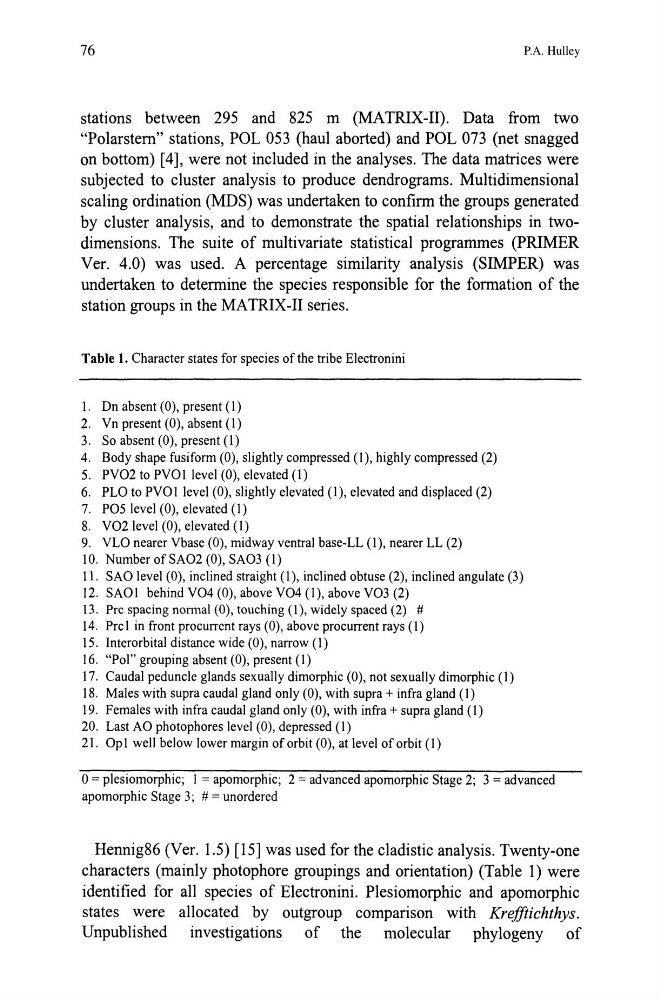
Table 1. Character states for species of the tribe Electronini
I. Dn absent (0), present (I)
2. Vn present (0), absent (I)
3. So absent (0), present (I)
4. Body shape fusiform (0), slightly compressed (I), highly compressed (2)
5. PV02 to PVOI level (0), elevated (I)
6. PLO to PVOl level (0), slightly elevated (I), elevated and displaced (2)
7. P05 level (0), elevated (I)
8. VOl level (0), elevated (I)
9. VLO nearer Vbase (0), midway ventral base-LL (I), nearer LL (2)
10. Number of SAOl (0), SA03 (I)
II. SAO level (0), inclined straight (I), inclined obtuse (2), inclined angulate (3)
12. SAOI behind V04 (0), above V04 (I), above V03 (2)
13. Prc spacing normal (0), touching (1), widely spaced (2) #
14. Prc 1 in front procurrent rays (0), above pro current rays (I)
15. Interorbital distance wide (0), narrow (I)
16. "Pol" grouping absent (0), present (I)
17. Caudal peduncle glands sexually dimorphic (0), not sexually dimorphic (I)
18. Males with supra caudal gland only (0), with supra + infra gland (I)
19. Females with infra caudal gland only (0), with infra + supra gland (1)
20. Last AO photophores level (0), depressed (I)
21. Op 1 well below lower margin of orbit (0), at level of orbit (1)
o = plesiomorphic; I = apomorphic; 2 = advanced apomorphic Stage 2; 3 = advanced
apomorphic Stage 3; # = unordered
Hennig86 (Ver. 1.5) [15] was used for the cladistic analysis. Twenty-one
characters (mainly photophore groupings and orientation) (Table 1) were
identified for all species of Electronini. Plesiomorphic and apomorphic
states were allocated by outgroup comparison with Krefftichthys.
Unpublished investigations of the molecular phylogeny of
P.A. Hulley
stations between 295 and 825 m (MATRIX-II). Data from two
"Polarstem" stations, POL 053 (haul aborted) and POL 073 (net snagged
on bottom) [4], were not included in the analyses. The data matrices were
subjected to cluster analysis to produce dendrograms. Multidimensional
scaling ordination (MDS) was undertaken to confirm the groups generated
by cluster analysis, and to demonstrate the spatial relationships in twodimensions. The suite of multivariate statistical programmes (PRIMER
Ver. 4.0) was used. A percentage similarity analysis (SIMPER) was
undertaken to determine the species responsible for the formation of the
station groups in the MATRIX-II series.
Table 1. Character states for species of the tribe Electronini
I. Dn absent (0), present (I)
2. Vn present (0), absent (I)
3. So absent (0), present (I)
4. Body shape fusiform (0), slightly compressed (I), highly compressed (2)
5. PV02 to PVOI level (0), elevated (I)
6. PLO to PVOl level (0), slightly elevated (I), elevated and displaced (2)
7. P05 level (0), elevated (I)
8. VOl level (0), elevated (I)
9. VLO nearer Vbase (0), midway ventral base-LL (I), nearer LL (2)
10. Number of SAOl (0), SA03 (I)
II. SAO level (0), inclined straight (I), inclined obtuse (2), inclined angulate (3)
12. SAOI behind V04 (0), above V04 (I), above V03 (2)
13. Prc spacing normal (0), touching (1), widely spaced (2) #
14. Prc 1 in front procurrent rays (0), above pro current rays (I)
15. Interorbital distance wide (0), narrow (I)
16. "Pol" grouping absent (0), present (I)
17. Caudal peduncle glands sexually dimorphic (0), not sexually dimorphic (I)
18. Males with supra caudal gland only (0), with supra + infra gland (I)
19. Females with infra caudal gland only (0), with infra + supra gland (1)
20. Last AO photophores level (0), depressed (I)
21. Op 1 well below lower margin of orbit (0), at level of orbit (1)
o = plesiomorphic; I = apomorphic; 2 = advanced apomorphic Stage 2; 3 = advanced
apomorphic Stage 3; # = unordered
Hennig86 (Ver. 1.5) [15] was used for the cladistic analysis. Twenty-one
characters (mainly photophore groupings and orientation) (Table 1) were
identified for all species of Electronini. Plesiomorphic and apomorphic
states were allocated by outgroup comparison with Krefftichthys.
Unpublished investigations of the molecular phylogeny of