

The Pelagic Fish Community of the Polar Frontal Zone off the Kerguelen Islands
65
the king penguin; these included nektonic early stages and fingerlings of 8
demersal species. Myctophidae (15 species) dominated the true pelagic
species both in number and biomass.
Fish Assemblages
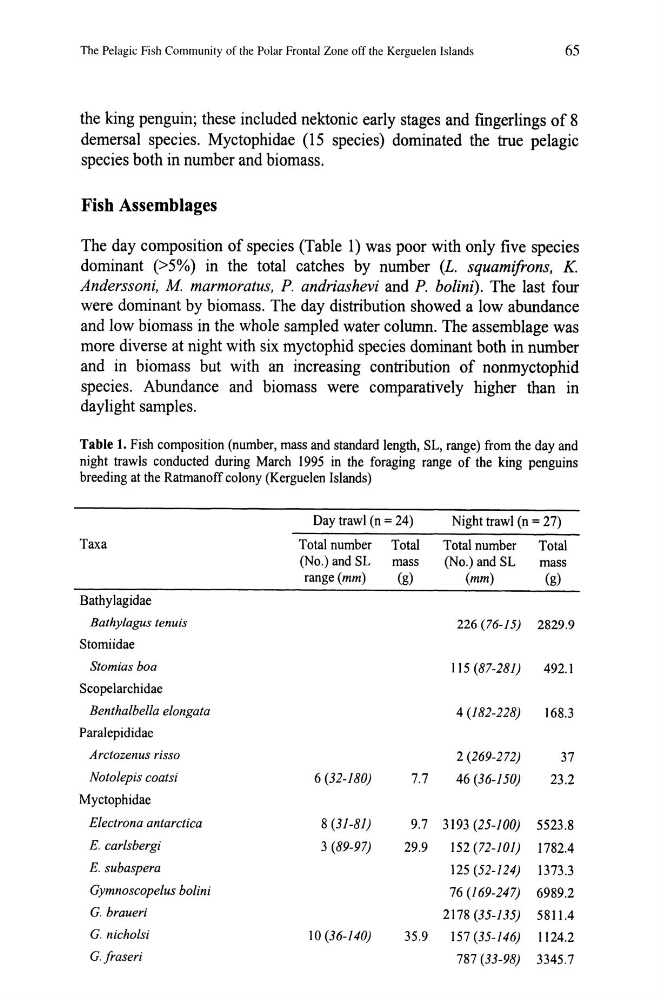
The day composition of species (Table 1) was poor with only five species
dominant (>5%) in the total catches by number (L. squamifrons, K.
Anderssoni, M marmoratus, P. andriashevi and P. bolini). The last four
were dominant by biomass. The day distribution showed a low abundance
and low biomass in the whole sampled water column. The assemblage was
more diverse at night with six myctophid species dominant both in number
and in biomass but with an increasing contribution of nonmyctophid
species. Abundance and biomass were comparatively higher than in
daylight samples.
Table 1. Fish composition (number, mass and standard length, SL, range) from the day and
night trawls conducted during March 1995 in the foraging range of the king penguins
breeding at the Ratmanoff colony (Kerguelen Islands)
Day trawl (n = 24)
Night trawl (n = 27)
Taxa
Total number Total
Total number
Total
(No.) and SL
mass
(No.) and SL
mass
range (mm)
(g)
(mm)
(g)
Bathylagidae
Bathylagus tenuis
226 (76-15) 2829.9
Stomiidae
Stomias boa
115 (87-281)
492.1
Scopelarchidae
Benthalbella elongata
4 (182-228)
168.3
Paralepididae
Arctozenus risso
2 (269-272)
37
Notolepis coatsi
6 (32-180)
7.7
46 (36-150)
23.2
Myctophidae
Electrona antarctica
8 (31-81)
9.7 3193 (25-100) 5523.8
E. carlsbergi
3 (89-97)
29.9
152 (72-101) 1782.4
E. subaspera
125 (52-124) 1373.3
Gymnoscopelus bolini
76 (169-247) 6989.2
G. braueri
2178 (35-135) 5811.4
G. nicholsi
10 (36-140)
35.9
157 (35-146) 1124.2
G·fraseri
787 (33-98) 3345.7
65
the king penguin; these included nektonic early stages and fingerlings of 8
demersal species. Myctophidae (15 species) dominated the true pelagic
species both in number and biomass.
Fish Assemblages
The day composition of species (Table 1) was poor with only five species
dominant (>5%) in the total catches by number (L. squamifrons, K.
Anderssoni, M marmoratus, P. andriashevi and P. bolini). The last four
were dominant by biomass. The day distribution showed a low abundance
and low biomass in the whole sampled water column. The assemblage was
more diverse at night with six myctophid species dominant both in number
and in biomass but with an increasing contribution of nonmyctophid
species. Abundance and biomass were comparatively higher than in
daylight samples.
Table 1. Fish composition (number, mass and standard length, SL, range) from the day and
night trawls conducted during March 1995 in the foraging range of the king penguins
breeding at the Ratmanoff colony (Kerguelen Islands)
Day trawl (n = 24)
Night trawl (n = 27)
Taxa
Total number Total
Total number
Total
(No.) and SL
mass
(No.) and SL
mass
range (mm)
(g)
(mm)
(g)
Bathylagidae
Bathylagus tenuis
226 (76-15) 2829.9
Stomiidae
Stomias boa
115 (87-281)
492.1
Scopelarchidae
Benthalbella elongata
4 (182-228)
168.3
Paralepididae
Arctozenus risso
2 (269-272)
37
Notolepis coatsi
6 (32-180)
7.7
46 (36-150)
23.2
Myctophidae
Electrona antarctica
8 (31-81)
9.7 3193 (25-100) 5523.8
E. carlsbergi
3 (89-97)
29.9
152 (72-101) 1782.4
E. subaspera
125 (52-124) 1373.3
Gymnoscopelus bolini
76 (169-247) 6989.2
G. braueri
2178 (35-135) 5811.4
G. nicholsi
10 (36-140)
35.9
157 (35-146) 1124.2
G·fraseri
787 (33-98) 3345.7