

Development, Dispersal and Recruitment: A Paradox for Survival Among Antarctic Fish
57
larval stages do not appear to be rapidly advected off the shelves of the
peri-Antarctic islands but are retained in neritic habitats.
Post-larval and early juvenile fish may well have sufficient locomotory
ability to maintain their position in areas of favourable conditions but
eggs and early larvae are essentially passive particles for several months
after spawning. The mechanisms by which these early stages are
distributed must by influenced by the prevailing physical conditions.
The observation that the larval stages of demersal and oceanic fish are
separated by a junction coincident with the shelf/slope edge suggests some
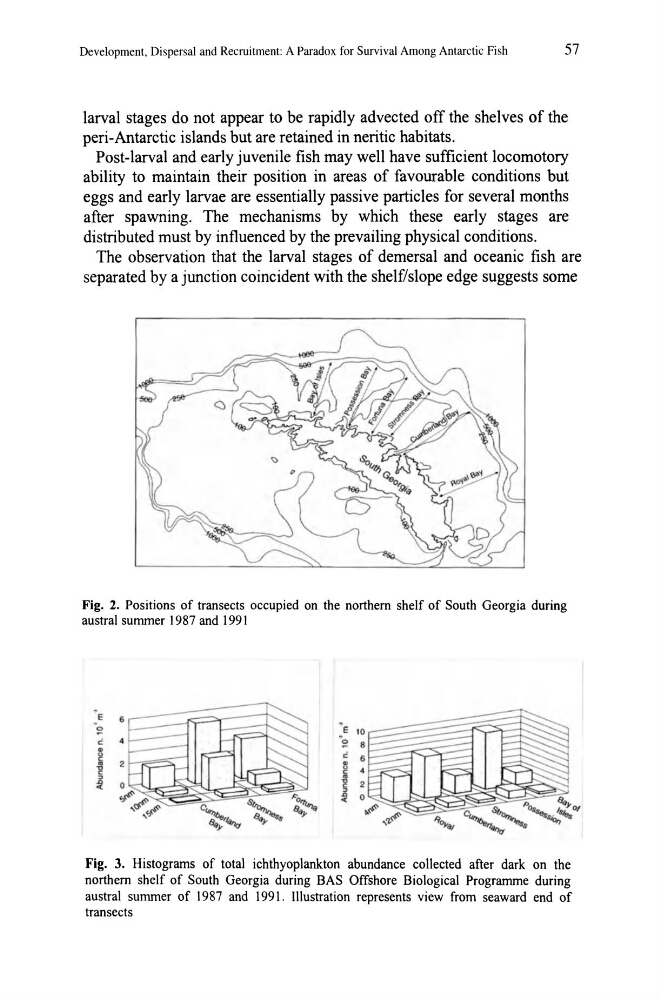
Fig. 2. Positions of transects occupied on the northern shelf of South Georgia during
austral summer 1987 and 1991
e 6 ~A=::3=
~
c 4
j 21-;<:;::::.:s:;=:J
~
Fig. 3. Histograms of total ichthyoplankton abundance collected after dark on the
northern shelf of South Georgia during BAS Offshore Biological Programme during
austral summer of 1987 and 1991. Illustration represents view from seaward end of
transects
57
larval stages do not appear to be rapidly advected off the shelves of the
peri-Antarctic islands but are retained in neritic habitats.
Post-larval and early juvenile fish may well have sufficient locomotory
ability to maintain their position in areas of favourable conditions but
eggs and early larvae are essentially passive particles for several months
after spawning. The mechanisms by which these early stages are
distributed must by influenced by the prevailing physical conditions.
The observation that the larval stages of demersal and oceanic fish are
separated by a junction coincident with the shelf/slope edge suggests some
Fig. 2. Positions of transects occupied on the northern shelf of South Georgia during
austral summer 1987 and 1991
e 6 ~A=::3=
~
c 4
j 21-;<:;::::.:s:;=:J
~
Fig. 3. Histograms of total ichthyoplankton abundance collected after dark on the
northern shelf of South Georgia during BAS Offshore Biological Programme during
austral summer of 1987 and 1991. Illustration represents view from seaward end of
transects