

56
~
. ' .
I(~
[ L SqU~mifrons
l_,~~~~---"
~.~~
t,.(.~ ·1' I
r
f
1 ~~.~/ .... . .
~~m~;cr~op~s~~~ !~/~ e~g~gs~~~
. N. coats;
M.O. White
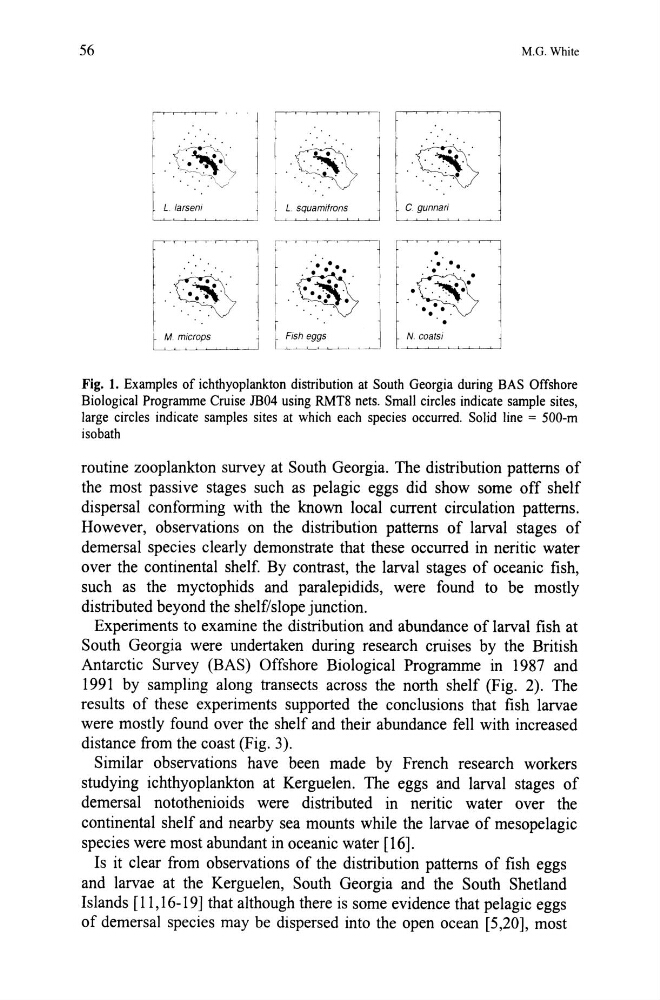
Fig. 1. Examples of ichthyoplankton distribution at South Georgia during BAS Offshore
Biological Programme Cruise JB04 using RMT8 nets. Small circles indicate sample sites,
large circles indicate samples sites at which each species occurred. Solid line = 500-m
isobath
routine zooplankton survey at South Georgia. The distribution patterns of
the most passive stages such as pelagic eggs did show some off shelf
dispersal conforming with the known local current circulation patterns.
However, observations on the distribution patterns of larval stages of
demersal species clearly demonstrate that these occurred in neritic water
over the continental shelf. By contrast, the larval stages of oceanic fish,
such as the myctophids and paralepidids, were found to be mostly
distributed beyond the shelf/slope junction.
Experiments to examine the distribution and abundance of larval fish at
South Georgia were undertaken during research cruises by the British
Antarctic Survey (BAS) Offshore Biological Programme in 1987 and
1991 by sampling along transects across the north shelf (Fig. 2). The
results of these experiments supported the conclusions that fish larvae
were mostly found over the shelf and their abundance fell with increased
distance from the coast (Fig. 3).
Similar observations have been made by French research workers
studying ichthyoplankton at Kerguelen. The eggs and larval stages of
demersal notothenioids were distributed in neritic water over the
continental shelf and nearby sea mounts while the larvae of mesopelagic
species were most abundant in oceanic water [16].
Is it clear from observations of the distribution patterns of fish eggs
and larvae at the Kerguelen, South Georgia and the South Shetland
Islands [11,16-19] that although there is some evidence that pelagic eggs
of demersal species may be dispersed into the open ocean [5,20], most
~
. ' .
I(~
[ L SqU~mifrons
l_,~~~~---"
~.~~
t,.(.~ ·1' I
r
f
1 ~~.~/ .... . .
~~m~;cr~op~s~~~ !~/~ e~g~gs~~~
. N. coats;
M.O. White
Fig. 1. Examples of ichthyoplankton distribution at South Georgia during BAS Offshore
Biological Programme Cruise JB04 using RMT8 nets. Small circles indicate sample sites,
large circles indicate samples sites at which each species occurred. Solid line = 500-m
isobath
routine zooplankton survey at South Georgia. The distribution patterns of
the most passive stages such as pelagic eggs did show some off shelf
dispersal conforming with the known local current circulation patterns.
However, observations on the distribution patterns of larval stages of
demersal species clearly demonstrate that these occurred in neritic water
over the continental shelf. By contrast, the larval stages of oceanic fish,
such as the myctophids and paralepidids, were found to be mostly
distributed beyond the shelf/slope junction.
Experiments to examine the distribution and abundance of larval fish at
South Georgia were undertaken during research cruises by the British
Antarctic Survey (BAS) Offshore Biological Programme in 1987 and
1991 by sampling along transects across the north shelf (Fig. 2). The
results of these experiments supported the conclusions that fish larvae
were mostly found over the shelf and their abundance fell with increased
distance from the coast (Fig. 3).
Similar observations have been made by French research workers
studying ichthyoplankton at Kerguelen. The eggs and larval stages of
demersal notothenioids were distributed in neritic water over the
continental shelf and nearby sea mounts while the larvae of mesopelagic
species were most abundant in oceanic water [16].
Is it clear from observations of the distribution patterns of fish eggs
and larvae at the Kerguelen, South Georgia and the South Shetland
Islands [11,16-19] that although there is some evidence that pelagic eggs
of demersal species may be dispersed into the open ocean [5,20], most