

334
I.C. Montgomery and I.A. Macdonald
angular distribution of down-welling light replacing the shadow that they
would otherwise cast when viewed from below. In the deeper oceans,
below about 1000 m, the only visually useful light is biologically produced
light. Light production by fish is used in species recognition and
communication, and flashlight fishes use red-light producing photophores
to detect their prey. As far as is known Antarctic fish have no photophores
and do not produce light.
Octavolateralis System
The octavolateralis system comprises the hair-cell-based senses of the
inner ear and the mechanosensory lateral line. As conditions for vision
deteriorate, the mechanosensory lateral line becomes relatively more
important. The functional unit of the lateral line system is the neuromast: a
patch of hair cells with an overlying gelatinous cupula. Typically there are
two main submodalities of the lateral line: superficial neuromasts on the
surface of the skin, and canal neuromasts located within subdermal canals.
The primary stimulus for any neuromast is displacement of the cupula by
movement of the surrounding water. Like almost all teleosts, Antarctic
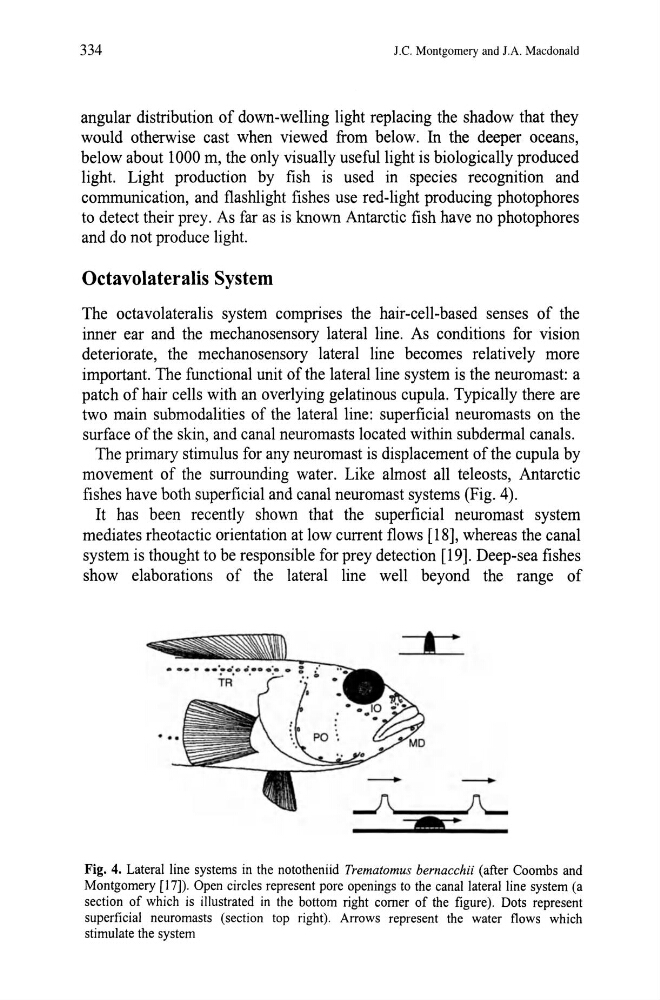
fishes have both superficial and canal neuromast systems (Fig. 4).
It has been recently shown that the superficial neuromast system
mediates rheotactic orientation at low current flows [18], whereas the canal
system is thought to be responsible for prey detection [19]. Deep-sea fishes
show elaborations of the lateral line well beyond the range of
a a
-
Fig. 4. Lateral line systems in the nototheniid Trematomus bernacchii (after Coombs and
Montgomery [I 7]). Open circles represent pore openings to the canal lateral line system (a
section of which is illustrated in the bottom right comer of the figure). Dots represent
superficial neuromasts (section top right). Arrows represent the water flows which
stimulate the system
I.C. Montgomery and I.A. Macdonald
angular distribution of down-welling light replacing the shadow that they
would otherwise cast when viewed from below. In the deeper oceans,
below about 1000 m, the only visually useful light is biologically produced
light. Light production by fish is used in species recognition and
communication, and flashlight fishes use red-light producing photophores
to detect their prey. As far as is known Antarctic fish have no photophores
and do not produce light.
Octavolateralis System
The octavolateralis system comprises the hair-cell-based senses of the
inner ear and the mechanosensory lateral line. As conditions for vision
deteriorate, the mechanosensory lateral line becomes relatively more
important. The functional unit of the lateral line system is the neuromast: a
patch of hair cells with an overlying gelatinous cupula. Typically there are
two main submodalities of the lateral line: superficial neuromasts on the
surface of the skin, and canal neuromasts located within subdermal canals.
The primary stimulus for any neuromast is displacement of the cupula by
movement of the surrounding water. Like almost all teleosts, Antarctic
fishes have both superficial and canal neuromast systems (Fig. 4).
It has been recently shown that the superficial neuromast system
mediates rheotactic orientation at low current flows [18], whereas the canal
system is thought to be responsible for prey detection [19]. Deep-sea fishes
show elaborations of the lateral line well beyond the range of
a a
-
Fig. 4. Lateral line systems in the nototheniid Trematomus bernacchii (after Coombs and
Montgomery [I 7]). Open circles represent pore openings to the canal lateral line system (a
section of which is illustrated in the bottom right comer of the figure). Dots represent
superficial neuromasts (section top right). Arrows represent the water flows which
stimulate the system