

Evolution of Sensory Systems: A Comparison of Antarctic and Deep-Sea Ichthyofauna
331
For example, in male halosaurs at maturity the anterior naris becomes
large and tubular and the olfactory lamellae become enlarged and
lobulated so that, as Marshall [9] describes it, the entire rosette comes to
look like a sprig of broccoli. Quantitative comparison of the size and
numbers of olfactory lamellae in the deep-sea hatchet fish [10] clearly
shows the extent of the difference between the sexes. To date there has
been no systematic investigation of the degree of development of olfactory
organs in notothenioid fishes. However, from the descriptions available we
can say with some confidence that there is no extreme elaboration of
olfactory organs, and that any sexual dimorphism that does exist is not
overtly apparent.
Vision
In response to the perpetual dim light of the deep ocean it is not surprising
to see a range of visual adaptations. In the mesopelagic realm, most of the
light available for vision is faint down-welling light. Correspondingly
many mesopelagic species have a dorsal visual axis, which is taken to the
extreme in fish like the telescope fish Opisthoproctus. The closest
Antarctic comparison is the slight shift in visual axis reported for
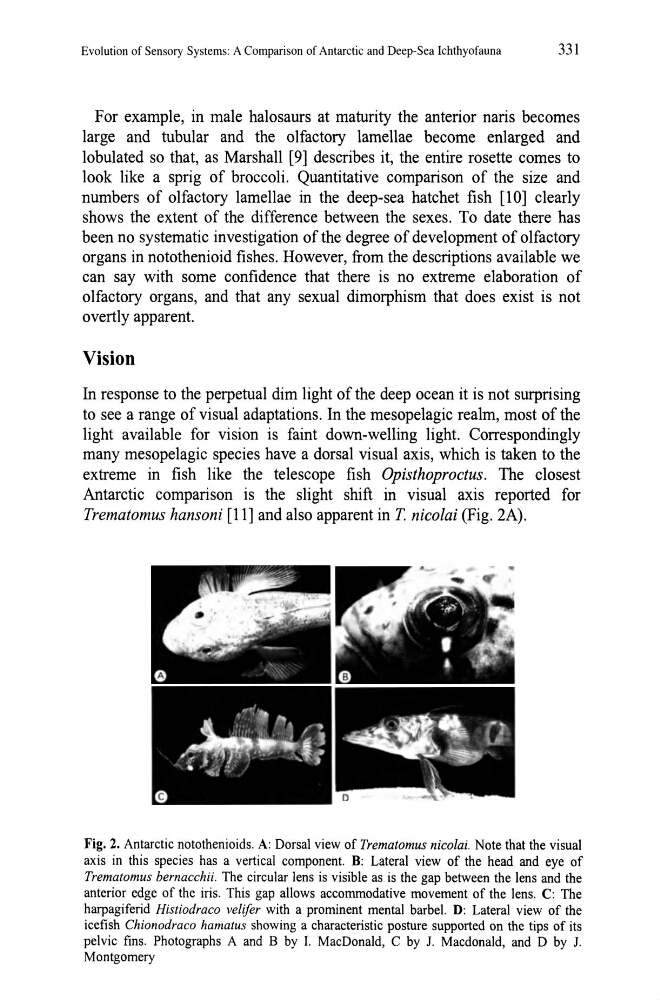
Trematomus hansoni [11] and also apparent in T. nicolai (Fig. 2A).
Fig. 2. Antarctic notothenioids. A: Dorsal view of Trematomus nicolai. Note that the visual
axis in this species has a vertical component. B: Lateral view of the head and eye of
Trematomus bernacchii. The circular lens is visible as is the gap between the lens and the
anterior edge of the iris. This gap allows accommodative movement of the lens. C: The
harpagiferid Histiodraco velifer with a prominent mental barbel. D: Lateral view of the
icefish Chionodraco hamatus showing a characteristic posture supported on the tips of its
pelvic fins. Photographs A and B by I. MacDonald, C by 1. Macdonald, and D by 1.
Montgomery
331
For example, in male halosaurs at maturity the anterior naris becomes
large and tubular and the olfactory lamellae become enlarged and
lobulated so that, as Marshall [9] describes it, the entire rosette comes to
look like a sprig of broccoli. Quantitative comparison of the size and
numbers of olfactory lamellae in the deep-sea hatchet fish [10] clearly
shows the extent of the difference between the sexes. To date there has
been no systematic investigation of the degree of development of olfactory
organs in notothenioid fishes. However, from the descriptions available we
can say with some confidence that there is no extreme elaboration of
olfactory organs, and that any sexual dimorphism that does exist is not
overtly apparent.
Vision
In response to the perpetual dim light of the deep ocean it is not surprising
to see a range of visual adaptations. In the mesopelagic realm, most of the
light available for vision is faint down-welling light. Correspondingly
many mesopelagic species have a dorsal visual axis, which is taken to the
extreme in fish like the telescope fish Opisthoproctus. The closest
Antarctic comparison is the slight shift in visual axis reported for
Trematomus hansoni [11] and also apparent in T. nicolai (Fig. 2A).
Fig. 2. Antarctic notothenioids. A: Dorsal view of Trematomus nicolai. Note that the visual
axis in this species has a vertical component. B: Lateral view of the head and eye of
Trematomus bernacchii. The circular lens is visible as is the gap between the lens and the
anterior edge of the iris. This gap allows accommodative movement of the lens. C: The
harpagiferid Histiodraco velifer with a prominent mental barbel. D: Lateral view of the
icefish Chionodraco hamatus showing a characteristic posture supported on the tips of its
pelvic fins. Photographs A and B by I. MacDonald, C by 1. Macdonald, and D by 1.
Montgomery