

318
Chi-Hing C. Cheng
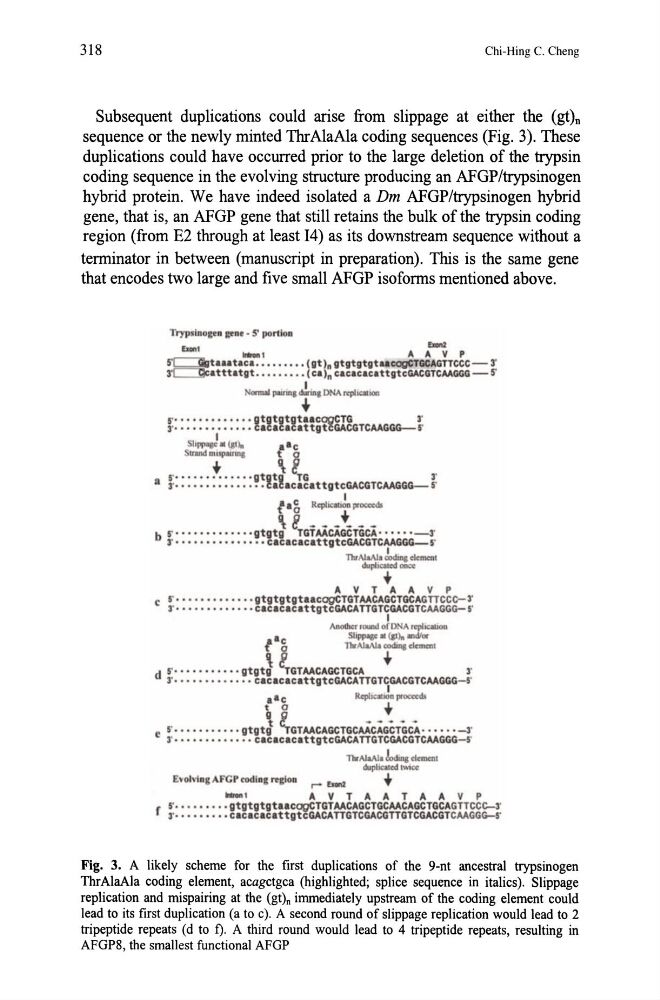
Subsequent duplications could arise from slippage at either the (gt)n
sequence or the newly minted ThrAlaAla coding sequences (Fig. 3). These
duplications could have occurred prior to the large deletion of the trypsin
coding sequence in the evolving structure producing an AFGP/trypsinogen
hybrid protein. We have indeed isolated a Dm AFGP/trypsinogen hybrid
gene, that is, an AFGP gene that still retains the bulk of the trypsin coding
region (from E2 through at least 14) as its downstream sequence without a
terminator in between (manuscript in preparation). This is the same gene
that encodes two large and five small AFGP isoforms mentioned above.
5'
S'
Elain:I
_I
A A Y P
taaatici ••••••••• (gtl. gtgtgtgtaacogCTGCAGTTCCC - 3"
Itttatgt ••••••••• (c. In clclcaclttgtcGACGTCMGGG - s·
omW_'~'D r
S" •••••••••••• gtgtgtgt .. cOOCTG
3'
3' · •••••••• , ••• clcaClcattgtcGACGTCAAGGG-S'
I
hPP/ll< II (sIlo
• Ie
tnnd m IJpII' ''''
t 0
S" •.•. . ~ ...•• gtat~ ~G
3'
D 3· •••••••••••• • •• elelelelttgteGACGTCAAGGG- 5"
I
r I ~ Rcplicolloo _do
"t8 ••• ~.b 5" •••••••••••• ·gtgtg TGTAACA. GCTGCA····· '-3'
3' •.••••••••••••• eaeaeacattgtCGACGTC'jAGGG- S'
ThtAlaAl. cio
+
A Y T A A Y P
C 5' ••• , ••••••••• gtgtgtgt'lcogCTGTAACAGCTGCAGTTCCC-l'
3' · •••••••••••. cacaeaclttgtCGACATTGT~GACGTCAAGGG- 5"
AlIot!oct r-.J of D, "r
SlIJIIIOI< II (&1)" a>
".."looAI. «>do.,. d
...
d S·· ·········· gtgtg TGTAACAGCTGCA
3'
~ ••••••...•••• cac.c.c.ttgtCGACATTGT~GACGTCAAGGG -5"
I I C
RcpI,,,,,,,,,._ds
t 0
+
~ 9
•
5' •••• • • • •••• gtgtg "rGTAACAGCTGCAACAGCTGCA······ -3'
C 3' .•••• , . ••• ••• CICICIClttgtcGACATTGTCGACGTCAAGGG-S'
".. .... aAl • .!.w..a dem","
"' pI' CII' ' ' ' """
tvoh ng Fer roding regloD r- Elain:I
+
_I A Y T A A T A A Y P
S· •• • ••• , •• gtgtgtgtaICogCTGTAACAGCTGCAACAGCTGCAGTTCCC--~
3'· ••••• , •• clcaclcattgtcGACATTGTCGACGTTGTCGACGTCAAGGG-S'
Fig. 3. A likely scheme for the first duplications of the 9-nt ancestral trypsinogen
ThrAlaAla coding element, acagctgca (highlighted; splice sequence in italics). Slippage
replication and mispairing at the (gt)n immediately upstream of the coding element could
lead to its first duplication (a to c). A second round of slippage replication would lead to 2
tripeptide repeats (d to f). A third round would lead to 4 tripeptide repeats, resulting in
AFGP8, the smallest functional AFGP
Chi-Hing C. Cheng
Subsequent duplications could arise from slippage at either the (gt)n
sequence or the newly minted ThrAlaAla coding sequences (Fig. 3). These
duplications could have occurred prior to the large deletion of the trypsin
coding sequence in the evolving structure producing an AFGP/trypsinogen
hybrid protein. We have indeed isolated a Dm AFGP/trypsinogen hybrid
gene, that is, an AFGP gene that still retains the bulk of the trypsin coding
region (from E2 through at least 14) as its downstream sequence without a
terminator in between (manuscript in preparation). This is the same gene
that encodes two large and five small AFGP isoforms mentioned above.
5'
S'
Elain:I
_I
A A Y P
taaatici ••••••••• (gtl. gtgtgtgtaacogCTGCAGTTCCC - 3"
Itttatgt ••••••••• (c. In clclcaclttgtcGACGTCMGGG - s·
omW_'~'D r
S" •••••••••••• gtgtgtgt .. cOOCTG
3'
3' · •••••••• , ••• clcaClcattgtcGACGTCAAGGG-S'
I
hPP/ll< II (sIlo
• Ie
tnnd m IJpII' ''''
t 0
S" •.•. . ~ ...•• gtat~ ~G
3'
D 3· •••••••••••• • •• elelelelttgteGACGTCAAGGG- 5"
I
r I ~ Rcplicolloo _do
"t8 ••• ~.b 5" •••••••••••• ·gtgtg TGTAACA. GCTGCA····· '-3'
3' •.••••••••••••• eaeaeacattgtCGACGTC'jAGGG- S'
ThtAlaAl. cio
+
A Y T A A Y P
C 5' ••• , ••••••••• gtgtgtgt'lcogCTGTAACAGCTGCAGTTCCC-l'
3' · •••••••••••. cacaeaclttgtCGACATTGT~GACGTCAAGGG- 5"
AlIot!oct r-.J of D, "r
SlIJIIIOI< II (&1)" a>
".."looAI. «>do.,. d
...
d S·· ·········· gtgtg TGTAACAGCTGCA
3'
~ ••••••...•••• cac.c.c.ttgtCGACATTGT~GACGTCAAGGG -5"
I I C
RcpI,,,,,,,,,._ds
t 0
+
~ 9
•
5' •••• • • • •••• gtgtg "rGTAACAGCTGCAACAGCTGCA······ -3'
C 3' .•••• , . ••• ••• CICICIClttgtcGACATTGTCGACGTCAAGGG-S'
".. .... aAl • .!.w..a dem","
"' pI' CII' ' ' ' """
tvoh ng Fer roding regloD r- Elain:I
+
_I A Y T A A T A A Y P
S· •• • ••• , •• gtgtgtgtaICogCTGTAACAGCTGCAACAGCTGCAGTTCCC--~
3'· ••••• , •• clcaclcattgtcGACATTGTCGACGTTGTCGACGTCAAGGG-S'
Fig. 3. A likely scheme for the first duplications of the 9-nt ancestral trypsinogen
ThrAlaAla coding element, acagctgca (highlighted; splice sequence in italics). Slippage
replication and mispairing at the (gt)n immediately upstream of the coding element could
lead to its first duplication (a to c). A second round of slippage replication would lead to 2
tripeptide repeats (d to f). A third round would lead to 4 tripeptide repeats, resulting in
AFGP8, the smallest functional AFGP