

Origin and Mechanism of Evolution of Antifreeze Glycoproteins in Polar Fishes
~
,
E
:
IU
,
B f!? :
B ~ :
c
,
II)
,
&start :
IU
'
en
'
El
E2
317
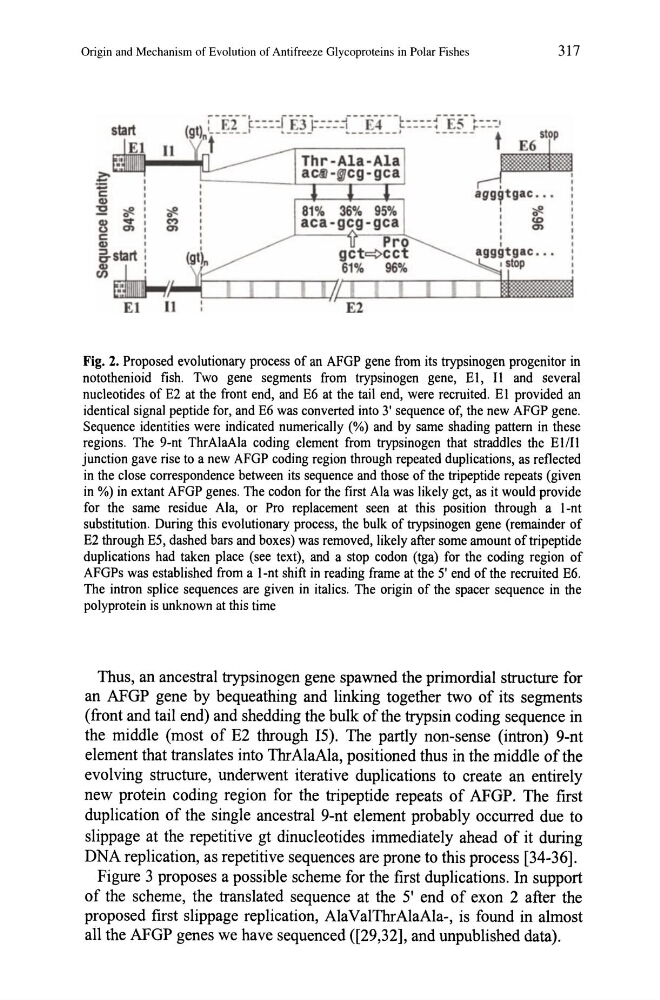
Fig. 2. Proposed evolutionary process of an AFGP gene from its trypsinogen progenitor in
notothenioid fish. Two gene segments from trypsinogen gene, EI, 11 and several
nucleotides of E2 at the front end, and E6 at the tail end, were recruited. EI provided an
identical signal peptide for, and E6 was converted into 3' sequence of, the new AFGP gene.
Sequence identities were indicated numerically (%) and by same shading pattern in these
regions. The 9-nt ThrAlaAla coding element from trypsinogen that straddles the EVil
junction gave rise to a new AFGP coding region through repeated duplications, as reflected
in the close correspondence between its sequence and those of the tripeptide repeats (given
in %) in extant AFGP genes. The codon for the first Ala was likely gct, as it would provide
for the same residue Ala, or Pro replacement seen at this position through a I-nt
substitution. During this evolutionary process, the bulk of trypsinogen gene (remainder of
E2 through E5, dashed bars and boxes) was removed, likely after some amount of tripeptide
duplications had taken place (see text), and a stop codon (tga) for the coding region of
AFGPs was established from a I-nt shift in reading frame at the 5' end of the recruited E6.
The intron splice sequences are given in italics. The origin of the spacer sequence in the
polyprotein is unknown at this time
Thus, an ancestral trypsinogen gene spawned the primordial structure for
an AFGP gene by bequeathing and linking together two of its segments
(front and tail end) and shedding the bulk of the trypsin coding sequence in
the middle (most of E2 through IS). The partly non-sense (intron) 9-nt
element that translates into ThrAlaAla, positioned thus in the middle of the
evolving structure, underwent iterative duplications to create an entirely
new protein coding region for the tripeptide repeats of AFGP. The first
duplication of the single ancestral 9-nt element probably occurred due to
slippage at the repetitive gt dinucleotides immediately ahead of it during
DNA replication, as repetitive sequences are prone to this process [34-36].
Figure 3 proposes a possible scheme for the first duplications. In support
of the scheme, the translated sequence at the 5' end of exon 2 after the
proposed first slippage replication, AlaVaIThrAlaAla-, is found in almost
all the AFGP genes we have sequenced ([29,32], and unpublished data).
~
,
E
:
IU
,
B f!? :
B ~ :
c
,
II)
,
&start :
IU
'
en
'
El
E2
317
Fig. 2. Proposed evolutionary process of an AFGP gene from its trypsinogen progenitor in
notothenioid fish. Two gene segments from trypsinogen gene, EI, 11 and several
nucleotides of E2 at the front end, and E6 at the tail end, were recruited. EI provided an
identical signal peptide for, and E6 was converted into 3' sequence of, the new AFGP gene.
Sequence identities were indicated numerically (%) and by same shading pattern in these
regions. The 9-nt ThrAlaAla coding element from trypsinogen that straddles the EVil
junction gave rise to a new AFGP coding region through repeated duplications, as reflected
in the close correspondence between its sequence and those of the tripeptide repeats (given
in %) in extant AFGP genes. The codon for the first Ala was likely gct, as it would provide
for the same residue Ala, or Pro replacement seen at this position through a I-nt
substitution. During this evolutionary process, the bulk of trypsinogen gene (remainder of
E2 through E5, dashed bars and boxes) was removed, likely after some amount of tripeptide
duplications had taken place (see text), and a stop codon (tga) for the coding region of
AFGPs was established from a I-nt shift in reading frame at the 5' end of the recruited E6.
The intron splice sequences are given in italics. The origin of the spacer sequence in the
polyprotein is unknown at this time
Thus, an ancestral trypsinogen gene spawned the primordial structure for
an AFGP gene by bequeathing and linking together two of its segments
(front and tail end) and shedding the bulk of the trypsin coding sequence in
the middle (most of E2 through IS). The partly non-sense (intron) 9-nt
element that translates into ThrAlaAla, positioned thus in the middle of the
evolving structure, underwent iterative duplications to create an entirely
new protein coding region for the tripeptide repeats of AFGP. The first
duplication of the single ancestral 9-nt element probably occurred due to
slippage at the repetitive gt dinucleotides immediately ahead of it during
DNA replication, as repetitive sequences are prone to this process [34-36].
Figure 3 proposes a possible scheme for the first duplications. In support
of the scheme, the translated sequence at the 5' end of exon 2 after the
proposed first slippage replication, AlaVaIThrAlaAla-, is found in almost
all the AFGP genes we have sequenced ([29,32], and unpublished data).