

292
Wei-Jen Chen et al.
on his preconceived view of channichthyid phylogeny. However, his
intuitions are strikingly confirmed by the present study, even for the
phylogenetic relationships of Dacodraco that he hesitated to branch as the
sister-group of the clade D (Figs. 1 and 2), a position that is unambiguously
supported by the two present mitochondrial genes. The only differing point
concerns the relationships of Channichthys. Constraining the "molecular
tree" to Iwami's morphological data set requires no extra step. Indeed, the
molecular position of Channichthys is already present in one of the four
equi-parsimonious trees given by PAUP from Iwami's data set. Therefore,
there is no contradiction between Iwami's data set and ours. For the
morphological data of Iwami [2], the molecular position of Channichthys
implies two reversals in the branch of Channichthys, respectively for the
characters 2 (sphenotic-pterosphenoid connection from the state
"separated" to the state "bordered") and 15 (ventral fin from the state "fan
or can-like shape" to the state "normal").
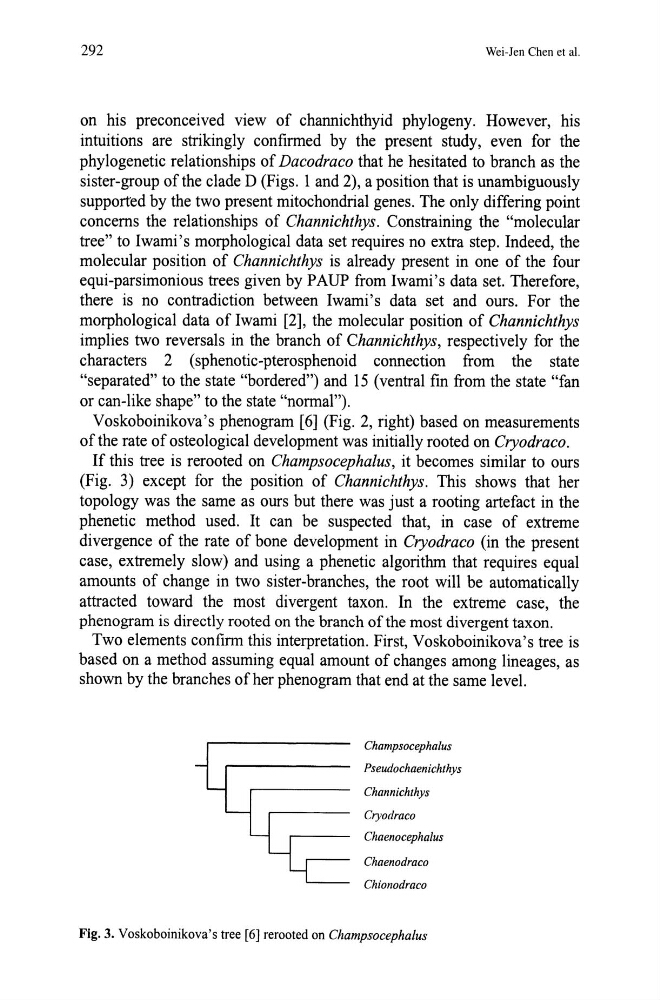
Voskoboinikova's phenogram [6] (Fig. 2, right) based on measurements
of the rate of osteological development was initially rooted on Cryodraco.
If this tree is rerooted on Champsocephaius, it becomes similar to ours
(Fig. 3) except for the position of Channichthys. This shows that her
topology was the same as ours but there was just a rooting artefact in the
phenetic method used. It can be suspected that, in case of extreme
divergence of the rate of bone development in Cryodraco (in the present
case, extremely slow) and using a phenetic algorithm that requires equal
amounts of change in two sister-branches, the root will be automatically
attracted toward the most divergent taxon. In the extreme case, the
phenogram is directly rooted on the branch of the most divergent taxon.
Two elements confirm this interpretation. First, Voskoboinikova's tree is
based on a method assuming equal amount of changes among lineages, as
shown by the branches of her phenogram that end at the same level.
Champsocephalus
Pseudochaenichthys
Channichthys
Cryodraco
Chaenocephalus
Chaenodraco
Chionodraco
Fig. 3. Voskoboinikova's tree [6] rerooted on Champsocephalus
Wei-Jen Chen et al.
on his preconceived view of channichthyid phylogeny. However, his
intuitions are strikingly confirmed by the present study, even for the
phylogenetic relationships of Dacodraco that he hesitated to branch as the
sister-group of the clade D (Figs. 1 and 2), a position that is unambiguously
supported by the two present mitochondrial genes. The only differing point
concerns the relationships of Channichthys. Constraining the "molecular
tree" to Iwami's morphological data set requires no extra step. Indeed, the
molecular position of Channichthys is already present in one of the four
equi-parsimonious trees given by PAUP from Iwami's data set. Therefore,
there is no contradiction between Iwami's data set and ours. For the
morphological data of Iwami [2], the molecular position of Channichthys
implies two reversals in the branch of Channichthys, respectively for the
characters 2 (sphenotic-pterosphenoid connection from the state
"separated" to the state "bordered") and 15 (ventral fin from the state "fan
or can-like shape" to the state "normal").
Voskoboinikova's phenogram [6] (Fig. 2, right) based on measurements
of the rate of osteological development was initially rooted on Cryodraco.
If this tree is rerooted on Champsocephaius, it becomes similar to ours
(Fig. 3) except for the position of Channichthys. This shows that her
topology was the same as ours but there was just a rooting artefact in the
phenetic method used. It can be suspected that, in case of extreme
divergence of the rate of bone development in Cryodraco (in the present
case, extremely slow) and using a phenetic algorithm that requires equal
amounts of change in two sister-branches, the root will be automatically
attracted toward the most divergent taxon. In the extreme case, the
phenogram is directly rooted on the branch of the most divergent taxon.
Two elements confirm this interpretation. First, Voskoboinikova's tree is
based on a method assuming equal amount of changes among lineages, as
shown by the branches of her phenogram that end at the same level.
Champsocephalus
Pseudochaenichthys
Channichthys
Cryodraco
Chaenocephalus
Chaenodraco
Chionodraco
Fig. 3. Voskoboinikova's tree [6] rerooted on Champsocephalus