

Phylogeny of the Channichthyidae (Notothenioidei, Teleostei)
291
Discussion
Morphological Data Sets
Phylogenetic analyses based on morphological characters in notothenioid
fishes often expressed the intrinsic difficulties in assessing character
polarization because of the pedomorphic nature of most of them.
Pedomorphosis plays an important role in the speciation of this group of
fishes, particularly in the Channichthyidae [6,17]. Moreover, channichthyid
adaptation for diverse niches to the extreme cold Antarctic environment
provoked phenotypic alterations corresponding to ecomorphological forms,
but has entailed little alteration of the basic perciform body. According to
Eastman [1], this mode of diversification does not favor the emergence of
morphological novelties that could constitute detectable synapomorphies.
For this reason, morphological studies attempting to reconstruct the
channichthyid phylogeny were difficult to carry out and left some
unresolved nodes. The two available studies [2,6] failed to recover the
same tree but this difference can easily be explained by their respective
methodologies.
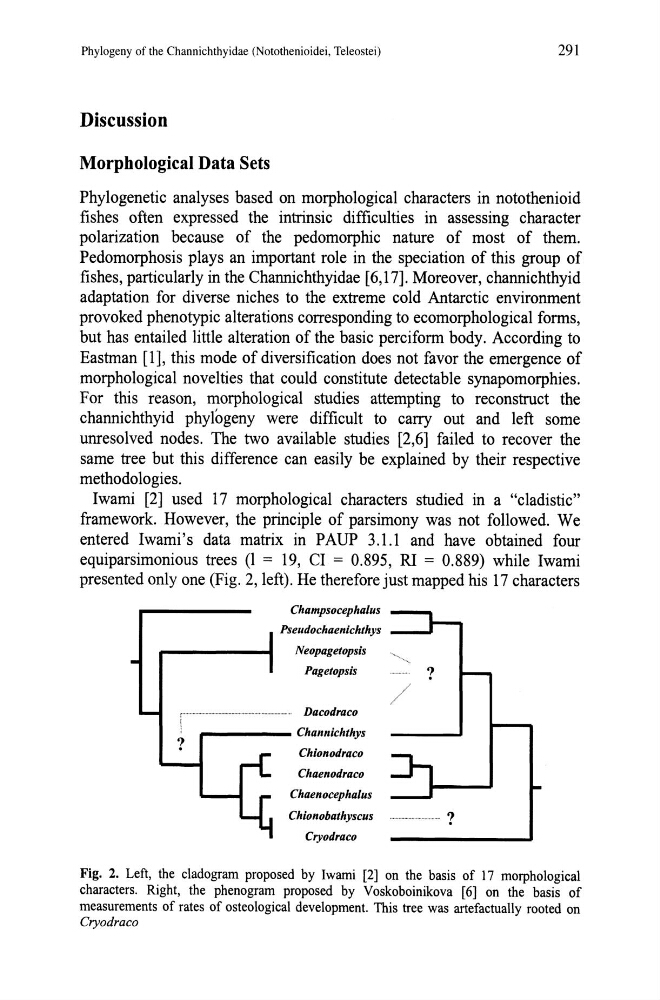
Iwami [2] used 17 morphological characters studied in a "cladistic"
framework. However, the principle of parsimony was not followed. We
entered Iwami's data matrix in PAUP 3.1.1 and have obtained four
equiparsimonious trees (l = 19, CI = 0.895, RI = 0.889) while Iwami
presented only one (Fig. 2, left). He therefore just mapped his 17 characters
Champsocephalus
Pseudochaenichthys
Neopagetopsis
Pagetopsis
Dacodraco
,... _ _ _ _ Channichthys
Chionodraco
Chaenodraco
Chaenocephalus
Chionobathyscus
.... ?
Cryodraco
Fig. 2. Left, the cladogram proposed by Iwami [2] on the basis of 17 morphological
characters. Right, the phenogram proposed by Voskoboinikova [6] on the basis of
measurements of rates of osteological development. This tree was artefactually rooted on
Cryodraco
291
Discussion
Morphological Data Sets
Phylogenetic analyses based on morphological characters in notothenioid
fishes often expressed the intrinsic difficulties in assessing character
polarization because of the pedomorphic nature of most of them.
Pedomorphosis plays an important role in the speciation of this group of
fishes, particularly in the Channichthyidae [6,17]. Moreover, channichthyid
adaptation for diverse niches to the extreme cold Antarctic environment
provoked phenotypic alterations corresponding to ecomorphological forms,
but has entailed little alteration of the basic perciform body. According to
Eastman [1], this mode of diversification does not favor the emergence of
morphological novelties that could constitute detectable synapomorphies.
For this reason, morphological studies attempting to reconstruct the
channichthyid phylogeny were difficult to carry out and left some
unresolved nodes. The two available studies [2,6] failed to recover the
same tree but this difference can easily be explained by their respective
methodologies.
Iwami [2] used 17 morphological characters studied in a "cladistic"
framework. However, the principle of parsimony was not followed. We
entered Iwami's data matrix in PAUP 3.1.1 and have obtained four
equiparsimonious trees (l = 19, CI = 0.895, RI = 0.889) while Iwami
presented only one (Fig. 2, left). He therefore just mapped his 17 characters
Champsocephalus
Pseudochaenichthys
Neopagetopsis
Pagetopsis
Dacodraco
,... _ _ _ _ Channichthys
Chionodraco
Chaenodraco
Chaenocephalus
Chionobathyscus
.... ?
Cryodraco
Fig. 2. Left, the cladogram proposed by Iwami [2] on the basis of 17 morphological
characters. Right, the phenogram proposed by Voskoboinikova [6] on the basis of
measurements of rates of osteological development. This tree was artefactually rooted on
Cryodraco