

282
E. Pisano et al.
Recently, the pattern of the NOR banding was used as new chromosomal
character to clarify the phylogenetic relationships between Notothenia and
Paranotothenia species, with C. gobio and B. angustifrons as outgroups.
The analysis produced a phylogenetic tree where the taxa coriiceps,
rossii, magellanica and microlepidota are clustered together (and could be
subgenera of the genus Notothenia) while cyanobrancha is clustered with
other Nototheniidae [7] (Fig. 3).
Bo'Vichtus angustifrons
~------ Cottoperca gobio
Notothenia microlepidota
Notothenia cyanobrancha
most Notothenioidei
Fig. 3. Phylogenetic relationships among NotothenialParanotothenia species, based on
Ag-NOR chromosome banding (from [7])
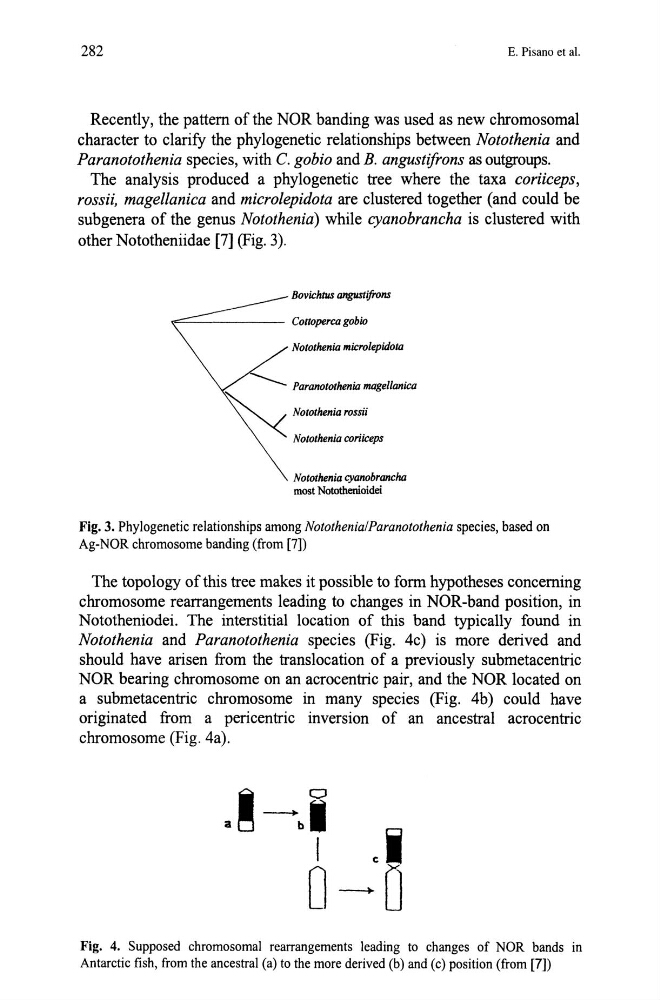
The topology of this tree makes it possible to form hypotheses concerning
chromosome rearrangements leading to changes in NOR-band position, in
Nototheniodei. The interstitial location of this band typically found in
Notothenia and Paranotothenia species (Fig. 4c) is more derived and
should have arisen from the translocation of a previously submetacentric
NOR bearing chromosome on an acrocentric pair, and the NOR located on
a submetacentric chromosome in many species (Fig. 4b) could have
originated from a peri centric inversion of an ancestral acrocentric
chromosome (Fig. 4a).
Fig. 4. Supposed chromosomal rearrangements leading to changes of NOR bands in
Antarctic fish, from the ancestral (a) to the more derived (b) and (c) position (from [7])
E. Pisano et al.
Recently, the pattern of the NOR banding was used as new chromosomal
character to clarify the phylogenetic relationships between Notothenia and
Paranotothenia species, with C. gobio and B. angustifrons as outgroups.
The analysis produced a phylogenetic tree where the taxa coriiceps,
rossii, magellanica and microlepidota are clustered together (and could be
subgenera of the genus Notothenia) while cyanobrancha is clustered with
other Nototheniidae [7] (Fig. 3).
Bo'Vichtus angustifrons
~------ Cottoperca gobio
Notothenia microlepidota
Notothenia cyanobrancha
most Notothenioidei
Fig. 3. Phylogenetic relationships among NotothenialParanotothenia species, based on
Ag-NOR chromosome banding (from [7])
The topology of this tree makes it possible to form hypotheses concerning
chromosome rearrangements leading to changes in NOR-band position, in
Nototheniodei. The interstitial location of this band typically found in
Notothenia and Paranotothenia species (Fig. 4c) is more derived and
should have arisen from the translocation of a previously submetacentric
NOR bearing chromosome on an acrocentric pair, and the NOR located on
a submetacentric chromosome in many species (Fig. 4b) could have
originated from a peri centric inversion of an ancestral acrocentric
chromosome (Fig. 4a).
Fig. 4. Supposed chromosomal rearrangements leading to changes of NOR bands in
Antarctic fish, from the ancestral (a) to the more derived (b) and (c) position (from [7])